
RCM outsourcing performance metrics help practices judge whether an external billing team meets agreed expectations. An SLA should define tasks, deadlines, exclusions, and reporting rules.
Use this guide to build a vendor scorecard, review results, and address missed service levels without applying one benchmark to every practice. Clear RCM outsourcing performance metrics make those reviews comparable.
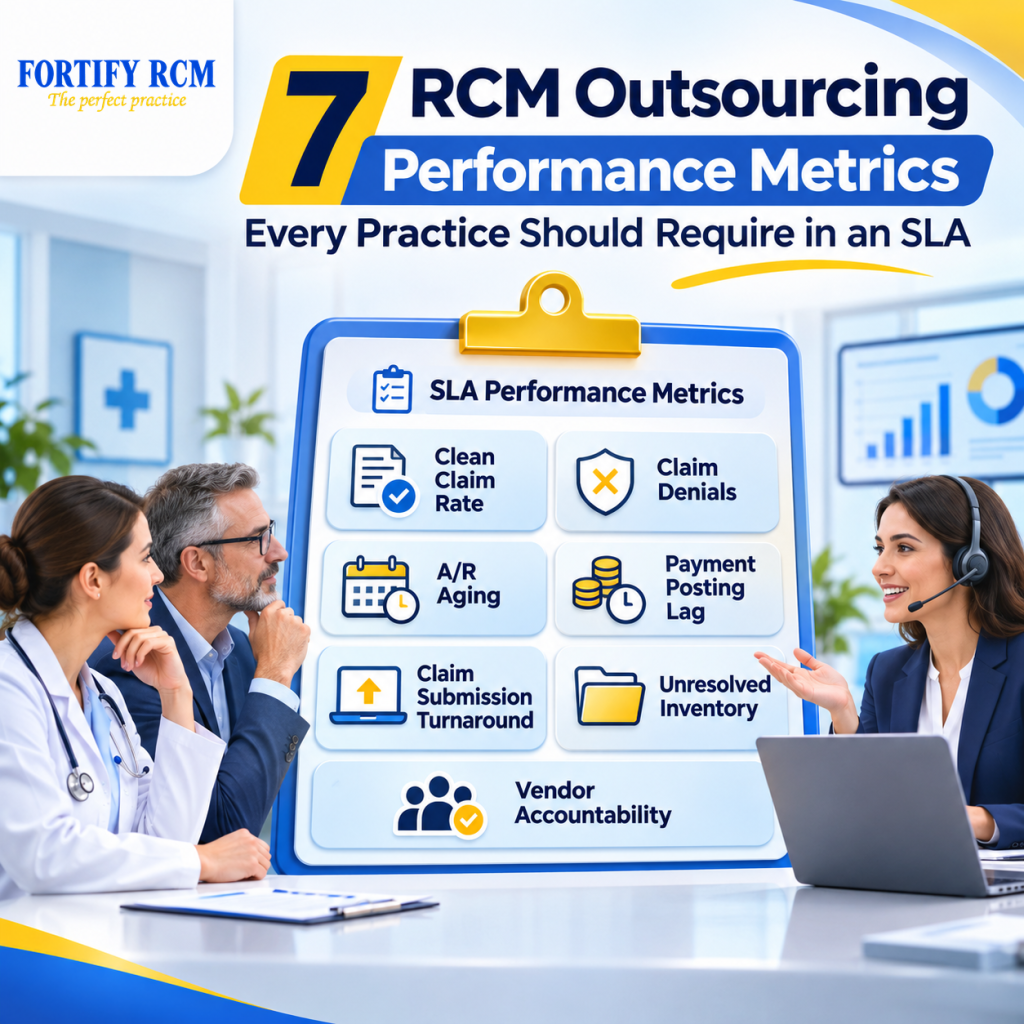
What an RCM Outsourcing SLA Should Define
An SLA should define measurable work, not promise “timely billing.” Specify included claims, start and stop events, required inputs, exclusions, and who controls delays. RCM outsourcing performance metrics are useful only when both parties apply the same definitions to the same population.
A practical SLA schedule should cover seven items:
-
Task and scope: Name activities, payer groups, specialties, locations, claim types, and opening inventory; list exclusions such as legacy A/R or appeals already underway.
-
Trigger: Define when work enters the vendor queue, such as a complete, approved claim released for submission.
-
Clock start and stop: Identify reproducible system timestamps for the beginning and completion of work.
-
Target and period: State the expected result, unit, time zone, business-day calendar, cut-off, and reporting window.
-
Dependencies: Record missing records, coding questions, payer outages, practice approvals, and system interruptions, with evidence.
-
Ownership: Name the performer, decision owner, backup contact, and escalation route.
-
Evidence: Specify the acknowledgement, queue record, report, audit log, or account note proving completion.
These RCM outsourcing performance metrics turn contract wording into auditable service expectations. This makes each measure verifiable.
Each RCM outsourcing performance metric needs a named owner and a traceable source.
A claim-submission SLA should not start when an appointment ends if the charge is still under review. Start when a complete, approved claim is released and stop at the agreed acknowledgement. Show total elapsed time beside vendor-controlled time; a paused clock must not hide aged work.
Define opening inventory before go-live. List pending claims, denials, appeals, payer requests, credit balances, and aged A/R; record their owner and the date responsibility changes. Otherwise, the vendor and practice may disagree about whether a pre-existing delay belongs in the new reporting period.
The agreement should also explain how payer mix, service lines, system changes, volumes, and scope changes affect targets. Add examples of completed and excluded work. For vendor selection and contract questions beyond the scorecard, practices can consult Fortify RCM’s RCM outsourcing pricing and contract checklist and its guide to outsourcing physician billing. Practices splitting tasks across teams may also find the hybrid RCM outsourcing guide useful. This article focuses on how the agreed service is measured after scope is defined.
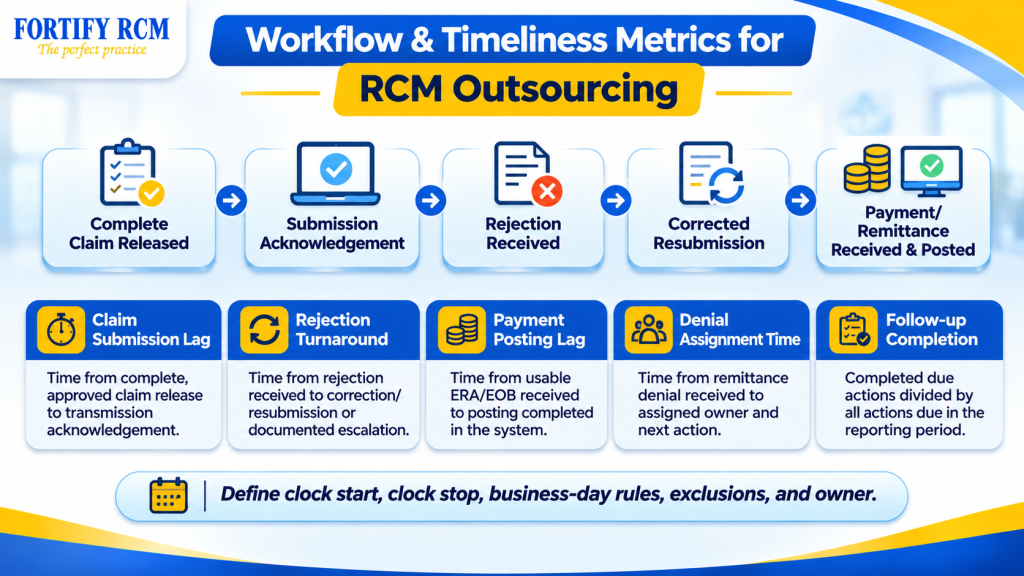
Separate Workflow and Timeliness Measures from Financial Outcomes
Workflow indicators show whether work is moving; financial outcomes show what happens after claims are processed or collected. A timely claim can still be denied later. RCM outsourcing performance metrics should separate vendor activity from outcomes affected by payers, practice documentation, contracts, and patients.
| Workflow measure | What it tracks | Definition to agree |
|---|---|---|
| Claim submission lag | Time from complete claim release to transmission acknowledgement | Start at approved release; stop at recorded submission acknowledgement |
| Front-end rejection turnaround | Time to review and correct an actionable rejection | Start when the rejection is received; stop at corrected resubmission or documented escalation |
| Payment posting lag | Time from usable remittance information to completed posting | Define whether receipt means clearinghouse availability, portal download, or file import |
| Denial assignment time | Delay before a denial has an owner and next action | Start at remittance receipt; stop when the item enters an assigned work queue |
| Follow-up completion | Whether accounts due for action receive a documented action | Completed due items divided by all items due in the reporting period |
| Report delivery | Whether required reports arrive on schedule | Reports delivered by the agreed deadline divided by reports scheduled |
| Exception aging | How long unresolved items remain open | Count and value by age, reason, dependency, and owner |
Report median and tail performance; a 90th-percentile or oldest-item view can expose hidden delays. Show counts beside percentages and define calendar days, business days, or hours.
Use statuses such as “vendor working,” “waiting on practice,” “waiting on payer,” “system issue,” and “escalated.” RCM outsourcing performance metrics should distinguish these delay categories. A paused clock needs a reason, owner, and next review date. Display vendor-controlled time beside total elapsed time. Review RCM outsourcing performance metrics by payer and specialty.
Do not label every returned claim a denial. A clearinghouse or front-end rejection occurs before adjudication and usually requires correction or resubmission. A payer denial is an adjudication outcome. Track rejection rate, adjudicated denial rate, and appeal results separately. This distinction makes RCM outsourcing performance metrics useful for finding where a workflow actually failed.
For charge lag, use a complete encounter or approved charge, not appointment time. See Fortify RCM’s medical billing charge capture controls, claims submission and payment posting workflow, and ERA/EOB reconciliation guide for related handoffs.
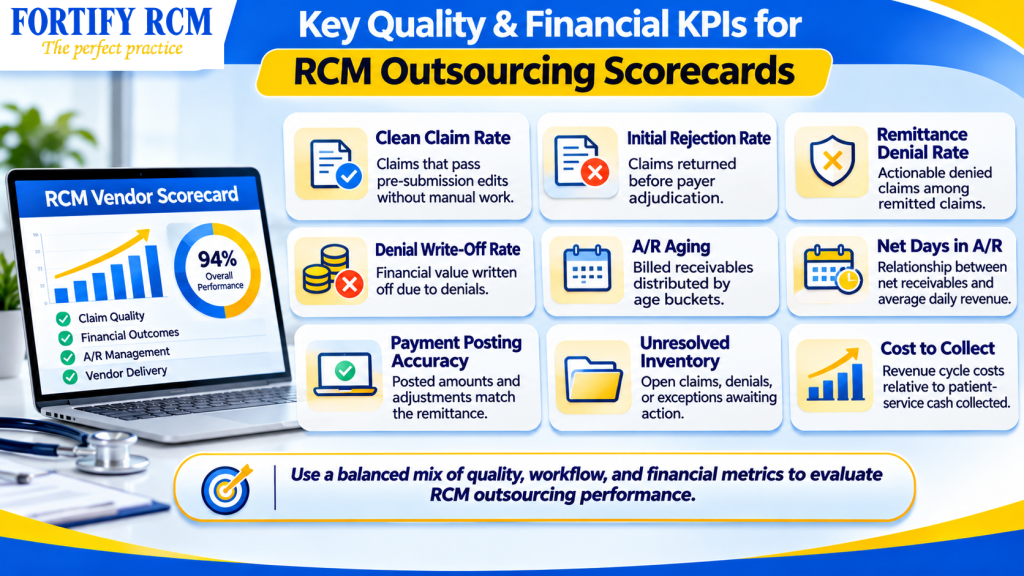
Build a Balanced Scorecard of RCM Outsourcing Performance Metrics
A balanced scorecard should cover claim quality, rejections, denials, posting, receivables, and unresolved inventory. RCM outsourcing performance metrics should connect each category to an owner and match the contracted scope; do not rely on one collection percentage.
| KPI | What it tells the practice | Reporting notes |
|---|---|---|
| Clean claim rate | Share of claims passing defined pre-submission edits without manual intervention | State the processing tool, numerator, denominator, and exclusions |
| Initial rejection rate | Claims returned before payer adjudication | Segment by rejection reason and correction owner |
| Remittance denial rate | Actionable denied claims among claims remitted under the selected definition | Use claim-level remittance data and disclose exclusions |
| Denial write-offs | Financial value written off because of denials | Show amount, period, reason, and approval status |
| A/R aging | Outstanding billed receivables by age bucket | Segment by payer, specialty, and responsible work queue |
| Net days in A/R | Relationship between net receivables and average daily net patient-service revenue | Use a consistent accounting source and formula |
| Payment posting accuracy | Whether amounts and adjustments match source remittances | Audit a defined sample and categorize errors |
| Unresolved inventory | Open claims, denials, payer requests, and exceptions | Show count, dollars, age, owner, and next action |
| Cost to collect | Revenue-cycle costs relative to patient-service cash collected | Define included operating costs and cash basis |
HFMA’s MAP Keys define indicators across patient access, pre-billing, claims, account resolution, and financial management. Clean Claim Rate (CL-1) measures claims passing edits without manual intervention divided by claims accepted into the processing tool; it is not automatically a first-pass paid rate. Remittance Denial Rate (AR-5) uses denied claims divided by claims remitted under specified rules. HFMA’s cost-to-collect definition, updated in August 2025, includes outsourced arrangements and related costs. Consult the HFMA MAP Keys for definitions, not vendor guarantees.
Interpret outcomes in context. Days in A/R can shift with payer mix, seasonality, contract changes, older inventory, and documentation delays. Net collections reflect adjustments, patient responsibility, recoupments, and claim maturity. Cost to collect includes agreed operating costs, not just the vendor invoice. RCM outsourcing performance metrics should link costs to service scope.
A vendor controls some workflow actions, but payer adjudication, clinical records, provider decisions, and patient behavior involve others. Claims submitted within an agreed window may be a vendor activity; net days in A/R is usually a joint outcome.
Connect denial reporting to reason, dollars, age, and appeal status. Fortify RCM’s medical claim denial root-cause dashboard groups patterns by payer, specialty, value, and status. Related resources cover prior authorization denial management, medical billing documentation requirements, and the medical billing clean-claim checklist. They address upstream causes; this article focuses on vendor measurement.
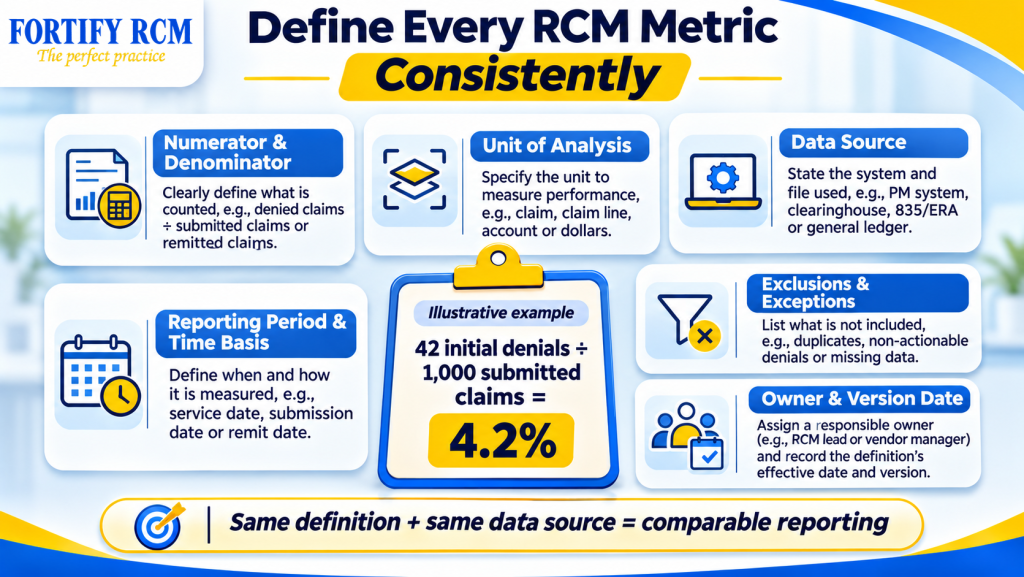
Define RCM Outsourcing Performance Metrics Consistently
Two reports can use the same KPI name but measure different populations. RCM outsourcing performance metrics need an approved dictionary with formula, numerator, denominator, unit, source, period, exclusions, owner, and version date. Stable definitions keep RCM outsourcing performance metrics comparable.
| Definition field | What to document |
|---|---|
| Metric name and purpose | The operating question the measure answers |
| Numerator and denominator | Exact counts or dollar values included |
| Unit of analysis | Claim, claim line, encounter, remittance, account, or dollar |
| Population | Payers, specialties, locations, providers, and date cohort |
| Data source | Practice-management system, clearinghouse, 835/ERA, bank, ledger, or work queue |
| Time basis | Service date, release date, submission date, remit date, posting date, or action date |
| Exclusions | Duplicates, non-actionable denials, incomplete records, or agreed external dependencies |
| Owner and version | Who approves the definition and when it becomes effective |
“Denial rate” may mean initial denials divided by submitted claims, remittance denials divided by remitted claims, denied dollars divided by billed charges, or denied lines divided by adjudicated lines. These measures are not interchangeable. Name the calculation and follow HFMA’s published definition when using a standardized measure.
For example, 42 initially denied claims from 1,000 submitted claims produce 4.2%. A rate using 850 remitted claims as the denominator answers a different question. State how corrected claims, rebills, duplicates, partial payments, and appeals are treated.
Specialty and payer mix matter: authorization, documentation, units, and claim types differ across behavioral health, therapy, physician, and home-health settings. Show counts for small groups; do not attribute all practice results to a vendor handling selected payers.
Do not change formulas midstream without recording the effective date. This versioning keeps RCM outsourcing performance metrics comparable over time. If a clearinghouse, practice-management system, payer, or contract changes, identify the break in trend. Retain the old definition or restate historical data only when a defensible method exists. Version control protects RCM outsourcing performance metrics from misleading month-to-month comparisons.
Run a Structured Monthly Performance Review
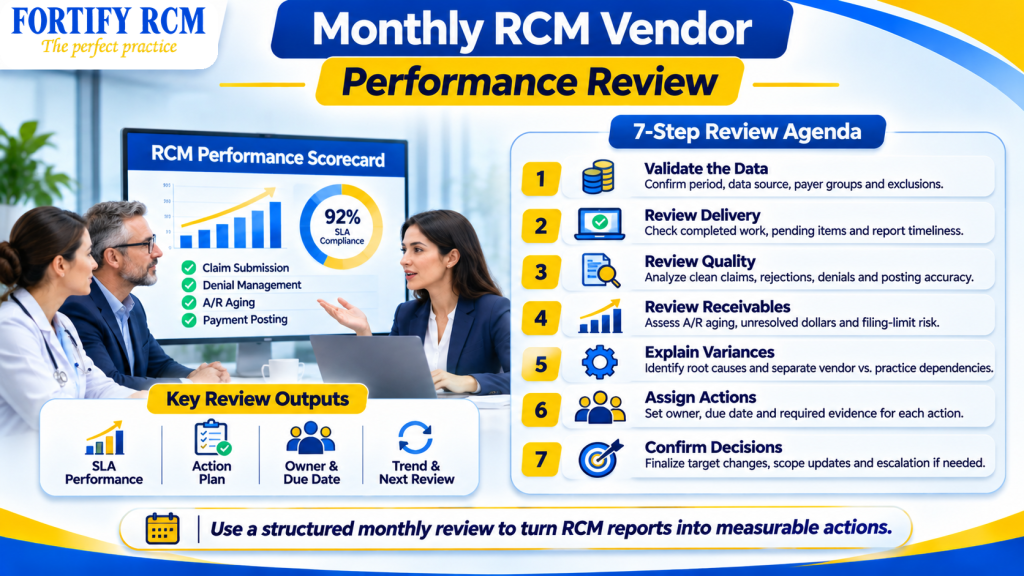
A monthly review should turn reports into decisions. Use RCM outsourcing performance metrics to set the agenda and prioritize exceptions. Validate results against account samples. Include the practice administrator, RCM lead, vendor manager, and vendor contact; invite compliance, IT, or finance when needed.
Use this agenda:
-
Validate the data: Confirm reporting dates, source systems, payer groups, claim population, exclusions, refresh time, and unresolved data gaps.
-
Review delivery: Check work completed, items outside agreed timelines, queue volume, report timeliness, and dependencies on the practice.
-
Review quality: Examine clean-claim edits, front-end rejections, adjudicated denials, posting corrections, and repeat errors.
-
Review receivables: Look at aging, unresolved dollars, payer distribution, old inventory, and filing-limit risk.
-
Explain variances: Separate vendor-controlled issues from missing practice data, payer changes, system outages, and contract or policy changes.
-
Assign actions: Give each action one owner, a due date, required evidence, and a review date.
-
Confirm decisions: Record target changes, scope changes, escalations, disputes, and any approved process revisions.
Use daily or weekly huddles for urgent inventory, monthly meetings for trends, and quarterly reviews for scope and strategy. Review RCM outsourcing performance metrics at the cadence that supports a decision. These are suggested cadences, not regulatory requirements; set frequency according to volume, risk, and service scope.
A useful scorecard should show actual, target, prior-period result, trend, numerator, denominator, data source, owner, variance explanation, and action status. Avoid a red/green dashboard without context. A target missed by one claim in a small sample may need a different response from a recurring pattern affecting hundreds of accounts.
| Metric | Agreed target | Actual | Trend | Owner | Review action |
|---|---|---|---|---|---|
| Claim submission lag | Contract-defined | Current result | Improving / worsening | Vendor lead | Review late-ready claims |
| Rejection correction | Contract-defined | Current result | Improving / worsening | Shared | Fix recurring edit |
| Payment posting lag | Contract-defined | Current result | Stable / changing | Vendor lead | Investigate missing ERA |
| A/R aging | Practice baseline | Current result | Improving / worsening | Shared | Prioritize payer group |
| Report delivery | Agreed due date | On time / late | Stable / changing | Vendor lead | Correct report process |
Where responsibility differs by payer, report RCM outsourcing performance metrics as separate cohorts.
For smaller organizations, Fortify RCM’s medical billing services for small practices guide discusses sample reports and review frequency. The AMA practice-management resources provide broader context. End each meeting with decisions and owners. RCM outsourcing performance metrics should lead to assigned actions.
Handle Missed SLAs Using RCM Outsourcing Performance Metrics
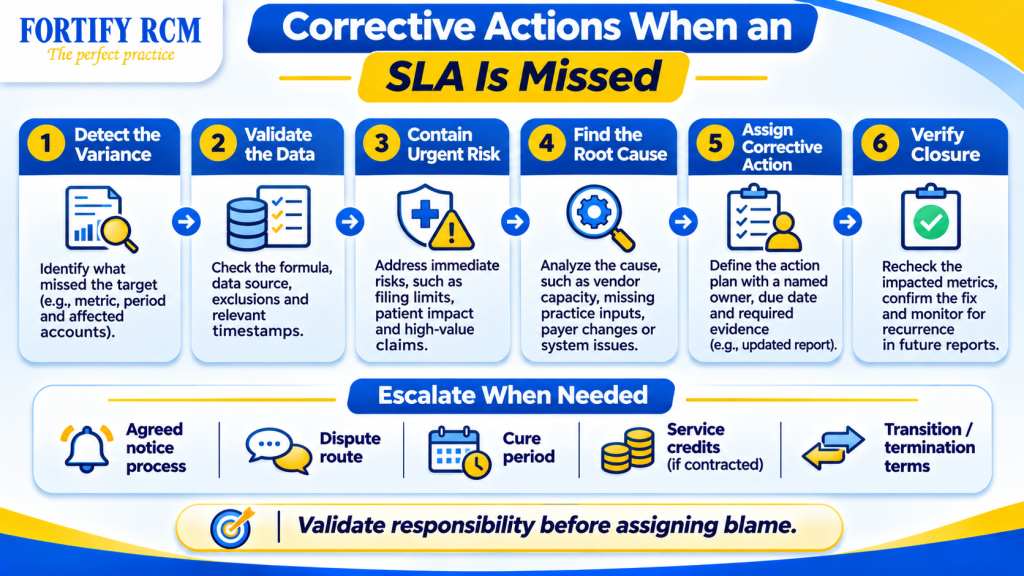
A missed target needs investigation, not automatic vendor blame. RCM outsourcing performance metrics can identify the variance, but account records, timestamps, source data, and dependencies must be checked before assigning responsibility.
Use six corrective-action stages:
-
Detect: Record the measure, period, variance, affected accounts, and exposure.
-
Validate: Check formula, source, exclusions, timestamps, denominator, and ownership.
-
Contain: Prioritize filing-limit risks, patient impact, high-value accounts, and unresolved payer requests.
-
Analyze: Test vendor capacity, training, workflow, missing practice input, payer behavior, system failure, and contract clarity.
-
Correct: Assign an action, owner, due date, evidence, and monitoring period.
-
Verify: Recheck the affected population and confirm recurrence has stopped. Track RCM outsourcing performance metrics after each correction.
Illustrative SLA wording for discussion—not a binding contract clause:
When a reported service measure falls outside the agreed target, the parties will validate the underlying data, applicable exclusions, and responsibility. The responsible party will document the cause, affected work, corrective action, owner, due date, and evidence of completion. The parties will review progress at the next governance meeting or sooner when patient, compliance, or filing-limit risk requires escalation.
The agreement should define notice, disputes, cure periods, service credits if negotiated, repeated failures, termination, transition support, and ownership of open inventory. RCM outsourcing performance metrics should support—not replace—these contract terms. Obtain legal review; a scorecard is not a complete contract, and service credits must not replace compliance escalation.
Privacy and security controls are separate from productivity targets. When a vendor performs billing, claims processing, or practice management involving protected health information on behalf of a covered entity, it may qualify as a HIPAA business associate. HHS explains that covered entities generally need satisfactory written assurances through a business associate agreement when the relationship meets the definition. Review HHS Business Associate guidance and HIPAA guidance for professionals. The agreement should address permitted uses, safeguards, incident reporting, subcontractors, and PHI at termination. A BAA does not replace vendor security due diligence.
If provider enrollment or revalidation is expressly included in the contracted work, define it as a separate service line with its own application-completeness, submission, and follow-up measures. Use CMS Medicare provider enrollment guidance for applicable Medicare program requirements rather than mixing enrollment timelines with claim-submission SLAs.
Specialties We Serve
Reporting requirements can differ across physician practices, behavioral health, ABA, therapy, and home-health organizations because payer mix, authorization patterns, documentation, and claim types vary. Fortify RCM can discuss service scope and reporting expectations in relation to each practice’s specialty and operating needs.
Mental Health Providers
Credentialing and billing for psychologists, therapists, counselors, and social workers in private or group practice.
Nutritionists & Dietitians
Specialized RCM and credentialing support for MNT providers, licensed dietitians, and wellness nutritionists.
Occupational Therapists
End-to-end billing and enrollment services for pediatric and adult OT clinics and independent therapists.
Non-Emergency Medical Transportation (NEMT)
We handle Medicaid credentialing, EDI setup, and claims billing for NEMT providers.
Home Health Agencies
Complete RCM services tailored for HHAs including Medicare credentialing, OASIS billing, and claims management.
Skilled Nursing Facilities (SNFs)
Credentialing, billing, and AR support for SNFs—compliant with payer-specific guidelines and long-term care needs.
Applied Behavior Analysis (ABA)
We support ABA therapy providers with credentialing, insurance billing, authorization and appeals for denied behavioral health claims.
Chiropractors & Physical Therapists
Credentialing and billing help for musculoskeletal therapy, rehab clinics, and solo practitioners.
Durable Medical Equipment (DME) Providers
We handle Medicare/Medicaid credentialing, EDI setup, and claims submission for DME suppliers.
Nurse Practitioners & Physician Assistants
Complete credentialing and billing support for NPs & PAs operating independently or in group practices.
Dentists & Oral Health Providers
Support with dental insurance credentialing and claims processing for general dentists and specialists.
Vision & Eye Care Specialists
Credentialing and RCM services for optometrists, ophthalmologists, and vision therapy providers.
Frequently Asked Questions about RCM Outsourcing Performance Metrics
1. What should an RCM outsourcing SLA include?
An SLA should define the contracted task, work trigger, clock start and stop, target, reporting period, exclusions, data source, owner, escalation route, and completion evidence. It should also identify the payer groups, specialties, locations, and opening inventory included. RCM outsourcing performance metrics should follow those agreed definitions.
2. Which RCM outsourcing performance metrics should a practice monitor?
Monitor the measures that match the vendor’s scope: claim submission lag, initial rejection rate, clean claim rate, remittance denial rate, payment posting lag, follow-up completion, A/R aging, unresolved inventory, and report timeliness. Add net days in A/R and cost to collect when the accounting definitions and data sources are consistent.
3. What Is the Difference Between Clean Claim Rate and First-Pass Payment Rate?
Clean claim rate measures the percentage of claims that pass defined pre-submission edits without requiring manual intervention. First-pass payment rate measures how often claims receive payment from the payer after their initial submission. These are different indicators and should not be treated as interchangeable. When evaluating rcm outsourcing performance metrics, practices should include both measures in medical billing vendor reporting to assess claim quality and payment outcomes. Consistent definitions help identify submission errors and recurring payer-related issues.
4. How Should Outsourced Billing KPIs and Denial Rates Be Measured?
Outsourced billing KPIs should use clearly defined formulas, reporting periods, and data sources. Practices should distinguish initial claim denials from remittance denials and front-end claim rejections. HFMA’s Remittance Denial Rate methodology uses denied claims divided by claims remitted, subject to its defined inclusions and exclusions. A medical billing service level agreement should specify these calculations so that rcm outsourcing performance metrics remain consistent across reporting periods. Practices should also review denial reasons, affected claim values, appeal outcomes, and corrective actions.
5. How often should RCM performance reports be reviewed?
Use daily or weekly views for active queues and urgent exceptions, monthly reviews for quality and SLA trends, and quarterly reviews for contract scope and priorities. The right cadence depends on volume, risk, staffing, and the work the vendor owns. Record action owners at each review.
6. How Can Practices Evaluate Revenue Cycle Vendor Performance?
Practices can evaluate revenue cycle vendor performance by reviewing claim submission timelines, rejection rates, payment posting accuracy, denial trends, A/R aging, and unresolved account inventory. Regular outsourced RCM reporting should include actual results, agreed targets, previous-period comparisons, and explanations for significant variations. Reviewing these rcm outsourcing performance metrics helps administrators identify workflow gaps, measure vendor accountability, and assign corrective actions. Monthly performance reviews and periodic scorecard assessments can help maintain consistent service expectations.
7. What should happen when an RCM vendor misses an SLA?
Validate the report and underlying records, identify affected work, contain urgent risks, and investigate the cause. Assign a corrective action with an owner, due date, evidence, and review date. Recurring or material failures should follow the agreement’s escalation, dispute, cure, or termination provisions.
8. What should an RCM vendor performance scorecard contain?
A scorecard should include definitions, targets, actuals, trends, denominators, sources, payer or specialty segments, exceptions, owners, and corrective-action status. Link each variance to evidence and a next action. RCM outsourcing performance metrics become actionable when an out-of-target result links to account evidence, a cause, and a next step.
Review Your RCM Reporting and SLA Framework with Fortify RCM
A useful vendor report should show what is moving, what is delayed, who owns the next action, and whether the agreed service is improving. RCM outsourcing performance metrics work best when scope, formulas, sources, exclusions, and escalation are agreed before performance is judged. A consistent set of RCM outsourcing performance metrics makes each review repeatable.
Fortify RCM supports defined billing workflows. Review the Fortify RCM Services Overview and Revenue Cycle Management Services, then compare scope with Fortify RCM Pricing and your reporting needs.
Before requesting a discussion, prepare your current scorecard, payer mix, service scope, sample reports, and unresolved reporting questions. A review of RCM outsourcing performance metrics can then focus on practical workflow decisions. To discuss reporting requirements and accountability against your workflow, contact the Fortify RCM team.