
Healthcare practices can submit clean claims and still struggle to understand what happened after a payer processes them. Remittance files may arrive separately from bank deposits, one payment may cover several claims, and adjustments can change patient balances. Without a controlled process, staff may leave cash unidentified, post adjustments incorrectly, or spend hours researching discrepancies. A documented ERA EOB reconciliation medical billing workflow connects payer decisions to deposits and patient accounts.
This guide covers ERA EOB reconciliation medical billing from receipt to final review: ERA/EOB/EFT differences, claim and deposit matching, exception handling, total reconciliation, and audit controls. Each payment, adjustment, reversal, and patient balance must be supported by a source record.
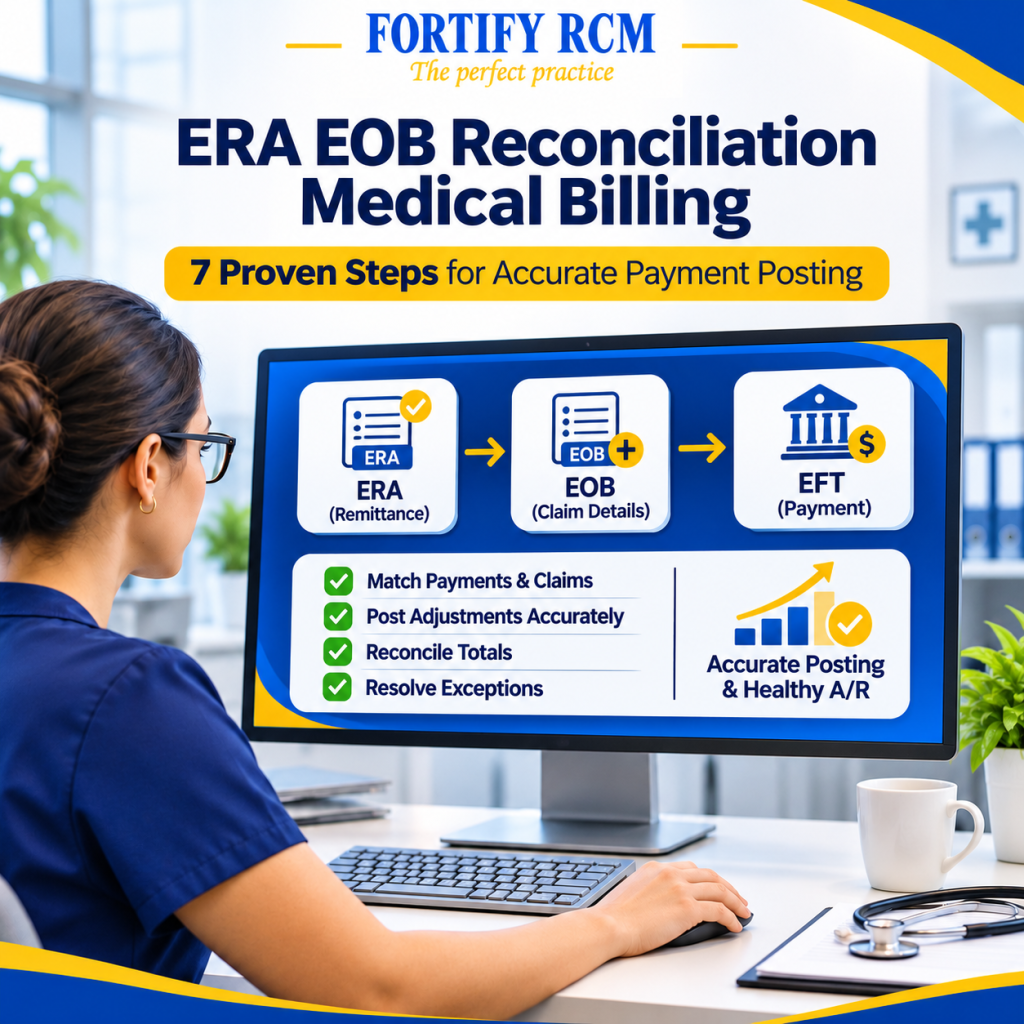
ERA, EOB, EFT, and Remittance Basics
ERA, EOB, and EFT are related but not interchangeable. An electronic remittance advice (ERA) explains how a health plan adjudicated claims and calculated payment or adjustments. An explanation of benefits (EOB) communicates claim-processing details electronically or on paper. An electronic funds transfer (EFT) moves funds to the provider’s bank. In ERA EOB reconciliation medical billing, the remittance explains the decision; the EFT confirms the transfer.
The X12 835 is the standard electronic claim payment/advice transaction. It can make a payment, send an EOB/remittance advice, or do both. See the X12 835 Health Care Claim Payment/Advice transaction.
| Term | Reconciliation purpose |
|---|---|
| ERA / 835 | Explains adjudication, payment, and adjustments |
| Paper EOB | Provides claim details when electronic remittance is unavailable |
| EFT | Transfers funds to the provider’s bank |
| CARC / RARC | Explain adjustments and add processing detail |
| PLB adjustment | Identifies provider-level balance adjustments |
A Medicare remit may include multiple claims and adjustments at claim, line, or provider level. CMS explains Group Codes, CARCs, RARCs, and provider-level adjustments in its remittance advice guidance. Do not move a provider-level adjustment automatically to a patient account.
For deposit matching, check the reassociation or trace reference. HHS says the X12 835 trace in EFT addenda should correspond to the trace in the associated ERA. Review the HHS EFT and ERA operating rules and CMS reassociation guidance. A sound ERA EOB reconciliation medical billing process uses trace data, not payer name or amount alone.
Receive and Match Remittance
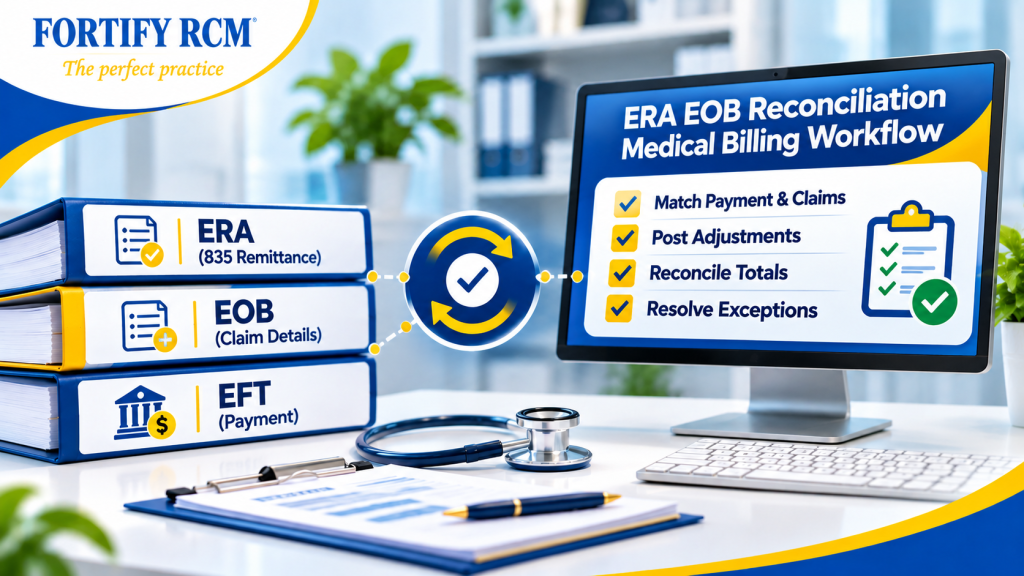
A reliable ERA EOB reconciliation medical billing workflow starts with controlled receipt. Remittances may arrive through a clearinghouse, payer portal, practice system, secure file transfer, or paper mail; EFT deposits appear through the bank. Log the source, dates, amount, file reference, and posting status. This intake discipline keeps ERA EOB reconciliation medical billing complete from the first handoff.
For ERA EOB reconciliation medical billing, follow six steps:
-
Log: payer, payee, dates, amount, file reference, and source.
-
Capture references: EFT trace, check number, payer reference, and ERA reassociation value.
-
Match deposit: compare trace first, then payer, payee, amount, and date.
-
Match claims: verify claim number, account, service date, charges, payment, and adjustments.
-
Post: apply insurance payment, contractual adjustment, deductible, copay, coinsurance, and patient responsibility under policy.
-
Reconcile: compare source, posting, and bank totals; leave unexplained differences open. This keeps ERA EOB reconciliation medical billing traceable beyond the posting screen.
CMS explains that EFT sends Medicare payments to a provider’s financial institution and supports bank reconciliation. See CMS EFT information and payment/remittance transaction guidance.
Example: A practice receives a $6,240 EFT and two remittance files linked by trace details. Verify the combined remit before closing; treating each file as a separate deposit could overstate cash. ERA EOB reconciliation medical billing requires trace-based matching, not amount alone.
Identify Posting Exceptions
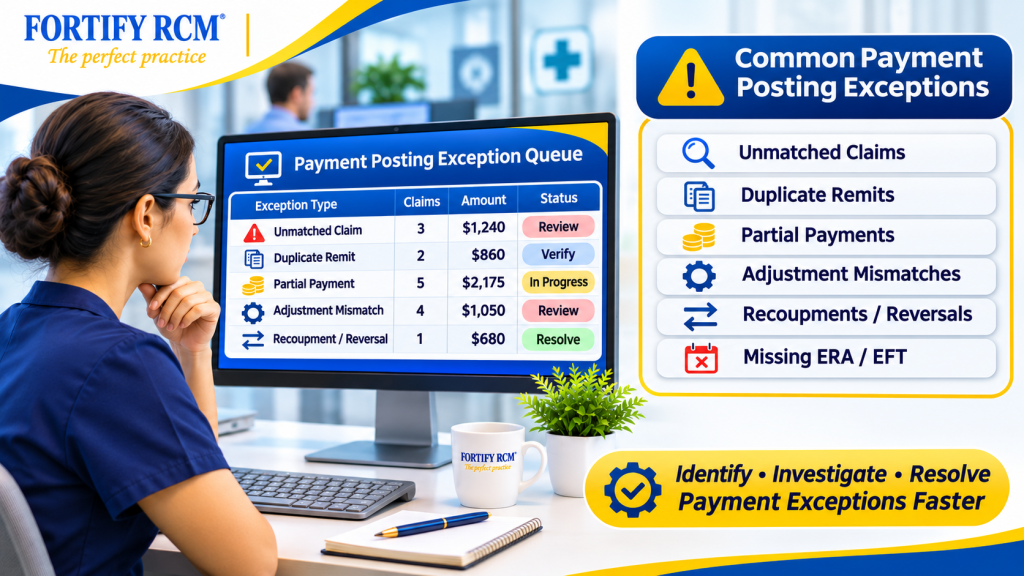
An effective ERA EOB reconciliation medical billing process sends questionable records to a controlled exception queue. The team must use ERA EOB reconciliation medical billing checks to distinguish valid adjustments from missing or misapplied records before closing the batch.
| Exception | What to verify |
|---|---|
| Unmatched claim | Claim number, patient account, service date, original submission |
| Duplicate remit | File ID, payment reference, claim amounts, posting history |
| Partial payment | Line-level adjudication, CARC/RARC, benefits, contract |
| Adjustment mismatch | Group code, CARC, RARC, posting policy |
| Recoupment / reversal | Original payment, reversal reference, affected claim |
| Missing EFT / ERA | Bank activity, payer portal, clearinghouse, trace |
CARCs and RARCs explain why a payer changed the amount. The Medicare Claims Processing Manual, Chapter 22 covers remittance balancing, the 835, and adjustment codes. Check payer and contract context before assigning responsibility.
For example, a service line has a $180 charge and a $120 payment. The remaining $60 should not automatically move to the patient. Review the adjustment group code, CARC, RARC, benefits, contract, and secondary-payer information. ERA EOB reconciliation medical billing requires checking why the balance remains, not just its arithmetic.
When a discrepancy relates to a denied or rejected claim, coordinate with the denial team. Fortify RCM’s guide on how to reduce medical claim denials provides related guidance.
Reconcile Totals Without Forcing a Match
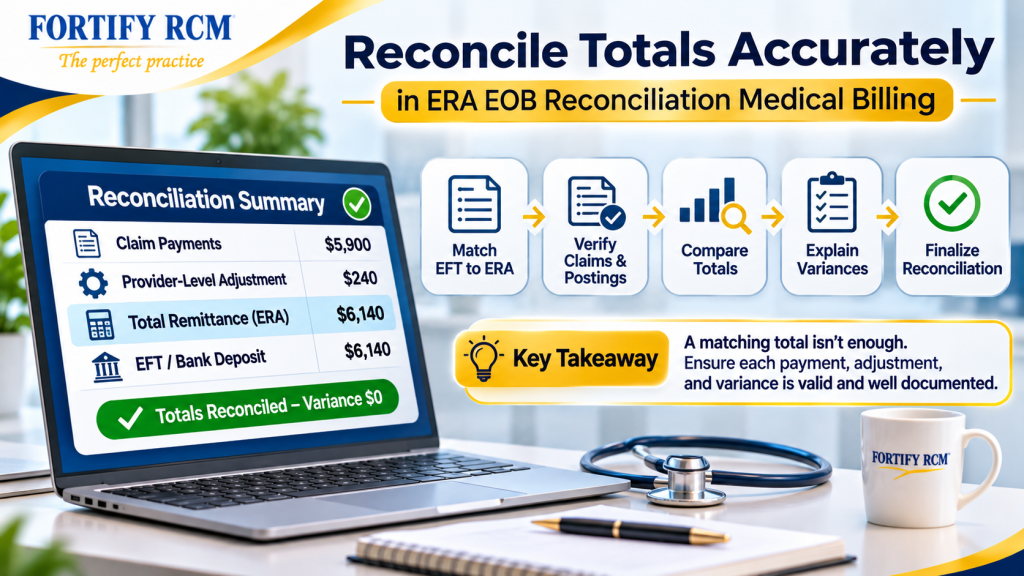
The purpose of ERA EOB reconciliation medical billing is to explain how remittance totals, claim postings, adjustments, and deposits relate. Totals can differ when one EFT covers multiple remittances or a remit includes provider-level adjustments. Document the reason; never create an unsupported balancing entry. This protects ERA EOB reconciliation medical billing from unexplained adjustments.
ERA EOB reconciliation medical billing compares payer, claim, batch, and bank totals. Record expected and actual totals, variance, explanation, and reviewer. Separate timing differences from posting errors.
| Check | Question |
|---|---|
| EFT to ERA | Does the deposit match the correct remittance? |
| ERA to claims | Do service-line amounts agree with the claims? |
| Claims to posting | Were payments and adjustments applied to the right accounts? |
| Posting to bank | Does posted cash agree with the deposit after explained items? |
| Variance review | Is each difference explained and assigned? |
Example: A batch has $5,900 in claim payments and a $240 provider-level adjustment; the deposit is $6,140. The arithmetic balances, but the team must validate the adjustment. A matching total does not prove correct claim posting. A complete ERA EOB reconciliation medical billing review checks the supporting entries.
Use the CMS Chapter 22 manual for Medicare remittance guidance; follow each commercial payer’s instructions and the practice contract.
Manage the Daily Exception Queue
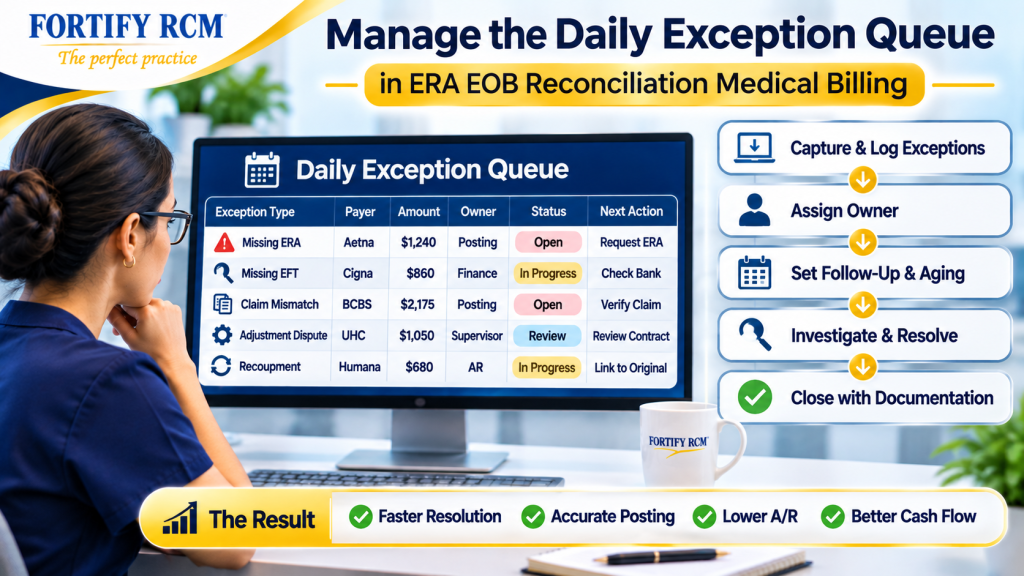
Every unresolved item needs an owner, next action, and review date. The ERA EOB reconciliation medical billing queue should record payer, payment reference, claim or patient identifier, amount, exception type, date, owner, status, and next action.
| Exception | Owner / next action |
|---|---|
| Missing ERA | Payment posting retrieves it from payer or clearinghouse and logs the request |
| Missing EFT | Posting and finance check bank activity and payer status using trace |
| Claim mismatch | Posting lead verifies patient, claim, date of service, and original claim |
| Adjustment dispute | Supervisor reviews code, contract, benefits, and payer explanation |
| Recoupment | Posting and AR link reversal to the original transaction |
| Repeated import error | Supervisor or system admin reviews import logs and duplicate controls |
Set internal aging rules based on staffing, payer response patterns, payment value, and practice policy. Review new items daily, escalate high-value unidentified deposits, and send aged items to a supervisor. These are internal controls, not payer deadlines.
ERA EOB reconciliation medical billing trends can reveal file, enrollment, identifier, or training issues. Fortify RCM’s EDI/ERA/EFT setup support and Claims Submission & Payment Posting services can support transaction and posting workflow reviews. Explore Revenue Cycle Management services for broader support.
Build an Audit Trail and Useful Controls
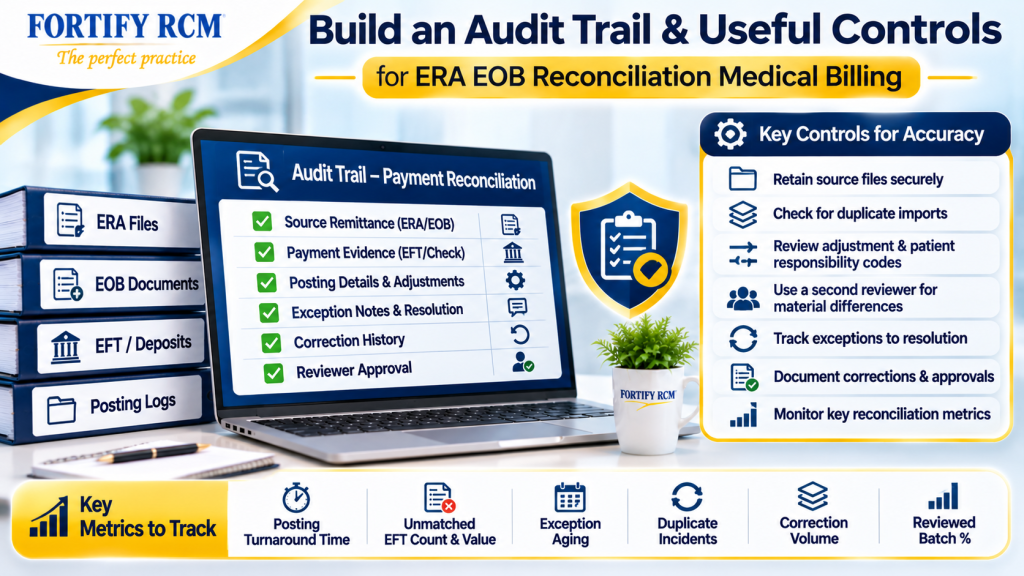
A strong ERA EOB reconciliation medical billing program lets a reviewer trace a transaction from source record to final account balance. Retain the ERA/EOB, EFT or check evidence, posting batch, adjustment details, exception notes, correction history, and reviewer approval under the practice’s retention policy.
Apply seven controls: retain source files securely; record received, posted, and unresolved totals; check for duplicate imports; review adjustment and patient responsibility codes; document each correction and approval; use a second reviewer for material differences; and track exceptions to resolution.
Monitor posting turnaround, unmatched EFT count and value, exception aging, duplicate incidents, correction volume, and reviewed-batch percentage. ERA EOB reconciliation medical billing metrics should be reviewed by payer and posting team. HFMA’s MAP Keys provides standardized revenue-cycle measures; select metrics relevant to the practice.
Daily close checklist
-
Expected remittances logged or marked missing.
-
EFTs/checks matched to available remittances.
-
Claims and service lines matched to correct accounts.
-
Payments, adjustments, and patient responsibility reviewed.
-
Duplicate files and postings checked.
-
Posting totals compared with remittance totals.
-
Bank deposits and timing differences reviewed.
-
Open variances assigned with next actions.
-
Corrections and approvals traceable.
-
Reviewer completed the batch close.
The objective of ERA EOB reconciliation medical billing is not zero variance at any cost; it is to ensure each material difference is understood, supported, assigned, and resolved. Explore Fortify RCM’s medical billing services for small practices when considering outside payment-posting support.
Specialties We Serve
ERA EOB reconciliation medical billing needs vary across physician, behavioral health, therapy, and dental practices with different payer mixes, claim volumes, and patient balances. Fortify RCM supports relevant teams with claims submission, payment posting, ERA/EOB reconciliation, and revenue cycle workflows.
Mental Health Providers
Credentialing and billing for psychologists, therapists, counselors, and social workers in private or group practice.
Nutritionists & Dietitians
Specialized RCM and credentialing support for MNT providers, licensed dietitians, and wellness nutritionists.
Occupational Therapists
End-to-end billing and enrollment services for pediatric and adult OT clinics and independent therapists.
Non-Emergency Medical Transportation (NEMT)
We handle Medicaid credentialing, EDI setup, and claims billing for NEMT providers.
Home Health Agencies
Complete RCM services tailored for HHAs including Medicare credentialing, OASIS billing, and claims management.
Skilled Nursing Facilities (SNFs)
Credentialing, billing, and AR support for SNFs—compliant with payer-specific guidelines and long-term care needs.
Applied Behavior Analysis (ABA)
We support ABA therapy providers with credentialing, insurance billing, authorization and appeals for denied behavioral health claims.
Chiropractors & Physical Therapists
Credentialing and billing help for musculoskeletal therapy, rehab clinics, and solo practitioners.
Durable Medical Equipment (DME) Providers
We handle Medicare/Medicaid credentialing, EDI setup, and claims submission for DME suppliers.
Nurse Practitioners & Physician Assistants
Complete credentialing and billing support for NPs & PAs operating independently or in group practices.
Dentists & Oral Health Providers
Support with dental insurance credentialing and claims processing for general dentists and specialists.
Vision & Eye Care Specialists
Credentialing and RCM services for optometrists, ophthalmologists, and vision therapy providers.
Frequently Asked Questions About ERA EOB Reconciliation Medical Billing
1. What is the difference between an ERA and an EOB?
An ERA is electronic remittance advice with claim adjudication and payment information. An EOB explains how a claim was processed and may be electronic or paper. ERA EOB reconciliation medical billing connects that payer decision to the practice account.
2. How is an EFT matched to an ERA?
Use reassociation or trace information when available, then verify payer, payee, payment date, amount, and related remittance records. HHS explains that the X12 835 trace segment should correspond to the trace segment in EFT addenda for the associated payment. Do not rely on amount alone.
3. What causes payment posting discrepancies?
Common causes include missing files, duplicate imports, claim mismatches, partial adjudication, adjustment errors, recoupments, and timing differences. A consistent ERA EOB reconciliation medical billing queue separates data problems from payer errors.
4. How should unmatched remittances be tracked?
Record payer, amount, reference, date, related claim, exception, owner, last action, and next follow-up. Keep the item open until matched or explained.
5. Can an EFT amount differ from one ERA total?
Yes. A deposit may relate to multiple remittances or provider-level adjustments. Review trace and payer references, examine associated files, and document the reason instead of forcing a posting entry.
6. What should a payment posting audit include?
Review source remittances, payment evidence, claim matching, payment and adjustment application, duplicate controls, batch totals, corrections, exception ownership, and reviewer approval. Another team member should be able to retrace the transaction.
7. What documents should a medical billing team retain for payment reconciliation?
A medical billing team should retain original ERA/EOB files, EFT or check payment evidence, claim details, posting batch records, adjustment information, correction history, and reviewer approvals. A consistent ERA EOB reconciliation medical billing process ensures that every transaction can be traced back to its original source and verified during an audit.
8. How should provider-level adjustments be handled during reconciliation?
Provider-level adjustments should be reviewed separately from individual claim adjustments. Billing teams should examine the PLB reason code, amount, associated payment, and supporting payer documentation before recording the adjustment. ERA EOB reconciliation medical billing should never assign provider-level adjustments directly to patient responsibility without proper validation.
9. Can medical practices post ERA payments before receiving the corresponding EFT?
Practices may follow different posting policies depending on their billing software and internal controls. However, an ERA should not automatically be treated as a confirmed bank deposit. In ERA EOB reconciliation medical billing, teams should track expected payments separately and complete EFT matching before closing the financial reconciliation process.
10. Which KPIs help measure payment reconciliation performance?
Important KPIs include payment posting turnaround time, unmatched EFT count and value, exception aging, duplicate posting incidents, correction volume, and reconciliation completion rate. Monitoring these indicators helps an ERA EOB reconciliation medical billing team identify recurring problems, improve accountability, and strengthen payment posting accuracy.
Strengthen ERA EOB Reconciliation Medical Billing With Fortify RCM
Unmatched remittances create extra work and make account balances harder to trust. A clear ERA EOB reconciliation medical billing workflow connects payer decisions, claim postings, adjustments, and deposits while assigning unresolved items to an owner.
Fortify RCM supports practices with claims submission, payment posting, ERA/EOB reconciliation, EDI/ERA/EFT setup, denial management, and broader revenue cycle management. Fortify RCM can review ERA EOB reconciliation medical billing controls, exception handling, and payment posting responsibilities with your team. Our Claims Submission & Payment Posting team can review remittance matching, payment and adjustment posting, and exception follow-up. Explore RCM services and pricing information to understand available support options.
If your team spends too much time searching for missing remittances, correcting posting entries, or investigating unexplained balances, review the current workflow. Identify where source records, ownership, exception tracking, and batch sign-off need improvement. Contact Fortify RCM to discuss ERA EOB reconciliation medical billing, a payment-posting workflow review and determine which billing responsibilities may benefit from additional support.