
Medical billing documentation requirements help prevent claim delays caused by incomplete notes, unclear medical necessity, missing signatures, or supporting records. Reviewing documentation before submission reduces rework and improves claim accuracy.
For physicians, billers, coders, and practice administrators, consistent pre-bill reviews help identify gaps, request clarification, and ensure claims are supported by accurate clinical records.
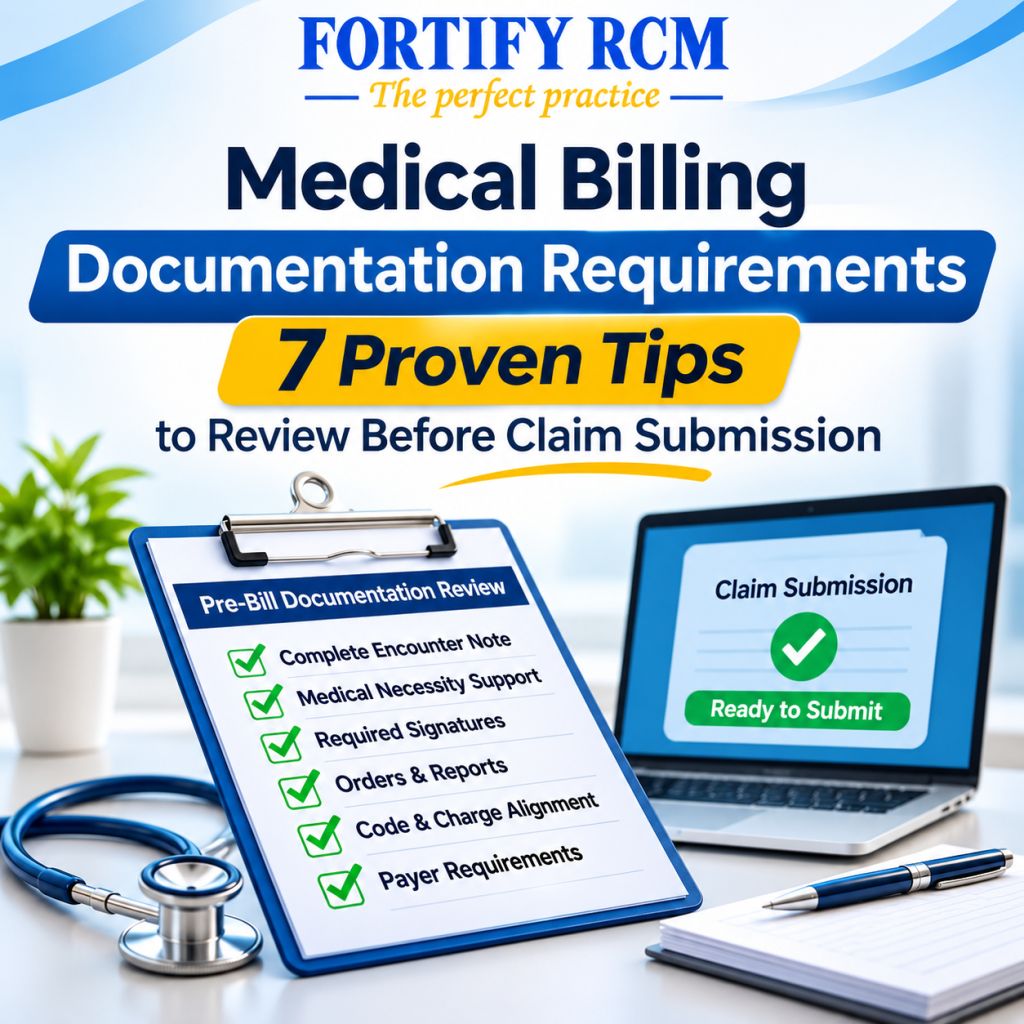
Why Documentation Matters Before Claim Submission
The medical record is the evidence that a service was furnished and that submitted codes and charges are supported. Medical billing documentation requirements show who provided the service, what happened, and how the claim reflects the work.
CMS says records should be legible and identify the reason for the encounter, relevant history, findings, assessment, plan, date, and author. They should support reported CPT, HCPCS, and ICD-10-CM codes. See CMS E/M guidance and its documentation fact sheet.
A complete record is not the longest note; it is accurate, attributable, relevant, and sufficient for the service and payer policy. Map medical billing documentation requirements to the service, code family, and payer instructions. A template can prompt fields, but it cannot replace clinical judgment. Use medical billing documentation requirements to guide an early review, not a retrospective fix.
If a note leaves the assessment unclear, the biller should not infer a diagnosis or choose a code to fit. Send a neutral query, hold the claim if needed, and preserve the response. This keeps medical billing documentation requirements tied to the encounter. A documented pre-bill standard makes medical billing documentation requirements visible to clinical and billing teams.
Common Documentation Gaps That Affect Claims
Medical billing documentation requirements vary by service, but practices repeatedly encounter a familiar set of gaps. A pre-submission review should identify missing evidence and route it to the person authorized to resolve it. Review medical billing documentation requirements before release. Compare medical billing documentation requirements with the actual chart for each service.
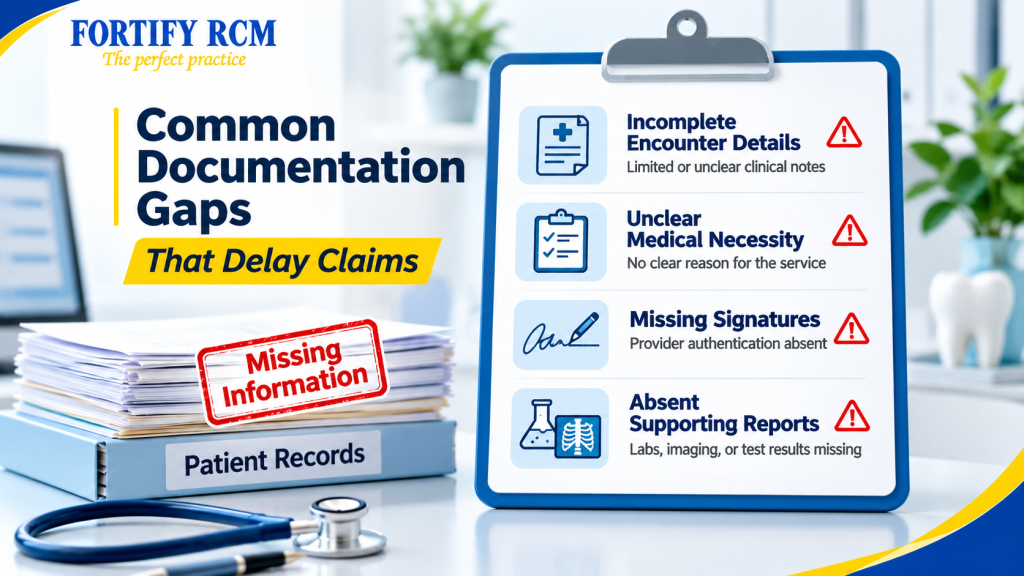
| Documentation gap | What to check | Next step |
|---|---|---|
| Incomplete encounter | Date, patient, provider, reason, findings, assessment, and plan | Request clarification from the author |
| Medical necessity unclear | Diagnosis, symptoms, clinical rationale, and coverage criteria | Route for clinical review; do not invent rationale |
| Missing authentication | Required signature, date, author identity, and applicable policy | Follow payer and record-authentication rules |
| Time or units unsupported | Time, units, duration, and service details where required | Verify the specific code and payer rule |
| Missing order or attachment | Order, referral, report, authorization, or supporting record | Obtain the source record before submission |
| Conflicting information | Different dates, providers, diagnoses, status, or units | Hold and request authorized clarification |
Signature rules are not identical across payers and services. Check the CMS Medicare Signature Requirements fact sheet and current payer instructions before correcting a record.
Orders need context. CMS says Medicare lab-test records must show the practitioner’s intent and support medical necessity; see CMS Lab Test Order Requirements. Do not apply a lab-specific rule to other services. Check medical billing documentation requirements by service.
A Clear Clinician-to-Coder Clarification Workflow
When a record is incomplete or ambiguous, the billing team needs a defined way to ask for clarification. Medical billing documentation requirements should be resolved by the professional responsible for the clinical record, not by a biller guessing what the clinician intended.
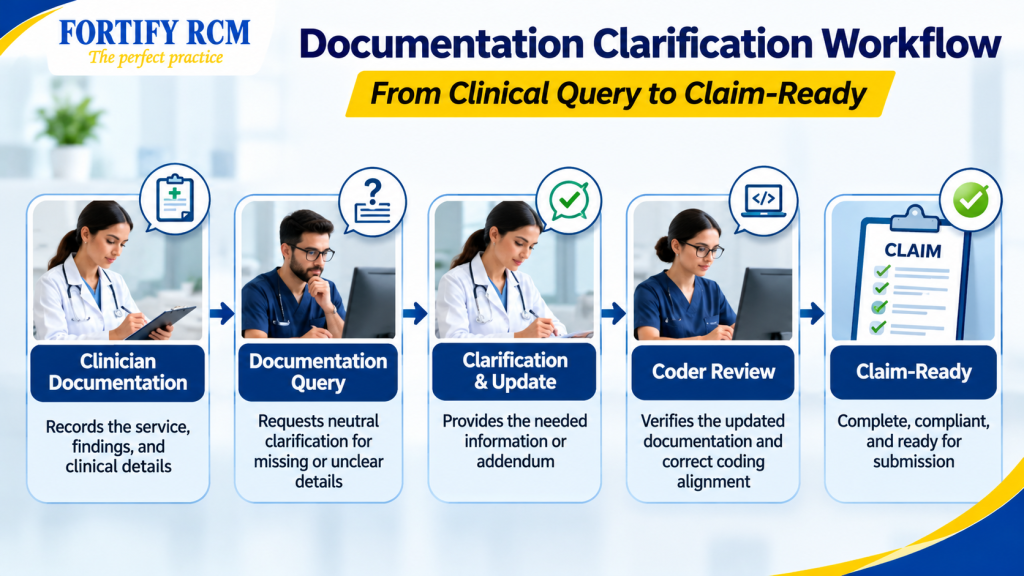
Use this workflow:
-
Identify: State the encounter, service date, record section, and specific gap.
-
Review: Check relevant notes, orders, test results, and permitted records first.
-
Query neutrally: Do not suggest a diagnosis, code, service level, or payment-driven answer.
-
Obtain the clinician’s response: The clinician records independent facts and judgment, or states that clarification is not possible.
-
Retain and code: Preserve dated addenda under policy; a qualified coder then applies the relevant guidance.
-
Release or escalate: Submit only when required information is present; otherwise document the hold and owner.
A neutral query describes a discrepancy without directing the answer: “The assessment refers to right knee pain, while the plan refers to left knee imaging. Please clarify the condition and side addressed, or indicate that the record cannot be clarified.” Do not ask the clinician to add a diagnosis for a particular code.
Medical billing documentation requirements need clear role boundaries: clinicians own clinical facts, coders interpret them under coding rules, billers verify required records, and supervisors manage exceptions. Route clinical questions to a clinician and coding questions to a qualified coding reviewer; billers must not create clinical facts. Align medical billing documentation requirements with query policy. Keep medical billing documentation requirements aligned with query ownership and coding review.
Payer and Specialty Differences
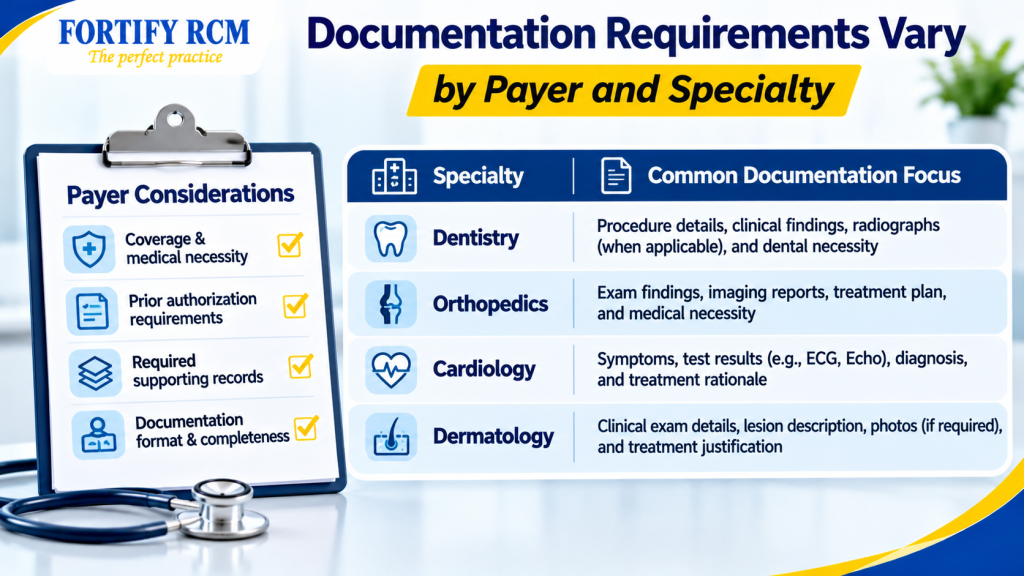
There is no single checklist that applies identically to every service, payer, and specialty. Medical billing documentation requirements depend on the service, code descriptor, coverage policy, contract, claim type, and payer instructions. Medicare guidance is important for Medicare claims, but it should not automatically be treated as a commercial-payer rule.
For Medicare E/M services, CMS explains that medical necessity is a key payment consideration and documentation should support the reported level. For most E/M visit families, the level is selected using medical decision-making or practitioner time, subject to the applicable code rules. Read CMS E/M guidance and the Medicare Claims Processing Manual.
Specialty examples differ: therapy may involve time, units, and plan-of-care details; behavioral health may require an individualized treatment plan; diagnostic tests may need an order and clinical support; and DME has its own order and medical-necessity rules. Check medical billing documentation requirements against each service’s applicable coverage policy.
Maintain a payer-and-specialty matrix listing payer/product, service and code family, required record elements, rule source, review date, and owner. Compare requests with the claim and chart; recheck medical billing documentation requirements whenever payer policy changes. For related denial-prevention practices, see Fortify RCM’s How to Reduce Medical Claim Denials.
Pre-Bill Review and Documentation Audit
A pre-bill review checks the actual record against the applicable billing rule before claim release. Medical billing documentation requirements should not be reduced to a generic template.
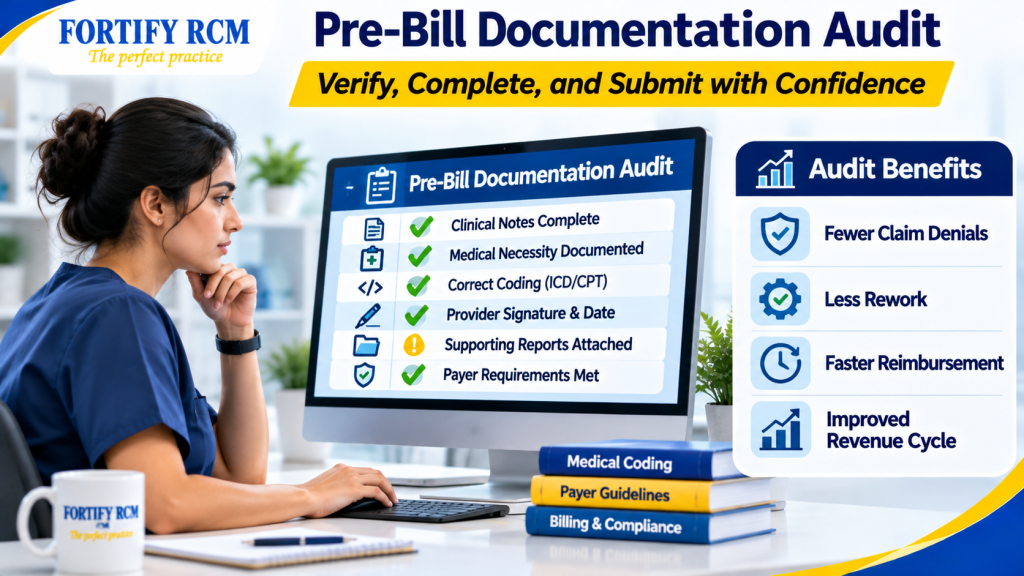
Use this review sequence:
-
Confirm the encounter is complete and the service was performed.
-
Match patient, date, provider, location, and service to the chart.
-
Check assessment, diagnosis, plan, and medical-necessity support.
-
Verify signatures, orders, time, units, modifiers, and attachments where applicable.
-
Compare codes and charges with documentation and current guidance.
-
Review payer edits and authorization or attachment instructions.
-
Assign exceptions, record the resolution, and release only when required checks are complete.
Pre-submission checklist
-
Correct patient, date, provider, and location
-
Encounter note complete, legible, and attributable
-
Service documented as performed
-
Diagnosis and assessment support services billed
-
Medical necessity supported where required
-
Required signature or authentication checked
-
Orders, time, units, and service details checked where applicable
-
Required reports or attachments available
-
Code and modifier review completed by qualified staff
-
Payer edits and claim instructions checked
-
Exceptions have an owner and documented outcome
Audit samples should include routine and higher-risk claims, such as those from new providers, unusual services, manual entries, late notes, recurring edits, and cases with prior documentation-related denials.
For Medicare claims selected for review, CMS may request records to determine whether coverage, coding, and billing requirements are supported. Its medical record documentation fact sheet explains documentation requests and supporting records. Fortify RCM’s Claims Submission and Payment Posting Services can support the claim-preparation and submission workflow. A pre-bill audit turns medical billing documentation requirements into repeatable checkpoints.
Measure Rework and Improve Documentation Quality
Measure whether required information is complete, queries are resolved, and the same gaps recur. Medical billing documentation requirements become easier to manage when the practice tracks the cause of rework instead of counting only claims held.
| KPI | Suggested definition |
|---|---|
| Documentation hold rate | Claims or encounters held for documentation ÷ reviewed |
| Query turnaround time | Time from query assignment to clinician response |
| Repeat-gap rate | Repeat instances of the same issue in a defined period |
| Pre-bill correction rate | Claims corrected before release ÷ reviewed |
| Documentation-related denial rate | Denials attributed to documentation ÷ adjudicated claims |
| Attachment completion rate | Claims with required records before release ÷ claims requiring attachments |
Define each numerator, denominator, exclusions, and period. Separate documentation gaps from eligibility, authorization, coding, and payer errors. Interpret query volume with severity and repeat rates.
Use findings to improve templates, training, handoffs, and payer tools. Do not add fields merely to lengthen notes. Medical billing documentation requirements should prompt accurate information, never documentation of services that did not occur.
OIG recommends internal monitoring and auditing, practice standards, training, communication, and corrective action as elements of a physician compliance program. Include medical billing documentation requirements in audit sampling. Review the OIG compliance program guidance for physicians. Fortify RCM provides broader billing and RCM services that practices can review when assessing administrative support. Track medical billing documentation requirements gaps by root cause.
Specialties We Serve
Documentation workflows differ across physician practices, behavioral health, therapy, diagnostic services, and DME because records, orders, time or unit details, and payer conditions vary. Fortify RCM supports practices with claims and revenue-cycle workflows that can include pre-bill review, claims submission, and follow-up, while clinical documentation decisions remain with qualified providers. Medical billing documentation requirements vary by specialty and payer.
Mental Health Providers
Credentialing and billing for psychologists, therapists, counselors, and social workers in private or group practice.
Nutritionists & Dietitians
Specialized RCM and credentialing support for MNT providers, licensed dietitians, and wellness nutritionists.
Occupational Therapists
End-to-end billing and enrollment services for pediatric and adult OT clinics and independent therapists.
Non-Emergency Medical Transportation (NEMT)
We handle Medicaid credentialing, EDI setup, and claims billing for NEMT providers.
Home Health Agencies
Complete RCM services tailored for HHAs including Medicare credentialing, OASIS billing, and claims management.
Skilled Nursing Facilities (SNFs)
Credentialing, billing, and AR support for SNFs—compliant with payer-specific guidelines and long-term care needs.
Applied Behavior Analysis (ABA)
We support ABA therapy providers with credentialing, insurance billing, authorization and appeals for denied behavioral health claims.
Chiropractors & Physical Therapists
Credentialing and billing help for musculoskeletal therapy, rehab clinics, and solo practitioners.
Durable Medical Equipment (DME) Providers
We handle Medicare/Medicaid credentialing, EDI setup, and claims submission for DME suppliers.
Nurse Practitioners & Physician Assistants
Complete credentialing and billing support for NPs & PAs operating independently or in group practices.
Dentists & Oral Health Providers
Support with dental insurance credentialing and claims processing for general dentists and specialists.
Vision & Eye Care Specialists
Credentialing and RCM services for optometrists, ophthalmologists, and vision therapy providers.
Frequently Asked Questions About Medical Billing Documentation Requirements
1. What documentation supports a medical claim?
The record identifies the patient, date, rendering professional, service, relevant clinical facts, assessment, and plan, plus any service-specific evidence. Medical billing documentation requirements depend on code, coverage policy, and claim type.
2. What are the most common documentation gaps?
Common gaps include incomplete notes, unclear medical necessity, missing authentication, unsupported time or units, absent orders or reports, and inconsistencies between chart and claim. Assign each gap to the right owner.
3. How should missing clinical information be clarified?
Review the chart, send a neutral query to the clinician, preserve the response, and hold the claim if required information is unresolved. Never guess a diagnosis or direct a provider toward a payment-driven answer.
4. Do documentation requirements vary by payer?
Yes. Medicare, state Medicaid, commercial contracts, coverage policies, and service rules can differ. Verify the current payer, product, service, and code rather than relying on one generic checklist.
5. Are signatures required on every medical record entry?
Requirements depend on applicable rules and payer instructions. Medicare has specific authentication and attestation guidance; check CMS signature requirements before correcting a record.
6. How can a practice reduce documentation-related claim rework?
Use a pre-bill checklist, neutral queries, payer references, and department-level tracking. Review documentation before submission and assign corrective actions to the team that owns the issue.
7. How can practices document medical necessity before claim submission?
Medical necessity should be supported by relevant clinical records, including the patient’s condition, examination findings, treatment rationale, and applicable coverage criteria. Medical billing documentation requirements should be checked against the specific service and payer policy before submission. A pre-bill checklist should map medical billing documentation requirements to the actual clinical evidence rather than relying on an order or template alone.
8. What should billing teams do when supporting records are held outside the practice?
Billing teams should identify where the records are maintained, contact the responsible provider or facility, and track the retrieval request. Medical billing documentation requirements should include a clear process for obtaining external records, assigning responsibility, and submitting requested documentation within the applicable deadline. CMS explains that billing providers may need to obtain supporting records from referring physician offices and other facilities
9. Do all medical claims require supporting attachments?
No. Attachment requirements depend on the payer, service, claim type, and applicable policy. Medical billing documentation requirements do not mean that every claim needs an additional attachment. Teams should verify whether an order, report, authorization, clinical note, or other supporting document is required before submission.
10. How should practices prioritize documentation gaps during pre-bill audits?
Prioritize gaps that affect code support, medical necessity, missing signatures, encounter accuracy, or payer-required records. Use medical billing documentation requirements to establish review priorities based on risk, submission deadlines, and recurring errors. Review medical billing documentation requirements by payer and specialty, assign each unresolved issue to an owner, and verify the correction before claim release.
Strengthen Your Pre-Bill Documentation Workflow With Fortify RCM
Incomplete records and unresolved queries can delay claims and create rework. A structured review identifies missing information, routes questions to the right professional, and checks medical billing documentation requirements against the service and payer policy.
Fortify RCM supports claims submission, payment posting, denial management, and billing workflows. Our team can discuss documentation checks, exception handoffs, and recurring issues. Explore Fortify RCM services, medical billing services for small practices, and Fortify RCM pricing.
If claims are held for missing notes, unclear orders, or incomplete records, identify recurring gaps, owners, and evidence needed before release. Contact Fortify RCM to discuss a documentation workflow review. A focused review can show whether medical billing documentation requirements are checked consistently. Ask how your current medical billing documentation requirements are translated into pre-bill controls and exception ownership.