
A service can be clinically appropriate, documented, and completed—and still fail to reach the claim. The gap often sits between the encounter and the billing system: an order is not linked to the visit, a procedure is not entered, a note remains unsigned, or a charge stays in an unresolved queue. A reliable medical billing charge capture process connects the care delivered to the charge that is reviewed and released, while preventing charges for services that were not performed.
For physicians, clinical managers, billing teams, and practice administrators, missed or delayed charges create more than a posting problem. They can distort reporting, delay claims, increase rework, and create compliance exposure when a claim does not match the record. This guide explains how to map the clinical-to-billing handoff, assign ownership, reconcile encounters to charges, and audit the controls that protect the revenue cycle. The goal is accurate, supported capture—not just faster entry. A consistent medical billing charge capture review keeps that standard visible
Charge Capture and Revenue Leakage
The charge capture process identifies services actually furnished, confirms that the record supports them, assigns appropriate charge information, and moves the item into billing. For finance leaders, medical billing charge capture links completed care to accountable revenue reporting. Medical billing charge capture is the bridge between clinical activity and the financial record.
Revenue leakage occurs when a performed service is not entered, a charge fails to transfer from the EHR to the practice-management system, or an item remains on hold without follow-up. The reverse error matters too: pre-loading a likely service or leaving a charge after cancellation can bill for care not delivered. Strong medical billing charge capture controls must detect both omissions and unsupported charges.
HHS-OIG says physician documentation should support services billed. CMS advises that records support the CPT, HCPCS, and ICD-10-CM codes reported. These Medicare-focused resources illustrate a wider principle: the claim should represent the service actually furnished and be supported by the record. See HHS-OIG physician guidance and CMS documentation guidance for E/M services.
For example, a clinician completes an office visit and performs a separately reportable procedure, but the procedure charge never reaches billing. The claim may contain only the visit charge. Earlier submission will not fix the omission; the practice needs reconciliation between the encounter record and posted charges. That is the core purpose of medical billing charge capture.
Clinical-to-Billing Workflow
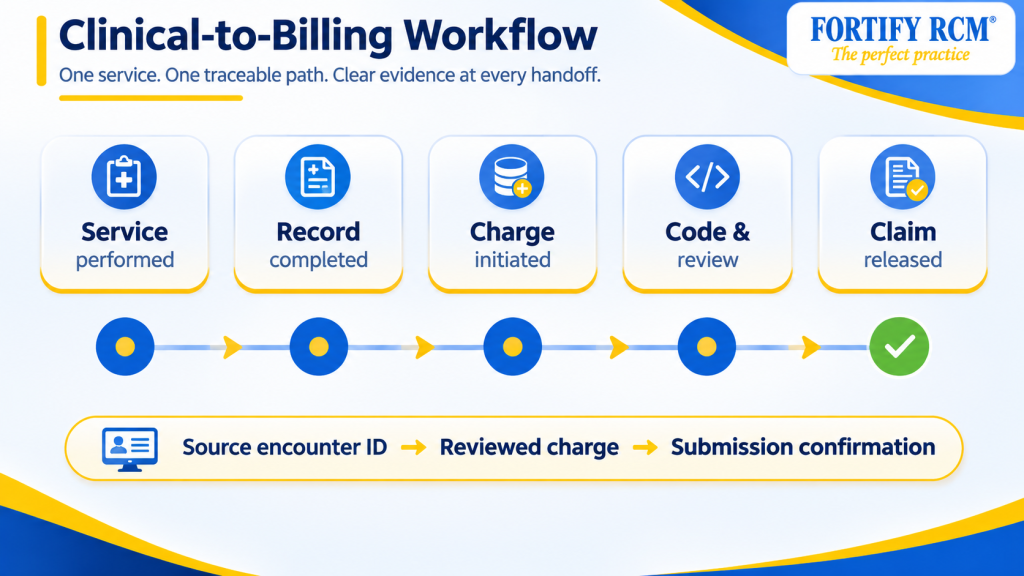
Map each service from delivery to claim release. Each medical billing charge capture stage needs an owner and evidence.
-
Service performed: Separate completed services from canceled, deferred, or not-performed activity.
-
Documentation completed: Record the date, rendering professional, service details, relevant orders, and code-supporting information. An appointment alone does not prove performance.
-
Charge initiated: Generate the item through the EHR, charge ticket, procedure log, or approved interface. Identify patient, encounter, service, units where applicable, and provider.
-
Coding and review: Compare the charge with documentation, code descriptors, modifiers, units, payer requirements, and the current charge master. Do not add charges to meet a revenue target.
-
Transfer confirmed: Verify the item reached billing and no edit, rejection, or hold remains unresolved.
-
Claim submitted: Create the claim from verified charges, apply relevant edits, submit under payer requirements, and retain confirmation.
Map from the source event to billing. The claims submission and payment posting workflow is downstream; completeness must be checked before claim creation. Each medical billing charge capture record should retain the source encounter ID and a disposition. Medical billing charge capture also needs a clear owner at each transfer: charged, legitimately excluded, held, corrected, or canceled with a reason. Teams can consult the Medicare Claims Processing Manual for Medicare fee-for-service billing instructions; payer rules may differ.
Common Capture Gaps
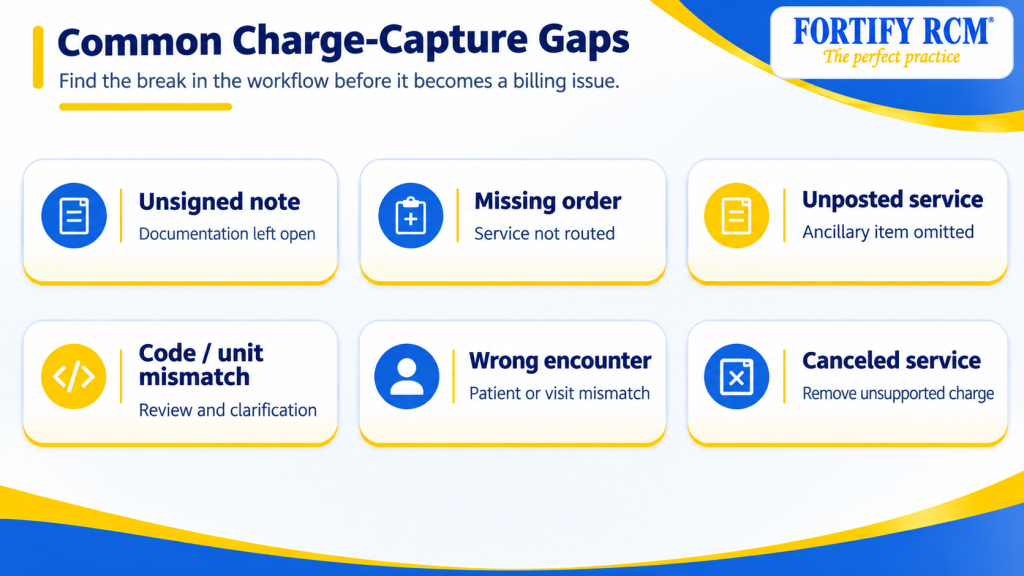
Start with the failure point, detection evidence, and correction owner. A medical billing charge capture audit should test recurring gaps such as:
| Capture gap | Detection | Corrective action |
|---|---|---|
| Unsigned note | Open-encounter aging report | Route to clinician |
| Missing order / procedure charge | Compare orders, logs, and posted charges | Repair interface or use controlled entry |
| Unposted ancillary service | Match lab, imaging, drug, or supply records | Validate units and charge master |
| Code / modifier / unit mismatch | Review edits and claim samples | Refer to qualified coding reviewer |
| Wrong encounter / duplicate | Match patient, date, provider, location, encounter ID | Correct and retain audit trail |
| Canceled service still charged | Compare final procedure status | Reverse under policy |
MGMA describes the risk of billing a planned procedure that was never performed and highlights ancillary services, units, and charge-master maintenance. Its charge-capture gap review is practice-management guidance, not a substitute for current coding references or payer policy.
Apply the same medical billing charge capture checks to manual and electronic workflows. A spreadsheet may expose a handoff problem; an interface report may show dropped transactions. Review source documentation and final service status before release. Medical billing charge capture staff should not treat an interface acknowledgment as proof of coding accuracy.
Role Ownership and Handoffs
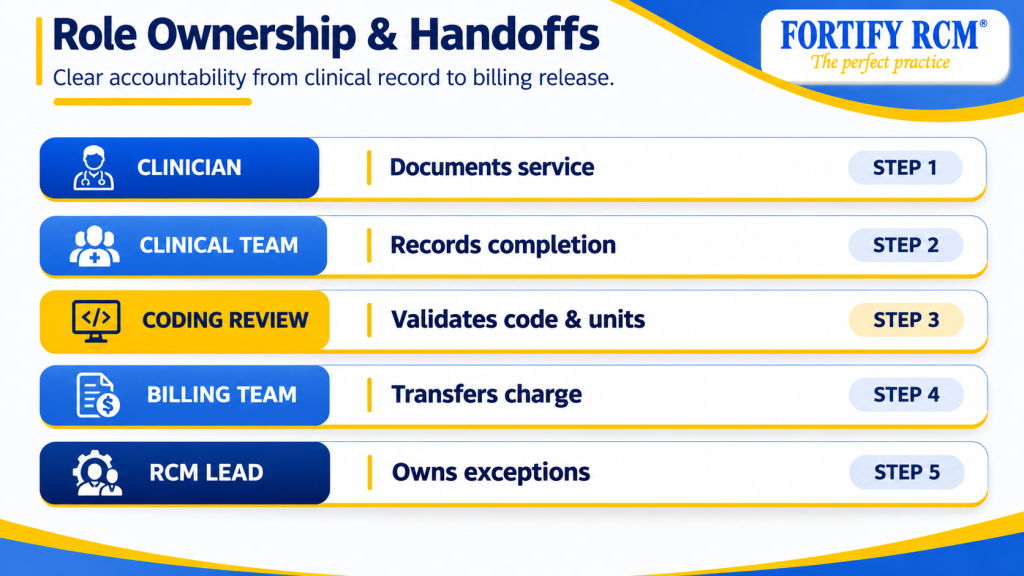
Ambiguous handoffs can still cause missed charges. Define ownership across documentation, charge creation, coding review, and billing release. A medical billing charge capture role matrix should make each handoff visible.
| Role | Responsibility | Evidence |
|---|---|---|
| Rendering clinician | Document service furnished; clarify clinical details | Signed note, order, procedure details |
| Clinical support | Record tests, administered services, and completion status within scope | Administration record, procedure log |
| Coding reviewer | Validate code, units, modifiers, documentation | Reviewed charge, query, edit result |
| Billing staff | Confirm item reaches correct account and system | Charge batch, interface status |
| Practice / RCM manager | Set policy, monitor exceptions, resolve bottlenecks | Dashboard, escalation log, audit |
Do not shift clinical judgment to billing staff; request clinician clarification rather than infer a service or code. The medical charge entry workflow should name the source record, queue, time frame, exception reason, escalation owner, and who may correct or void a charge. The medical billing charge capture owner should be able to trace a held item to its final decision.
Small practices may combine roles, but ownership must remain explicit. The Fortify RCM services overview describes billing and revenue-cycle support where additional operational capacity may help.
Exception Queues and Reconciliation
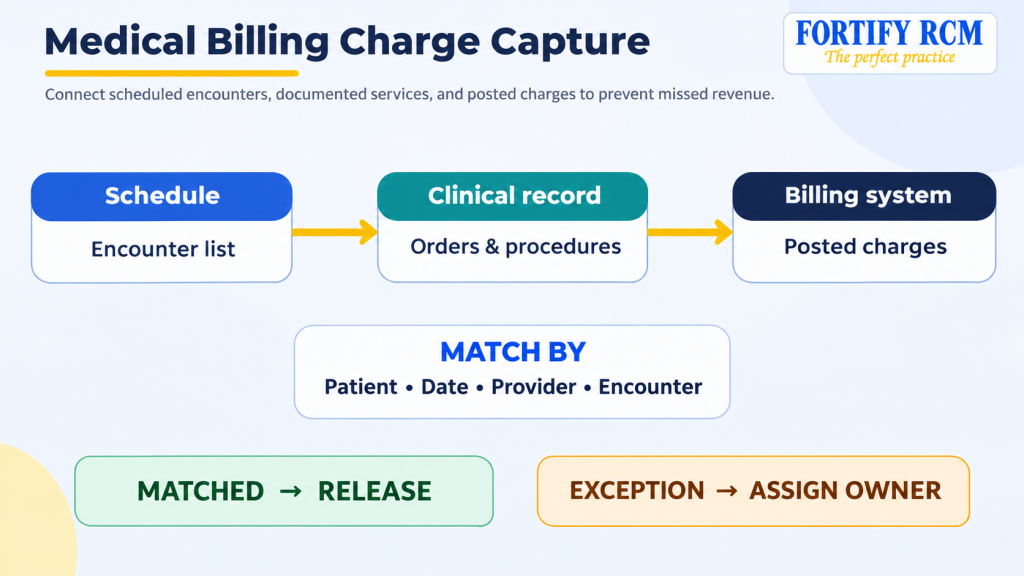
A queue is a control only when every item has a reason, owner, age, and outcome. Separate routine work from unsigned notes, missing charges, interface failures, coding questions, duplicates, canceled services, and payer holds. A medical billing charge capture queue must not become an unowned holding area.
Charge capture reconciliation compares three populations: the schedule or encounter list, the clinical record or order/procedure source, and charges posted to billing. Add relevant medication, imaging, lab, therapy, surgical, or DME records. Matching totals do not prove the same services were captured; medical billing charge capture requires item-level matching.
Daily reconciliation sequence
-
Pull completed encounters and in-scope service events.
-
Match each event to a charge using patient, date, provider, location, and encounter ID.
-
Confirm final service status; flag canceled, duplicate, or not-performed activity.
-
Assign unmatched items a reason, owner, and due date.
-
Record resolution and rerun the unmatched report.
Measure billing charge lag between date of service and a defined posting or release event. State the start and end points; use one shared definition. Set internal targets by specialty and workflow; no universal lag target fits every practice.
Prioritize aged exceptions by service type, filing deadline, and unresolved clinical dependency—not dollar value alone. Medical billing charge capture worklists should show actions, not just totals. Review repeat interface failures with IT and clinical operations. The practice’s revenue cycle management workflow should include this reconciliation step.
Audit and Improvement Controls
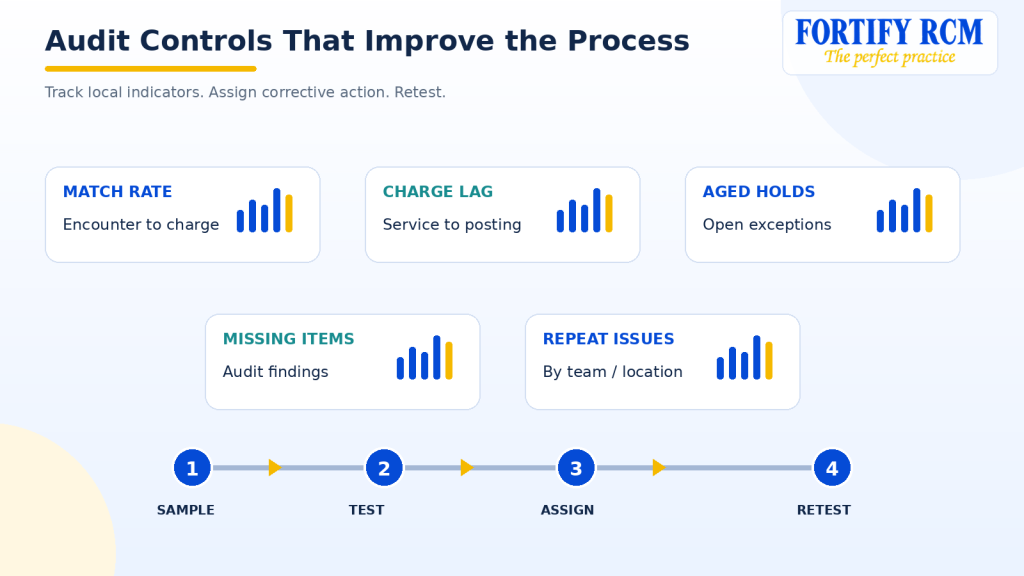
An audit tests completeness and accuracy. Completeness asks whether each in-scope service has a documented disposition. Accuracy asks whether the charge matches the patient, encounter, service, record, units, modifiers, and billing rules. Charge volume alone cannot prove complete medical billing charge capture.
Sample medical billing charge capture audit checklist
| Audit question | Evidence | Disposition |
|---|---|---|
| Does each encounter have a final status? | Schedule, note status | Resolve mismatch |
| Are procedures and ancillary services represented? | Orders, procedure / administration logs | Add only supported charges |
| Do charge details match the record? | Note, code, units, modifier, provider, date | Hold and clarify |
| Did the charge reach billing? | Interface log, batch report | Repair failed transfer |
| Are cancellations and old exceptions resolved? | Reversal history, queue aging | Correct and document |
Sample clinicians, locations, service lines, late charges, manual entries, and edited items. Record the period, method, findings, owner, due date, and retest.
Track match rate, charge lag, aged exceptions, missing-charge findings, corrections, interface failures, and repeat issues by department. Define numerator, denominator, exclusions, and reporting period; these are local controls, not universal benchmarks. Use the trends to improve medical billing charge capture. A medical billing charge capture review should recheck indicators after changes.
OIG third-party billing guidance discusses pre- and post-submission claim review, supporting documentation, provider communication, and corrective action. It is older compliance-program guidance, not a current payer rule. See the OIG compliance guidance for third-party medical billing companies. Align medical billing charge capture policies with staff education, periodic testing, and retesting.
| Finding | First response | Escalation |
|---|---|---|
| Missing documentation | Request clinician clarification | Clinical lead |
| Interface failure | Track affected batch; open IT incident | EHR / interface owner |
| Coding uncertainty | Hold for qualified review | Coding / compliance lead |
| Unsupported / duplicate charge | Approved reversal workflow | Revenue-integrity lead |
| Recurring department gap | Review process and training | Practice administrator |
Close the loop with the team that can fix the cause. An incomplete procedure log requires a clinical-workflow fix; dropped interface data requires a system fix. Effective medical billing charge capture assigns action where the failure originates.
Specialties We Serve
Workflows vary across behavioral health, therapy, chiropractic, home health, and physician practices because service records, units, and documentation differ. Fortify RCM supports providers with billing and revenue-cycle workflows, helping practices assess handoffs, claims readiness, and follow-up needs without replacing clinician documentation or coding judgment. For these teams, medical billing charge capture depends on reliable specialty-level handoffs.
Mental Health Providers
Credentialing and billing for psychologists, therapists, counselors, and social workers in private or group practice.
Nutritionists & Dietitians
Specialized RCM and credentialing support for MNT providers, licensed dietitians, and wellness nutritionists.
Occupational Therapists
End-to-end billing and enrollment services for pediatric and adult OT clinics and independent therapists.
Non-Emergency Medical Transportation (NEMT)
We handle Medicaid credentialing, EDI setup, and claims billing for NEMT providers.
Home Health Agencies
Complete RCM services tailored for HHAs including Medicare credentialing, OASIS billing, and claims management.
Skilled Nursing Facilities (SNFs)
Credentialing, billing, and AR support for SNFs—compliant with payer-specific guidelines and long-term care needs.
Applied Behavior Analysis (ABA)
We support ABA therapy providers with credentialing, insurance billing, authorization and appeals for denied behavioral health claims.
Chiropractors & Physical Therapists
Credentialing and billing help for musculoskeletal therapy, rehab clinics, and solo practitioners.
Durable Medical Equipment (DME) Providers
We handle Medicare/Medicaid credentialing, EDI setup, and claims submission for DME suppliers.
Nurse Practitioners & Physician Assistants
Complete credentialing and billing support for NPs & PAs operating independently or in group practices.
Dentists & Oral Health Providers
Support with dental insurance credentialing and claims processing for general dentists and specialists.
Vision & Eye Care Specialists
Credentialing and RCM services for optometrists, ophthalmologists, and vision therapy providers.
FAQs
1. What is medical billing charge capture?
It identifies services actually furnished, validates the supporting record, assigns charge information, and transfers the item into billing. It should account for completed, canceled, held, and corrected services.
2. What causes missed charges in a medical practice?
Common causes include incomplete notes, missing procedure or administration records, unposted ancillary services, interface failures, manual handoff gaps, duplicate accounts, and unresolved queues. Encounter-to-charge reconciliation helps locate the failure point.
3. How can a practice identify delayed charge entry?
Define charge lag consistently, then compare the date of service with the charge-posting or release date. Review average and median lag alongside aged exceptions and the percentage posted within the practice’s internal target.
4. Who should reconcile encounters and charges?
Appoint an operational owner, often a revenue-cycle or practice manager, while clinical, coding, billing, and IT teams resolve issues within their responsibilities. Do not assume another department checked the encounter.
5. How often should medical billing charge capture be reviewed?
Use daily reconciliation for active exceptions where feasible, supported by periodic risk-based audits. Medical billing charge capture frequency should be risk-based. Frequency should reflect service volume, specialty complexity, system design, and the practice’s risk assessment; there is no single universal frequency.
6. What records should a practice compare to identify missing charges?
A practice should compare appointment schedules, completed encounter records, clinical notes, procedure logs, orders, ancillary service records, and charges entered into the billing system. Medical billing charge capture reconciliation helps identify services that were performed but never transferred to billing. A consistent medical billing charge capture process should also document canceled, held, corrected, and completed services.
7. How should canceled or duplicate services be handled during charge capture?
Billing teams should verify the final service status using encounter records, procedure logs, and cancellation documentation. Charges for services that were not performed should not remain active for billing. Medical billing charge capture controls should identify duplicate entries and canceled services, assign corrections to authorized staff, and preserve an audit trail.
8. What should a medical billing charge capture audit evaluate?
An audit should evaluate encounter-to-charge matching, documentation completeness, code and modifier accuracy, units, interface transfers, unresolved exceptions, and charge posting delays. Medical billing charge capture audits should record findings, assign corrective actions, and retest recurring issues to strengthen revenue integrity.
Strengthen Your Charge Capture Workflow with Fortify RCM
Missed services and handoffs can obscure whether billing reflects delivered care. Fortify RCM can review the surrounding revenue-cycle workflow, including claims submission, payment posting, and reporting, and discuss where additional billing support may fit. Clinical records and coding remain under qualified professional oversight.
Start with a conversation about your current process, the systems your team uses, and the exceptions that remain open. Explore Fortify RCM’s revenue cycle management services or review Fortify RCM pricing and contact the team to discuss a workflow assessment. A dependable medical billing charge capture process starts with a clear map, reliable handoffs, and evidence that each in-scope service has a documented outcome. Fortify RCM can discuss how medical billing charge capture fits into the wider billing workflow.