
Healthcare practices do not need to manage every billing activity internally or outsource their entire revenue cycle. Hybrid revenue cycle outsourcing allows practices to divide responsibilities while retaining control over important decisions.
This guide explains which RCM tasks to keep in-house, which to outsource, and how to manage vendor responsibilities, privacy, and operational handoffs.
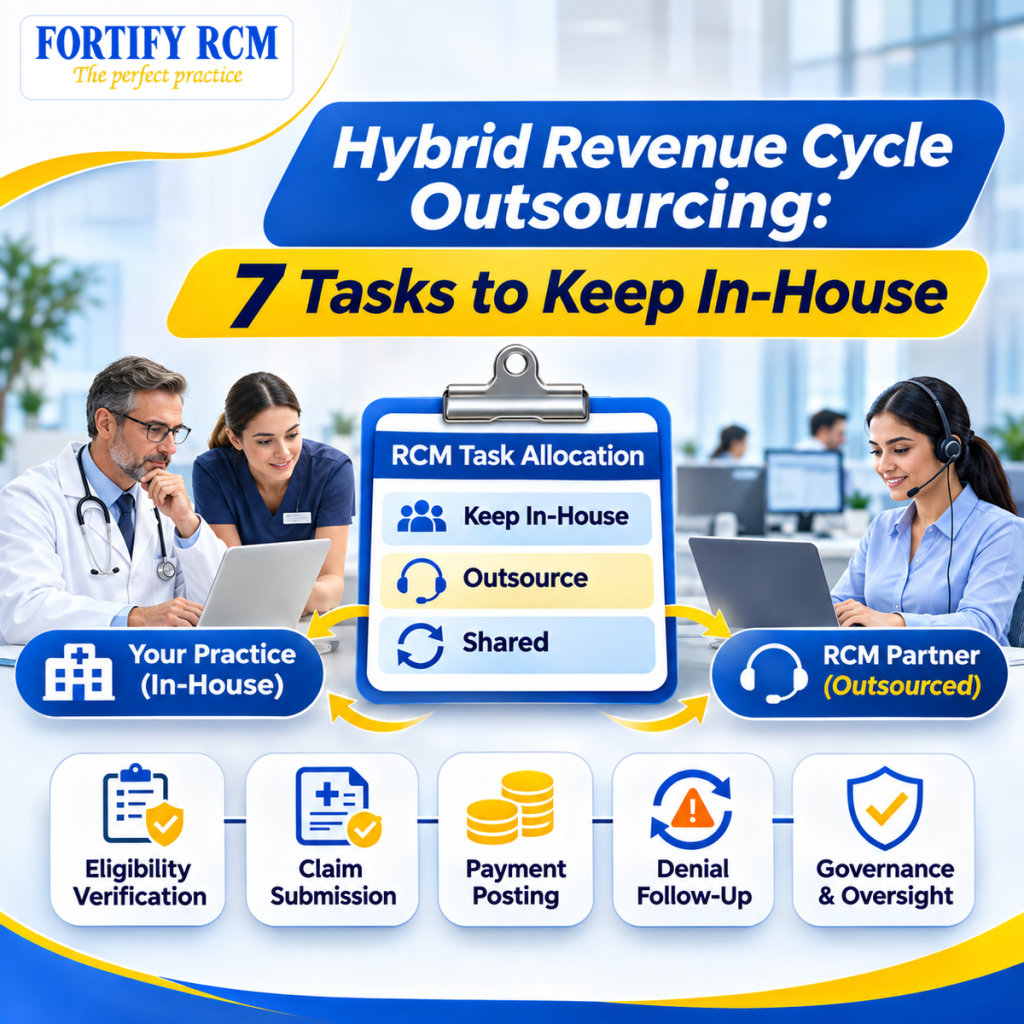
Define Hybrid Outsourcing
An in-house model assigns daily revenue-cycle work to practice employees. A fully outsourced model gives a contracted scope to an external RCM partner. Hybrid revenue cycle outsourcing divides selected activities between the practice and the partner by task, payer, location, specialty, or queue.
Hybrid revenue cycle outsourcing is an operating design, not simply sending claims to a third party. It needs named owners, documented handoffs, role-based access, service expectations, and escalation routes. A behavioral health group might retain scheduling, clinical documentation, patient conversations, and final account decisions while assigning eligibility checks, claim submission, payment posting, and selected payer follow-up to a partner.
Choose hybrid revenue cycle outsourcing based on staffing, specialty, payer mix, volume, software, risk, and patient-contact needs. This hybrid medical billing model still needs one named owner for each handoff. Keep clinical context, sensitive communication, and practice approval authority clearly assigned.
Use three categories:
-
Retain: practice authority, clinical context, patient knowledge, or direct control.
-
Delegate: repeatable work a partner can complete to a documented standard.
-
Share: one team prepares or investigates while the other reviews or approves.
This makes hybrid revenue cycle outsourcing easier to scope and measure. Hybrid revenue cycle outsourcing must preserve decision ownership.
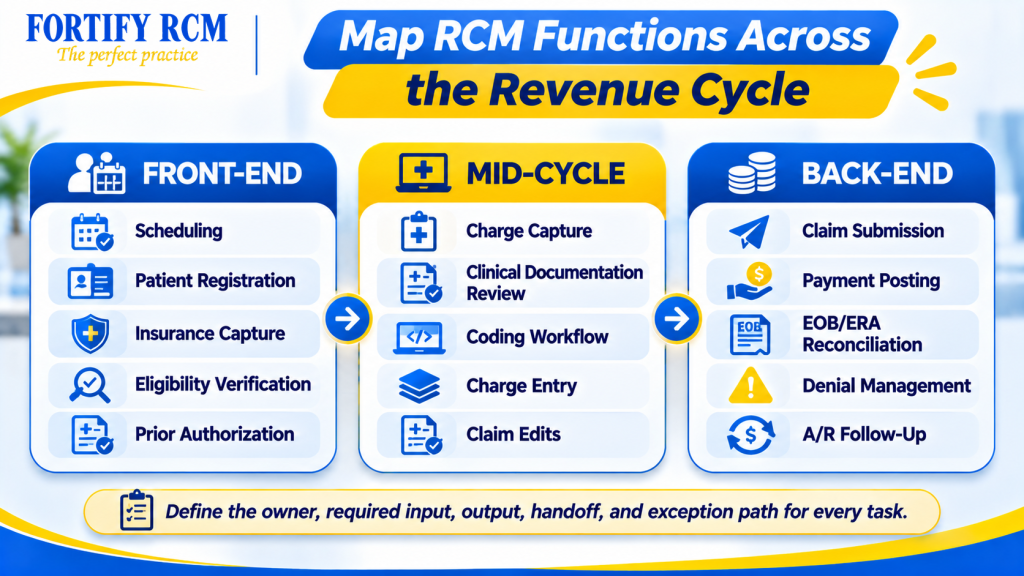
Map RCM Functions Across the Revenue Cycle
Map hybrid revenue cycle outsourcing work from patient intake to final account resolution. For each task, record its trigger, required information, system, output, next recipient, and exception owner. Do not transfer an activity while its inputs or approvals remain undefined. Hybrid revenue cycle outsourcing should follow mapped handoffs.
| Stage | Common activities | Boundary |
|---|---|---|
| Front-end | Scheduling, registration, insurance capture, eligibility, authorization, estimates | Practice owns patient policies and clinical decisions |
| Mid-cycle | Charge review, coding, documentation queries, charge entry, claim edits | Clinical content and provider attestations need authorized input |
| Back-end | Claims, payment posting, EOB/ERA reconciliation, denials, A/R follow-up | Define queue ownership, approval, and closure |
These are planning categories, not fixed job descriptions. The map keeps hybrid revenue cycle outsourcing grounded in actual work. Small offices may combine roles; larger groups may centralize some queues but retain patient financial conversations locally.
Trace one encounter from registration and eligibility through clinical documentation, claim submission, posting, and A/R follow-up. Each handoff needs a sender, recipient, due time, required data, and acknowledgement.
A hybrid revenue cycle outsourcing plan must state where the partner starts and stops. A vendor may verify benefits but route clinical questions to staff, or post routine payments while the practice approves unusual adjustments. Fortify RCM lists these functions in its Revenue Cycle Management Workflow. Confirm inclusions and exclusions in your agreement.
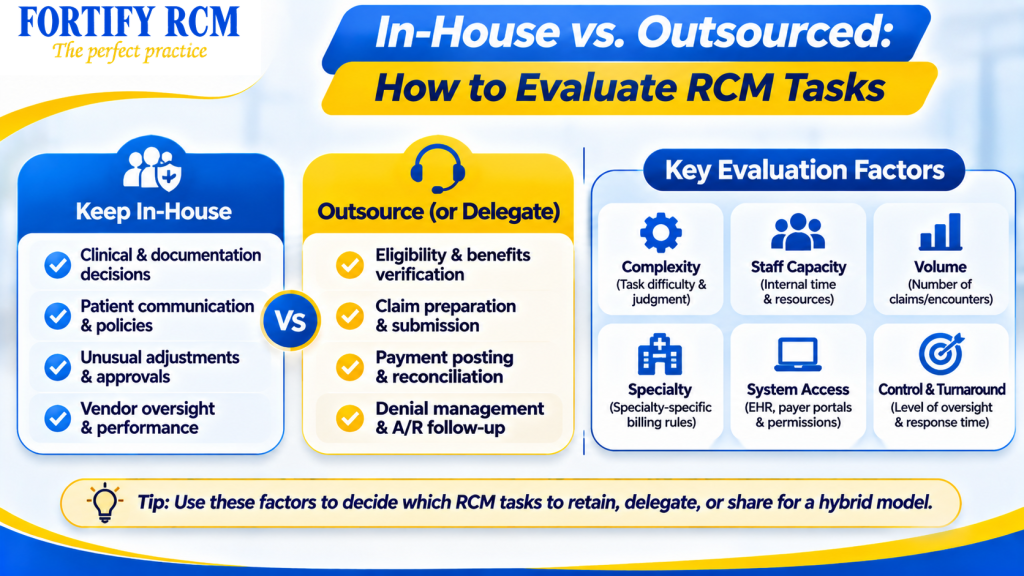
Evaluate Which Tasks Fit In-House or Outsourced Delivery
Do not select tasks on labor cost alone. Assess outsourced RCM tasks one by one instead of assuming one package fits every practice. Evaluate each activity consistently and document why it belongs with the practice, a partner, or both. Hybrid revenue cycle outsourcing should follow operational needs, not assumptions.
| Factor | Question | Possible implication |
|---|---|---|
| Complexity | Does it require specialty expertise or judgment? | Retain decisions; outsource standard steps with review |
| Capacity and volume | Is trained staff time available? | Partner support may address backlogs |
| Specialty | Are documentation or authorization rules distinct? | Use trained specialists or an internal reviewer |
| System access | Can approved EHR and payer permissions be used? | Restrict access by role |
| Patient contact | Does it involve sensitive discussions or policy decisions? | Keep practice authority |
| Turnaround | Does another team need to act quickly? | Define handoff and escalation times |
Rate factors low, medium, or high; this score is a planning aid. A high-volume eligibility queue may suit external execution with approved access and prompt exception handling. Sensitive patient-balance discussions may belong with practice staff. The “in house outsourced billing” split must name each task owner.
For example, a clinic may retain registration, documentation review, patient questions, and unusual adjustment approval while assigning routine posting and defined payer follow-up to a partner. Test remittance access and unmatched-payment escalation before transfer. This is a limited hybrid revenue cycle outsourcing scope.
For provider enrollment, a partner may track records, but the practice should control attestations. See the CMS provider enrollment guide.
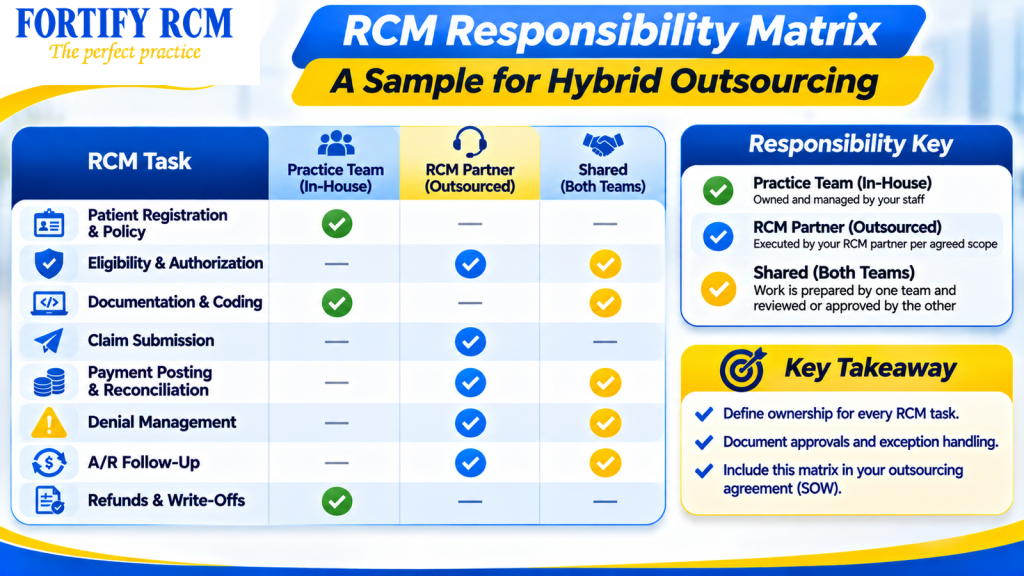
Build a Responsibility Matrix Before Work Moves
A responsibility matrix converts a service description into an operating agreement. A partial RCM outsourcing plan should begin with clear task boundaries. Hybrid revenue cycle outsourcing depends on this division of work. RCM task allocation belongs in the statement of work. Name each task’s performer, decision owner, contributors, and recipients before granting access.
| RCM task | Practice team | RCM partner | Control |
|---|---|---|---|
| Registration and patient policy | Owns policy and corrections | Only if contracted | Practice retains policy authority |
| Eligibility and authorization | Supplies patient or clinical details | Performs assigned checks | Define timing and exceptions |
| Documentation and coding | Owns clinical content and policy | May flag gaps or conduct agreed review | Route queries to authorized staff |
| Claim submission | Approves provider data and exceptions | Prepares and submits within scope | Set release rules |
| Posting and reconciliation | Approves unusual adjustments | Posts and reports variances | Define balancing rules |
| Denial and A/R follow-up | Supplies records; reviews escalations | Works assigned inventory | Set deadlines and closure evidence |
| Refunds and write-offs | Retains approval authority | Investigates if contracted | Require approval record |
Performing work is not the same as owning a decision. The matrix makes hybrid revenue cycle outsourcing auditable. A vendor may prepare a claim or recommend an adjustment while the practice retains approval for exceptions. Put the matrix in the statement of work. Avoid “full billing support” unless the agreement lists included tasks, exclusions, payer and specialty scope, volume assumptions, reports, escalation, and change-request rules. Hybrid revenue cycle outsourcing should be clear enough for a new employee to route each item correctly.
Establish Governance, Privacy, and Handoffs
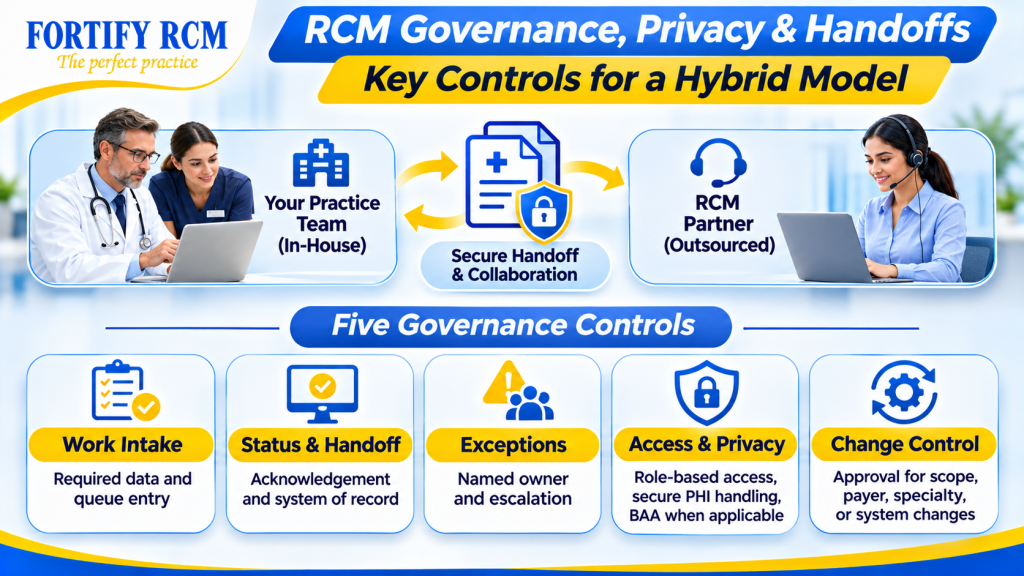
Handoffs can delay work or leave it unowned. The medical billing hybrid model should preserve patient-facing controls. Name operational, vendor, clinical-escalation, privacy, and scope-change owners, plus backups. Hybrid revenue cycle outsourcing requires documented access boundaries and an urgent escalation route.
Document five controls:
-
Work intake: queue entry requirements and return of incomplete items.
-
Status and handoff: system of record, status definitions, and acknowledgement.
-
Exceptions: owners for payer disputes, missing records, and unusual adjustments.
-
Access management: who approves, reviews, changes, and removes access.
-
Change control: approval for new specialties, payers, systems, tasks, or volume.
Review privacy before an external team receives protected health information (PHI). HHS explains that a service involving PHI performed for a covered entity may create a business associate relationship; billing and practice management are examples. Where the definition applies, a written business associate agreement is generally required. See HHS Business Associate guidance and HIPAA guidance for professionals. A software supplier without PHI access is not automatically a business associate.
The agreement should cover permitted uses, safeguards, incidents, subcontractors, PHI return or destruction when required, and termination. Hybrid revenue cycle outsourcing governance must include privacy. Confirm access, training, secure transmission, audit logs, and incident escalation. Review inventory, aging, rework, exceptions, system changes, and overdue actions regularly. Hybrid revenue cycle outsourcing governance must assign an owner and due date to each issue.
Pilot the Model, Measure Results, and Scale Carefully
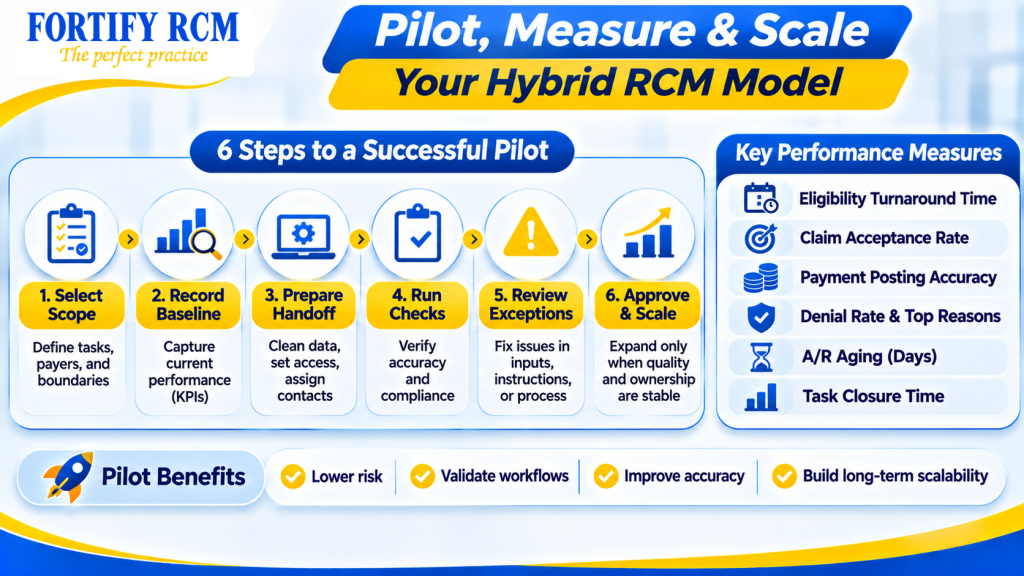
Start with one payer group, location, specialty, or defined queue rather than moving a large part of the revenue cycle at once. Record current inventory, exceptions, and measures before work moves. A pilot tests hybrid revenue cycle outsourcing in a limited setting.
Use six steps:
-
Select scope: define the task, inputs, outputs, and boundaries.
-
Record baseline: volume, aging, turnaround, rework, and internal time.
-
Prepare handoff: clean the worklist, confirm data fields, set role-based access, and name contacts.
-
Run checks: sample completed work against the expected result.
-
Review exceptions: identify input, instruction, system, training, or allocation gaps.
-
Approve or adjust: expand only when quality and ownership are stable.
Track measures suited to the task: timely eligibility, avoidable claim rework, posting accuracy, aged work, denial categories, and task closure time. Define each metric’s numerator, denominator, source, period, and exclusions. Hybrid revenue cycle outsourcing pilots need baseline comparisons, not changing definitions.
HFMA’s MAP Keys provide standardized revenue-cycle KPIs across patient access, pre-billing, claims, account resolution, and financial management. The AMA practice-management resource hub can inform broader operations. For related RCM topics, see Fortify RCM Blogs. Use relevant definitions and avoid inventing benchmarks.
Retained-vs-Outsourced Task Worksheet
| Task | Current owner | Proposed owner | Input / evidence |
|---|---|---|---|
| Eligibility | ____ | ____ | Patient / payer; completion log |
| Coding | ____ | ____ | Documentation; audit |
| Claims | ____ | ____ | Approved charges; acceptance |
| Posting | ____ | ____ | ERA/EOB; reconciliation |
| Denials | ____ | ____ | Remittance; appeal status |
| A/R | ____ | ____ | Claim history; next action |
Scope Questions to Ask Before Signing
-
Which tasks, payers, specialties, and locations are in scope or excluded?
-
Who supplies data and when?
-
Who approves claims, adjustments, and appeals?
-
How are PHI access and incidents handled?
-
Who receives reports and owns open inventory at termination?
Scale only when work moves reliably between teams. If results are mixed, revise handoffs first. Hybrid revenue cycle outsourcing should grow with the practice, not create unclear queues.
Specialties We Serve
Hybrid RCM arrangements can suit physician groups, behavioral health and ABA practices, therapy clinics, and home health agencies. Specialty context should guide hybrid revenue cycle outsourcing scope and the tasks delegated.
Mental Health Providers
Credentialing and billing for psychologists, therapists, counselors, and social workers in private or group practice.
Nutritionists & Dietitians
Specialized RCM and credentialing support for MNT providers, licensed dietitians, and wellness nutritionists.
Occupational Therapists
End-to-end billing and enrollment services for pediatric and adult OT clinics and independent therapists.
Non-Emergency Medical Transportation (NEMT)
We handle Medicaid credentialing, EDI setup, and claims billing for NEMT providers.
Home Health Agencies
Complete RCM services tailored for HHAs including Medicare credentialing, OASIS billing, and claims management.
Skilled Nursing Facilities (SNFs)
Credentialing, billing, and AR support for SNFs—compliant with payer-specific guidelines and long-term care needs.
Applied Behavior Analysis (ABA)
We support ABA therapy providers with credentialing, insurance billing, authorization and appeals for denied behavioral health claims.
Chiropractors & Physical Therapists
Credentialing and billing help for musculoskeletal therapy, rehab clinics, and solo practitioners.
Durable Medical Equipment (DME) Providers
We handle Medicare/Medicaid credentialing, EDI setup, and claims submission for DME suppliers.
Nurse Practitioners & Physician Assistants
Complete credentialing and billing support for NPs & PAs operating independently or in group practices.
Dentists & Oral Health Providers
Support with dental insurance credentialing and claims processing for general dentists and specialists.
Vision & Eye Care Specialists
Credentialing and RCM services for optometrists, ophthalmologists, and vision therapy providers.
Frequently Asked Questions
1. What is hybrid RCM outsourcing?
It is a model where a practice retains selected revenue-cycle responsibilities and assigns defined activities to an external RCM partner under a written scope. Hybrid revenue cycle outsourcing is not the same as transferring every responsibility.
2. Which revenue-cycle tasks can be outsourced selectively?
Depending on the agreement, a partner may perform eligibility checks, claims, posting, denial categorization, payer follow-up, or assigned A/R work. Those are common hybrid revenue cycle outsourcing workstreams. Clinical decisions and approvals need explicit owners.
3. What should a practice keep in-house?
Practices commonly retain clinical documentation, patient policies, sensitive conversations, unusual adjustment approvals, access authorization, and vendor oversight.
4. How should a hybrid arrangement be governed?
Use a written scope, responsibility matrix, named contacts, access controls, performance measures, and exception reviews. Address a business associate agreement when HIPAA requires one.
5. Can a vendor work alongside internal billers?
Yes. Divide work by task, queue, payer, or stage; identify the system of record; and give every task one primary owner. This is the operational discipline behind hybrid revenue cycle outsourcing.
6. How Often Should a Practice Review Hybrid RCM Vendor Performance?
Practices should establish a regular performance-review schedule based on claim volume, service scope, and operational risk. Monthly reviews can examine claim acceptance, payment posting accuracy, denial trends, A/R aging, turnaround times, and unresolved exceptions. Hybrid revenue cycle outsourcing works best when both teams review performance reports, assign corrective actions, and document progress against agreed service expectations.
7. What Should Be Included in a Hybrid Revenue Cycle Outsourcing Agreement?
A hybrid revenue cycle outsourcing agreement should clearly define task responsibilities, service scope, turnaround expectations, reporting requirements, data access, HIPAA obligations, escalation procedures, and performance measures. It should also explain which activities remain under the practice’s control and which are handled by the external RCM partner. A detailed agreement helps prevent responsibility gaps, improve accountability, and maintain consistent billing operations.
8. How Can Small Healthcare Practices Benefit From Hybrid Revenue Cycle Outsourcing?
Small healthcare practices can use hybrid revenue cycle outsourcing to access external billing support without giving up control of important internal operations. They can retain patient communication, clinical documentation, and financial approvals while delegating eligibility verification, claim submission, payment posting, and A/R follow-up. This approach helps practices manage limited staffing capacity, improve workflow coverage, and maintain oversight of essential revenue-cycle activities.
Build an RCM Model Around Your Practice
Hybrid revenue cycle outsourcing should fit your workload, specialty, systems, and control requirements. A scoped hybrid revenue cycle outsourcing model is not one-size-fits-all. Identify what stays internal, what can be delegated, and where both teams need a documented handoff. Hybrid revenue cycle outsourcing needs a written scope, measurable expectations, privacy safeguards, and a clear exception process.
Fortify RCM supports eligibility verification, claims submission, payment posting, denial management, and A/R follow-up. Review the Fortify RCM Services Overview to understand available support areas. Compare the scope with Fortify RCM Pricing and your task inventory.
Before discussing a partial transition, prepare your workflow, payer mix, specialty requirements, and retained-vs-outsourced matrix. A practice-specific hybrid revenue cycle outsourcing scope is the goal. Contact the Team to discuss which activities may fit external support and which responsibilities should remain with your staff.