
Physician practices may consider outsourcing when billing competes with patient care, payer follow-up slips, or claim volume exceeds internal capacity. A partner can take on defined administrative work, but it does not transfer every responsibility or guarantee faster payment. Before you outsource physician billing services, assess scope, privacy, pricing, performance, and exit terms.

When Should a Physician Practice Consider Outsourcing Billing?
Consider outsourcing when claims queue up, rejections remain unresolved, aged A/R grows, payer follow-up lacks visibility, or staffing cannot support a larger provider roster—not simply because a vendor promises better results.
Identify the bottleneck first: staffing, training, technology, incomplete documentation, late charge approval, or unclear ownership. A vendor cannot fix missing clinical documentation or replace provider oversight. The practice must retain responsibility for accurate records and timely answers to queries.
Decide which tasks should move, which should remain in-house, and who handles exceptions. Some practices need broad support; others need only claim submission, payment posting, denial follow-up, or A/R assistance.
For practices at this stage, outsource physician billing services only after documenting the bottleneck and deciding how the partner will be measured.
What Should a Physician Billing Service Include?
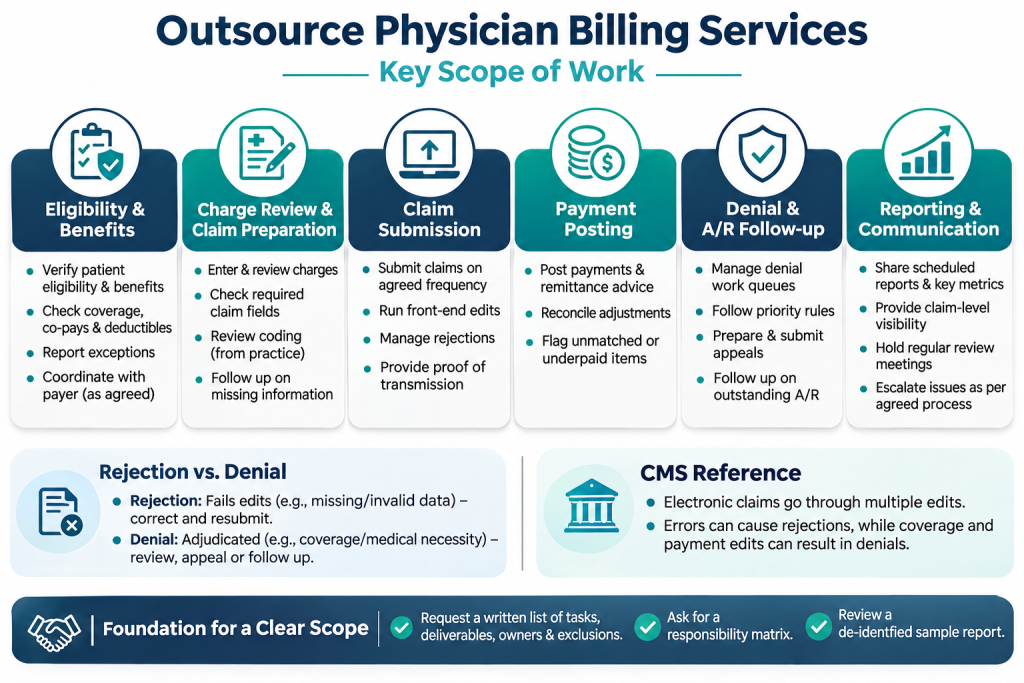
“Billing support” can mean different things. Require a written list of tasks, deliverables, owners, and exclusions. Scope may include:
Eligibility and benefits: When checks occur, what is verified, how exceptions are reported, and who contacts the payer. Eligibility information is not a guarantee of coverage or payment.
Charge review and claim preparation: Who enters charges, checks required fields, reviews coding supplied by the practice, and follows up on missing information. Define who owns clinical documentation and coding decisions.
Claim submission: Submission frequency, clearinghouse arrangements, front-end edits, rejection queues, and proof of transmission.
Payment posting: How remittance advice and payments are posted, adjustments reconciled, and unmatched or underpaid items flagged.
Denial and A/R follow-up: Work queues, priority rules, appeal ownership, filing deadlines, and information the practice must provide.
Reporting and communication: Report frequency, agreed metrics, meeting cadence, escalation contacts, and access to claim-level detail.
CMS explains that electronic claims pass through multiple edits. Errors may cause batch or individual-claim rejections, while coverage and payment edits may result in denials. Ask how the vendor separates a rejection from an adjudicated denial and assigns the next action. See the CMS guide to electronic health care claims and Fortify RCM’s claims submission and payment posting service.
A clear scope is the foundation when you outsource physician billing services because it prevents assumptions about who owns each task. Do not accept “we handle everything” as a scope description. Request a responsibility matrix and a de-identified sample report.
7 Critical Checks Before You Choose a Billing Partner
Use these checks to compare proposals before you outsource physician billing services; request written answers rather than relying on sales-call assurances.
1. Physician-specialty and payer experience. Before you outsource physician billing services, ask which specialties and payer types the team supports today. Request examples of workflows—not confidential client records—and ask how it handles specialty-specific documentation, modifiers, authorization requirements, and payer edits. Experience in one specialty does not prove expertise in another.
2. A precise scope of work. Practices that outsource physician billing services should compare proposals line by line. Check whether eligibility, charge entry, coding review, claim submission, rejection correction, denial work, appeals, payment posting, patient statements, and old A/R are included. Identify exclusions, volume limits, and separately billed work.
3. Privacy and security safeguards. When you outsource physician billing services, ask about role-based access, workforce training, secure data transfer, monitoring, incident response, subcontractors, and data return. If a vendor creates, receives, maintains, or transmits protected health information on the practice’s behalf and meets the HIPAA business-associate definition, an appropriate written business associate agreement (BAA) is generally required.
Review HHS guidance on covered entities and business associates, sample BAA provisions, and the HHS Security Rule summary. A BAA is important, but it does not replace vendor due diligence.
4. Transparent pricing. If you outsource physician billing services, understand whether fees are based on a percentage of collections, a flat monthly amount, per-claim charges, or a combination. Ask what counts as collections and whether patient payments, refunds, recoupments, setup, software, clearinghouse, minimum-volume, historical A/R, and termination charges are included. Compare the total cost for the same scope—not only the headline rate. Put the pricing formula in the agreement.
5. Useful performance reporting. Teams that outsource physician billing services need a sample dashboard and defined metrics before launch. Measures may include claims submitted, first-pass acceptance, rejections, denials, days in A/R, A/R aging, posting lag, appeal status, and unresolved work by owner. Agree on the formula, data source, reporting period, and exclusions. A metric without a definition can mislead.
6. Technology and workflow compatibility. Before you outsource physician billing services, confirm compatibility with your practice management system, EHR, clearinghouse, and payer portals. Clarify who creates user accounts, approves access, transfers files, and responds to interface failures. Medicare electronic transactions may require provider EDI enrollment and authorization even when a billing service is involved. Review CMS instructions for Medicare EDI enrollment.
7. Accountability and exit terms. A practice that chooses to outsource physician billing services must have clear operational contacts, response expectations, escalation paths, service measures, and review cadence in the contract. It should also cover termination notice, transition support, final reports, data return or destruction, access removal, and ownership of open claims and appeals. A partner should explain how work will be handed back without leaving pending items untracked.
In-House, Outsourced, or Hybrid: Which Model Fits?
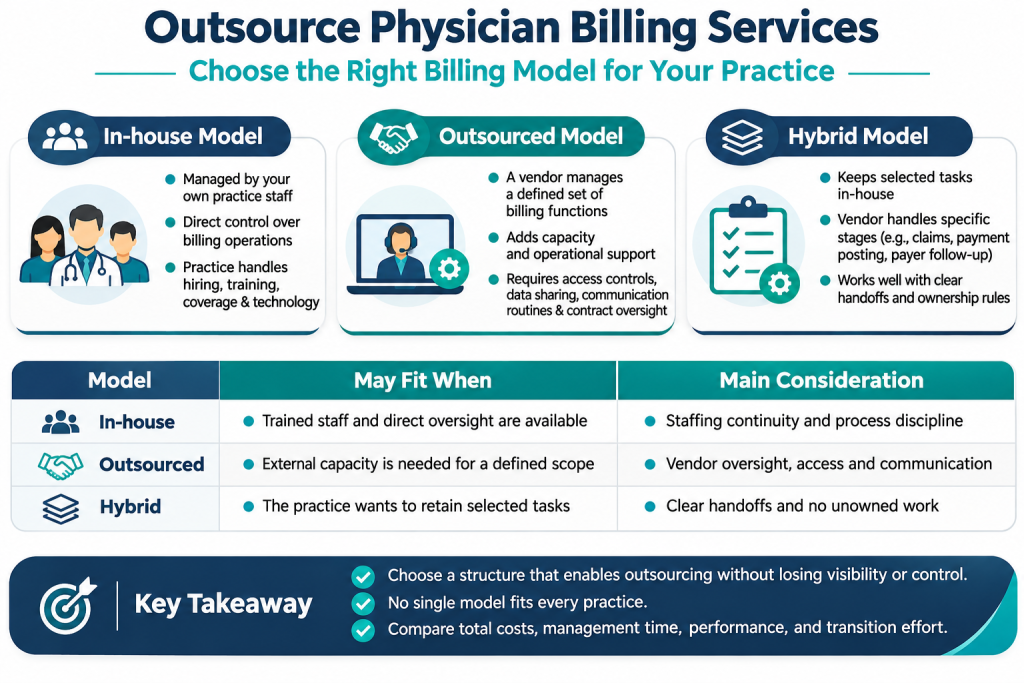
An in-house team may fit a practice with stable staffing, reliable systems, and management capacity to supervise billing. It offers direct control, but recruitment, training, coverage, and technology remain the practice’s responsibility.
A fully outsourced model may suit a practice that wants a vendor to manage a defined set of billing functions. It can add capacity, but it requires strong access controls, data-sharing procedures, communication routines, and contract oversight. Outsourcing does not remove the provider’s responsibility for documentation, coding oversight, or authorized access to patient information.
A hybrid model keeps selected tasks inside the practice while a partner handles specific stages. For example, staff may retain charge capture and clinical queries while the vendor handles claim submission, payment posting, and payer follow-up. This can be a measured way to outsource physician billing services, provided handoffs and ownership rules are clear.
| Model | May fit when | Main consideration |
|---|---|---|
| In-house | Trained staff and direct oversight are available | Staffing continuity and process discipline |
| Outsourced | External capacity is needed for a defined scope | Vendor oversight, access, and communication |
| Hybrid | The practice wants to retain selected tasks | Clear handoffs and no unowned work |
The best structure is the one that makes it possible to outsource physician billing services without losing visibility or control over exceptions. No model is best for every practice. Compare total costs, management time, performance, and transition effort.
How to Plan a Controlled Transition
Treat implementation as a project with owners, dates, and acceptance checks. Test the workflow and prepare a fallback before moving every queue.
Step 1: Establish a baseline. Record claim volume, rejection and denial categories, A/R aging, posting lag, open appeals, and payer requests. Use consistent definitions for later comparisons.
Step 2: Inventory open work. List submitted and pending claims, rejections, denials, appeals, credit balances, payer requests, and filing deadlines. Assign an owner to every item. Confirm whether historical A/R is included in the fee.
Step 3: Confirm access and permissions. Approve named users, least-privilege access, secure transfer methods, and required payer or Medicare authorizations. Avoid shared logins. Decide how access will be removed when a worker or subcontractor leaves.
Step 4: Test before go-live. Run a limited batch or representative workflow. Check claim data, acknowledgments, work queues, payment posting, reports, and escalation contacts. Record defects and assign owners before increasing volume.
Step 5: Review the first operating cycle. Hold regular check-ins. Review exceptions, unresolved claims, missing information, and report accuracy. Adjust the workflow based on evidence rather than assuming implementation is complete on launch day.
A staged handover helps practices outsource physician billing services while maintaining continuity for claims already in progress. Keep a transition register showing each task, owner, due date, status, dependency, and completion evidence. This helps prevent claims or appeals from being lost between teams.
How to Measure Performance After Go-Live
Build the scorecard before you outsource physician billing services so the vendor and practice agree on what success means.
Use a scorecard that connects activity to outcomes. Do not rely on one headline measure, such as collections percentage. Results are influenced by payer mix, service mix, patient responsibility, contract rates, claim volume, and timing—not only billing operations.
Track a practical scorecard:
Submission timeliness: Time from complete, approved charges to claim submission.
Front-end rejection rate: Share of claims returned before adjudication, grouped by reason and correction owner.
Denial rate and resolution: The agreed definition, denial reasons, appeal status, and outcomes by payer or service line.
A/R aging: Unpaid balances grouped by age, with high-value and deadline-sensitive items highlighted.
Payment posting timeliness: Time from remittance or payment receipt to accurate posting and reconciliation.
Open-work inventory: Claims, appeals, payer requests, and exceptions still unresolved, with named owners.
Agree on the data source and calculation method before comparing periods. Review trends with operational context: changes in payer mix or provider volume can affect results. The goal of outsourcing physician billing services should be controlled work and better visibility—not a guaranteed collection rate or payment date.
Specialties We Serve
Our outsource physician billing services support a wide range of healthcare specialties by streamlining medical billing, improving claim accuracy, reducing denials, and optimizing revenue cycle performance. We understand that every medical specialty has unique coding requirements, payer guidelines, and reimbursement challenges. Our billing solutions are tailored to help healthcare providers maintain efficient billing operations, accelerate reimbursements, and improve financial performance while allowing physicians to focus on delivering quality patient care.
Mental Health Providers
Credentialing and billing for psychologists, therapists, counselors, and social workers in private or group practice.
Nutritionists & Dietitians
Specialized RCM and credentialing support for MNT providers, licensed dietitians, and wellness nutritionists.
Occupational Therapists
End-to-end billing and enrollment services for pediatric and adult OT clinics and independent therapists.
Non-Emergency Medical Transportation (NEMT)
We handle Medicaid credentialing, EDI setup, and claims billing for NEMT providers.
Home Health Agencies
Complete RCM services tailored for HHAs including Medicare credentialing, OASIS billing, and claims management.
Skilled Nursing Facilities (SNFs)
Credentialing, billing, and AR support for SNFs—compliant with payer-specific guidelines and long-term care needs.
Applied Behavior Analysis (ABA)
We support ABA therapy providers with credentialing, insurance billing, authorization and appeals for denied behavioral health claims.
Chiropractors & Physical Therapists
Credentialing and billing help for musculoskeletal therapy, rehab clinics, and solo practitioners.
Durable Medical Equipment (DME) Providers
We handle Medicare/Medicaid credentialing, EDI setup, and claims submission for DME suppliers.
Nurse Practitioners & Physician Assistants
Complete credentialing and billing support for NPs & PAs operating independently or in group practices.
Dentists & Oral Health Providers
Support with dental insurance credentialing and claims processing for general dentists and specialists.
Vision & Eye Care Specialists
Credentialing and RCM services for optometrists, ophthalmologists, and vision therapy providers.
FAQs
1. What does it mean to outsource physician billing services?
It means engaging an external partner to perform agreed revenue-cycle tasks, such as claim preparation, submission, payment posting, rejection correction, denial follow-up, or A/R work. The contract defines the scope. The practice retains responsibility for clinical documentation, provider oversight, and approving access to its information.
2. Can a practice outsource only part of its billing workflow?
Yes. A practice may outsource selected functions, such as claim submission or payer follow-up, while retaining charge capture, coding oversight, patient communication, or other tasks internally. Define each handoff and name the team responsible for exceptions.
3. Does outsourcing guarantee fewer denials or faster payments?
No. A vendor can organize work, but payer decisions depend on coverage, documentation, coding, eligibility, authorization, and timely filing. Request transparent reporting, not reimbursement guarantees.
4. What should we check before sharing patient information with a billing company?
Review access controls, security policies, workforce training, incident response, subcontractor arrangements, and data-return procedures. Where the vendor is a HIPAA business associate, put an appropriate BAA in place and define permitted uses and safeguards. Have your privacy or compliance lead review the arrangement.
5. Does a billing company need Medicare EDI authorization?
Medicare EDI requirements can apply when a provider uses a billing service or clearinghouse. CMS instructs providers to complete applicable enrollment and authorization steps. Confirm the current process with the relevant Medicare Administrative Contractor and document which transactions the third party may handle.
6. How should we compare billing service prices?
Compare identical scope, provider count, claim volume, payer mix, and A/R duties. Identify percentage bases, flat fees, minimums, add-ons, setup, and termination charges. Ask for a written example using your proposed agreement.
7. How long does implementation take?
Implementation time depends on practice size, billing complexity, and system integration. When you outsource physician billing services, onboarding includes workflow setup, data access, staff coordination, and claim testing to ensure a smooth transition.
Ready to Evaluate Your Billing Workflow?
A careful review helps you outsource physician billing services for the right reasons, with defined responsibilities and measurable expectations.
Before making a decision, map the work causing the most pressure, decide what should remain with your team, and prepare questions about scope, security, pricing, reporting, and transition support.
Fortify RCM states that its RCM offering includes eligibility and benefits verification, claims submission, payment posting, denial management, EDI/ERA/EFT setup, insurance follow-up, and monthly performance reporting. Its published pricing page describes its current RCM model and inclusions. Review the live page and confirm the terms that apply to your practice before relying on any figure.
Share your specialty, provider count, systems, payer mix, and the tasks you may want to move. Contact Fortify RCM to discuss scope and fit. The objective is not to outsource everything by default; it is to create a clear, accountable billing process that your practice can monitor.