
Understanding credentialing services pricing is not as simple as comparing two numbers on a proposal. One company may charge per provider and per payer, while another may offer a bundled package, a monthly maintenance plan, or a project-based quote. The service scope can also differ: application preparation, CAQH support, payer follow-up, group enrollment, contracting assistance, and recredentialing may or may not be included.
This guide explains seven practical factors that influence credentialing services pricing, shows how to compare two quotes on equal terms, and identifies questions to resolve before signing. It is written for US healthcare practices evaluating credentialing support—not as a claim that one price fits every provider, specialty, payer, or state.

Why Credentialing Quotes Are Not Always Apples-to-Apples
A credentialing quote is only meaningful when you know exactly what work it covers. A fee for preparing one application is not directly comparable with a package that includes provider data collection, application submission, payer follow-up, recredentialing reminders, and account reporting. Before evaluating credentialing services pricing, define the work your practice expects the vendor to perform. Use that scope map as the basis for comparing credentialing services pricing rather than relying on an advertised starting figure.
The total cost may depend on the number of providers, the number and type of payers, practice locations, provider specialties, organizational structure, and whether the engagement covers initial enrollment or ongoing maintenance. A new practice with multiple locations may require a different workload from an established solo provider adding one commercial payer.
Ask each company to quote the same assumptions: provider count, payer list, state and location count, group or individual enrollment needs, and the exact tasks required. This gives you a more useful comparison of credentialing services pricing than a headline fee alone. Searches such as physician credentialing services cost, cost of credentialing with insurance companies, provider credentialing services cost, and insurance credentialing services cost reflect similar buyer questions, but the answer still depends on the scope being purchased.
The phrase “full-service credentialing” is not a standardized package. One vendor may include CAQH profile support but charge separately for payer follow-up; another may include follow-up but exclude contract review or ongoing demographic updates. Get the scope in writing before you compare the credentialing services pricing.
7 Pricing Factors to Check Before Signing
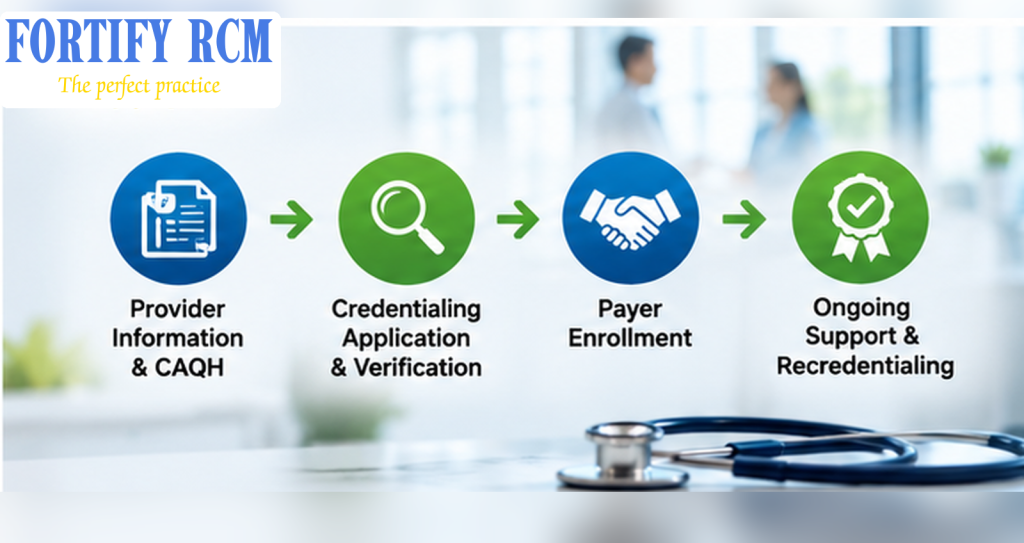
The seven factors below help explain why credentialing services pricing can vary between vendors and between practices. Use the same questions for every proposal so the comparison reflects actual deliverables, not just the first number presented.
1. Per-Provider, Per-Payer, or Bundled Pricing
First, identify the unit used to calculate the fee. Some companies charge per provider, per payer application, per location, or per project. Others combine multiple services into a package or charge a recurring monthly fee. The best way to understand credentialing services pricing is to ask for the total cost for your actual roster and payer list.
A per-payer model can be easier to forecast when a practice needs a small number of specific enrollments. A per-provider package may be easier to administer when several payers must be handled for each clinician. A bundled arrangement may suit a group that needs ongoing support, but only if the agreement defines the covered provider and payer volume. Your actual credentialing services pricing should be calculated against that exact volume.
Ask what happens when a provider is added, a new payer is requested, a clinician changes locations, or an application must be corrected. Confirm whether each event triggers a new fee. Do not assume a quoted “per provider” price includes every payer or every practice location. These details can change the real credentialing services pricing substantially.
2. Initial Applications Versus Maintenance and Recredentialing
Initial credentialing and payer enrollment are usually project-based tasks, while maintenance can continue after the initial application. A quote may cover the first submission but exclude recredentialing, reattestation reminders, license-expiration monitoring, demographic updates, or changes to a provider’s group affiliation.
Ask whether maintenance is billed per event, per payer, per provider, or through a recurring fee. Establish whether the vendor will track renewal dates, prepare updated records, contact the provider for missing documents, and submit required changes—or simply notify your team that action is due. These distinctions matter when comparing credentialing services pricing over a full year rather than only at onboarding. Ask the vendor to show the ongoing maintenance charges separately so you can compare the complete credentialing services pricing.
Medicare revalidation is a separate program requirement and should not be confused with every commercial payer’s recredentialing cycle. CMS says Medicare providers and suppliers generally revalidate every five years, while DMEPOS suppliers generally revalidate every three years; CMS may also request an off-cycle revalidation. Check the current CMS revalidation guidance and ask the vendor to state exactly which maintenance activities are included.
3. CAQH Profile Setup, Attestation, and Updates
CAQH-related support can be part of the service fee or listed as a separate line item. Ask whether the vendor will create or help update a provider profile, organize supporting documents, monitor attestation dates, obtain the provider’s authorization for participating organizations, and make corrections when information changes. These administrative tasks should be visible in the credentialing services pricing breakdown.
Do not confuse a portal’s provider access fee with a vendor’s administrative labor. CAQH’s provider guide describes entering profile information free of charge, while a credentialing company may charge for staff time spent collecting, entering, reviewing, or maintaining information. Review the CAQH ProView provider guide and ask the vendor to itemize any CAQH-related service charge.
Clarify whether one-time profile setup includes future updates or whether every change is billed separately. Ask who is responsible for reviewing the data before attestation and who must provide final approval. This prevents a low initial quote from understating the ongoing credentialing services pricing your practice may need.
4. Individual Versus Group Enrollment, Locations, and Payer Additions
A practice may need individual provider enrollment, group enrollment, reassignment or affiliation work, and location-specific updates. The proposal should identify which of these are included. Ask whether the fee changes when a provider joins a group, leaves a group, moves to another location, or adds a new service address.
Do not assume “group enrollment included” means every group, tax ID, location, or payer combination is covered. Ask the company to explain how it handles the practice’s legal entity, tax identification details, provider-to-group affiliations, and each location required by the payer. The application and supporting information can differ by payer and provider type.
For Medicare, CMS uses PECOS for online enrollment and changes, but the correct application path depends on the provider or supplier category. The CMS enrollment applications page identifies forms for different enrollment types. Do not treat that Medicare process as a universal commercial payer workflow. Clear definitions of provider, group, and location scope make credentialing services pricing easier to evaluate.
5. Contracting Support, Fee-Schedule Work, and Follow-Up
Some proposals use “credentialing” as an umbrella term for several activities. Ask separately whether the fee includes payer enrollment, contract review, contracting support, fee-schedule analysis or negotiation, and routine payer follow-up. These are not automatically the same deliverable. Make sure contracting and fee-schedule work are explicitly identified in the credentialing services pricing schedule.
If contracting support is offered, clarify whether the vendor only tracks the contract, reviews basic terms, coordinates signatures, or actively supports fee-schedule discussions. Ask who has authority to negotiate or approve contract terms and whether legal review is excluded. Never assume a credentialing application fee includes negotiation or guarantees network participation.
Follow-up should also be defined. Ask how often the vendor checks an application, whether it records reference numbers and payer communications, how it handles requests for additional information, and what escalation steps are included. The credentialing services pricing should make clear whether follow-up continues through a stated milestone or ends after submission.
6. Government or Payer Fees, Exclusions, and Pass-Through Costs
Separate the vendor’s professional service fee from any application fee charged by a government program or payer. Also ask whether background checks, verifications, courier costs, licensing charges, document retrieval, or other third-party expenses are included or passed through at cost.
For example, CMS lists a 2026 Medicare enrollment application fee of $750 for certain institutional providers and suppliers, while physicians, non-physician practitioners, physician organizations, and certain other categories do not pay that application fee. The fee is not a universal credentialing-company charge and does not apply to every provider. Check the current CMS Medicare provider enrollment guidance to determine whether it applies to your organization.
Your quote should state which charges are the vendor’s fees and which are external costs. Ask whether you must approve pass-through expenses before they are incurred, whether receipts are provided, and whether any payer or government fee is refundable. Separating these items prevents credentialing services pricing from being confused with a government application fee.
7. Refunds, Completion Definitions, Contract Terms, and Reporting
A proposal should define what “completed” means. Is the vendor’s work considered complete when an application is submitted, when the payer confirms receipt, when a credentialing decision is issued, or when enrollment is effective? Those milestones are different, and the payer controls its own review and decision.
Ask what happens if an application is delayed, pended, withdrawn, or denied. Clarify whether the vendor will correct errors or resubmit at no extra charge, which situations are outside the agreed scope, and whether any refund applies when the vendor has not completed a contracted task. A refund policy should be written, not inferred from a sales conversation.
Review contract length, renewal terms, termination notice, cancellation fees, data return, access to work records, and the handoff of open applications. Ask what reporting you will receive and how often. A clear agreement helps you compare credentialing services pricing based on defined deliverables rather than a verbal promise.
Fortify RCM vs Other Credentialing Companies: What Do You Get for the Price?
When comparing credentialing providers, the real question is not just how much they charge, but what services are included in that amount. Some proposals may cover application preparation only, while others may include payer follow-ups, CAQH maintenance, group enrollment, and contracting support. Before choosing a provider, compare the actual deliverables rather than looking at the quoted price alone.
Fortify RCM follows a transparent per-provider, per-insurance pricing model. According to its published pricing page, credentialing and enrollment services cost $200 per insurance per provider. The listed fee includes the following services.
Fortify RCM vs Other Credentialing Companies
| Service / Pricing Factor | Fortify RCM | Other Credentialing Companies |
|---|---|---|
| Pricing Model | $200 per insurance per provider | Pricing models vary; request a specific quote |
| Individual Provider Enrollment | Included | Confirm whether included or separately charged |
| Group Enrollment | Included at no extra cost | Check for additional group enrollment fees |
| CAQH Setup and Maintenance | Included | Confirm setup and ongoing maintenance charges |
| Recredentialing and Address Updates | Included in the published service scope | Check whether these are included or billed separately |
| Contracting and Fee-Schedule Negotiation | Included in the published service scope | Confirm whether contracting support is available and what it costs |
| Payer Follow-Ups and Updates | Regular follow-ups and updates until approval | Ask about follow-up frequency and any additional charges |
| Setup and Onboarding Charges | No setup or onboarding charges | Confirm whether any initial charges apply |
| Contract Commitment | No long-term contracts | Review minimum contract periods and cancellation terms |
| Account Management and Reporting | Dedicated account manager and transparent reporting with monthly analytics | Ask about account ownership and reporting frequency |
Note: The other-provider column identifies points to verify in competing proposals. It does not claim that every other credentialing company charges extra or excludes these services. Inclusions and fees vary by company and agreement.
What Makes Fortify RCM’s Pricing Different?
Fortify RCM’s published model combines individual provider enrollment, group enrollment, CAQH support, recredentialing, address updates, contracting assistance, and regular payer follow-ups under its stated per-insurance, per-provider fee.
For example, if your practice needs credentialing support for three providers across two insurance payers, the published pricing model would work out as:
3 providers × 2 insurance payers × $200 = $1,200
This is an illustrative calculation based on the published rate, not a customized quote. Confirm the applicable scope and charges with Fortify RCM before proceeding.
You can review the complete service inclusions and current pricing directly on the Fortify RCM Pricing Page.
How Should You Compare Other Credentialing Providers?
Before selecting a provider, request an itemized proposal covering the same number of providers, insurance payers, group affiliations, and service requirements. Compare the proposed fees, included activities, exclusions, follow-up responsibilities, reporting, and contract terms.
A lower initial quote may not represent a lower total cost if important services are billed separately. Likewise, a higher quote may include additional work that your practice would otherwise manage internally.
The objective is to understand exactly what your practice receives for the quoted fee. Reviewing Fortify RCM’s published pricing alongside other providers’ written proposals gives you a clearer basis for evaluating credentialing services pricing and choosing a service arrangement that fits your operational requirements.
Fortify RCM’s Published Pricing: A First-Party Example
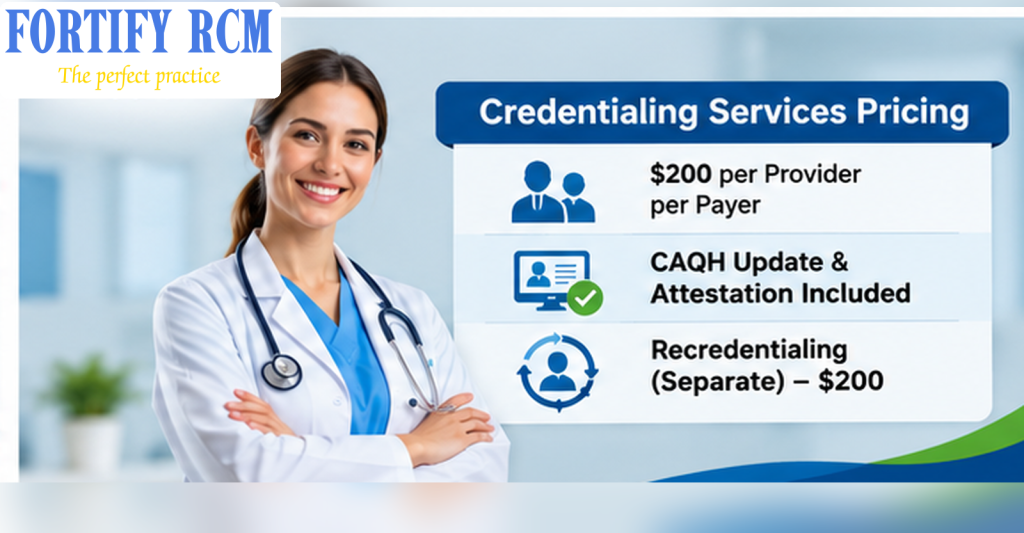
Fortify RCM’s website currently lists credentialing and enrollment at $200 per insurance per provider. Its pricing page states that the listed service includes individual provider enrollment, group enrollment at no extra cost, recredentialing and address updates, CAQH setup and maintenance, contracting and fee-schedule negotiation, and regular payer follow-ups and updates. It also states that there are no setup or onboarding charges for the credentialing service. These are Fortify RCM’s own published terms, not an independent market benchmark.
Review the Fortify RCM pricing page for the current description and confirm the exact inclusions, eligibility, terms, and availability directly with the company before relying on the figure. Ask how the per-insurance, per-provider model applies to your payer list, group structure, locations, and any special work your practice may need. This helps you compare Fortify’s credentialing services pricing fairly with other proposals once their scopes are aligned.
Fortify also describes its broader credentialing and enrollment support on the credentialing services page. Read the service details alongside the price so you can assess both the work offered and the fee basis. If you need other revenue cycle support, review the company’s services overview separately; do not assume every RCM task is part of a credentialing quote.
Because prices and inclusions can change, verify the current page before publication and before signing an agreement. A company’s advertised figure is useful as a first-party example, but it should never be presented as the average cost of the US market. Use the same scope checklist for Fortify RCM and every other provider when assessing credentialing services pricing.
Build a Realistic First-Year Credentialing Budget
A first-year budget should include more than the initial application fee. Start with the number of providers, payer applications, group affiliations, and locations. Add the vendor’s service charges, any recurring maintenance, and applicable external fees. Then identify work that may remain with your internal staff, such as gathering documents, obtaining signatures, reviewing profile information, or responding to requests. Include every likely cost component when estimating credentialing services pricing for the first year.
A simple budget can use this structure:
-
Initial vendor fees: Provider count multiplied by the applicable per-provider or per-payer rate.
-
Additional enrollment work: New payers, locations, group affiliations, or special applications not included in the base scope.
-
Ongoing support: Recredentialing, profile updates, expiry tracking, and other maintenance that is billed separately.
-
External expenses: Government or payer fees, verifications, licensing costs, and approved pass-through charges.
-
Internal administration: Staff time required to collect information, review applications, approve attestations, and manage handoffs.
Do not insert a generic market average where your practice-specific quote is available. The aim is to model your likely cost using written rates and known workload. Revisit the budget if your provider roster, payer mix, or locations change. This helps keep credentialing services pricing connected to the actual work rather than a one-time headline quote.
Questions to Resolve Before Approving a Credentialing Quote
Before signing, ask the vendor to confirm the following in writing. These answers will help you understand the full credentialing services pricing and identify any responsibilities that remain with your practice.
-
Is the fee charged per provider, payer, application, location, or month?
-
Which initial credentialing and enrollment tasks are included?
-
Are CAQH setup, profile updates, and reattestations included?
-
Does the quote include individual and group enrollment, and which locations?
-
Is payer follow-up included, and what milestone ends that work?
-
Are recredentialing, Medicare revalidation support, and demographic updates billed separately?
-
Are contracting and fee-schedule activities included, and what exactly do they cover?
-
Which third-party, government, or payer charges may be passed through?
-
What does completion mean, and what happens if the payer requests corrections?
-
What are the refund, cancellation, renewal, data-return, and open-file handoff terms?
A vendor should be able to explain its pricing structure without implying that it controls payer approval or effective dates. If a detail is not in the proposal, ask for a written amendment before work begins. This final review makes credentialing services pricing easier to understand and reduces the chance of a disagreement about what the fee covered.
Specialties We Serve
Credentialing needs and pricing can vary by provider type, specialty, state, payer mix, and practice structure. Fortify RCM describes support for a range of healthcare providers and organizations, including:
Mental Health Providers
Credentialing and billing for psychologists, therapists, counselors, and social workers in private or group practice.
Nutritionists & Dietitians
Specialized RCM and credentialing support for MNT providers, licensed dietitians, and wellness nutritionists.
Occupational Therapists
End-to-end billing and enrollment services for pediatric and adult OT clinics and independent therapists.
Non-Emergency Medical Transportation (NEMT)
We handle Medicaid credentialing, EDI setup, and claims billing for NEMT providers.
Home Health Agencies
Complete RCM services tailored for HHAs including Medicare credentialing, OASIS billing, and claims management.
Skilled Nursing Facilities (SNFs)
Credentialing, billing, and AR support for SNFs—compliant with payer-specific guidelines and long-term care needs.
Applied Behavior Analysis (ABA)
We support ABA therapy providers with credentialing, insurance billing, authorization and appeals for denied behavioral health claims.
Chiropractors & Physical Therapists
Credentialing and billing help for musculoskeletal therapy, rehab clinics, and solo practitioners.
Durable Medical Equipment (DME) Providers
We handle Medicare/Medicaid credentialing, EDI setup, and claims submission for DME suppliers.
Nurse Practitioners & Physician Assistants
Complete credentialing and billing support for NPs & PAs operating independently or in group practices.
Dentists & Oral Health Providers
Support with dental insurance credentialing and claims processing for general dentists and specialists.
Vision & Eye Care Specialists
Credentialing and RCM services for optometrists, ophthalmologists, and vision therapy providers.
Frequently Asked Questions About Credentialing Services Pricing
1. What Is the Credentialing Services Pricing at Fortify RCM?
Fortify RCM offers provider credentialing services at $200 per provider, per payer. Our credentialing services pricing covers the initial credentialing process for one provider with one insurance payer. Each additional payer requires a separate credentialing fee of $200.
2. Does Credentialing Services Pricing Include CAQH Profile Updates and Attestation?
Yes. Our credentialing services pricing of $200 includes CAQH profile updates and attestation. Providers do not need to pay an additional fee for these services when they are part of the initial credentialing package.
3. Is Recredentialing Included in the Standard Credentialing Services Pricing?
No. Recredentialing is not included in the standard $200 credentialing services pricing. It is offered as a separate service with an additional fee of $200. This allows healthcare practices to manage initial credentialing and periodic recredentialing requirements separately.
4. How Is Credentialing Services Pricing Calculated for Multiple Insurance Payers?
Credentialing services pricing is calculated at $200 per provider, per payer. For example, credentialing one provider with three different insurance payers would cost $600. Each provider-payer combination is treated as a separate credentialing application.
5. Are CAQH Profile Maintenance and Attestation Charged Separately?
No. CAQH profile updates and attestation are already included in Fortify RCM’s standard credentialing services pricing of $200 per provider, per payer. Maintaining accurate CAQH information helps support the provider enrollment and credentialing process with participating health plans.
6. What Is the Difference Between Initial Credentialing and Recredentialing, and How Are They Priced?
Initial credentialing involves verifying a provider’s qualifications and submitting an application to establish participation with an insurance payer. Recredentialing is a separate periodic review to confirm that an existing provider continues to meet payer requirements. Fortify RCM charges $200 per provider, per payer for initial credentialing, while recredentialing is billed separately at an additional $200.
Get a Credentialing Quote That Matches Your Practice
A low headline fee is not enough to make a credentialing service the right choice. Your practice needs to know what the vendor will handle, what your staff must provide, which charges may arise later, and how open applications will be tracked. A properly scoped quote makes credentialing services pricing easier to evaluate before you commit.
Fortify RCM provides credentialing and enrollment support for healthcare practices. Share your provider count, payer list, specialty, locations, and the services you need. The team can discuss the published pricing model and help clarify which tasks may fit your practice’s requirements.
You can also review the company’s About Fortify RCM page and its published service information before starting a conversation. Ask for written confirmation of inclusions, exclusions, pass-through expenses, and service responsibilities so you can compare proposals on equal terms. The final decision should be based on your actual requirements—not a generic market claim or an assumed payer outcome.