
Choosing a credentialing partner can affect how smoothly a practice prepares provider records, responds to payer requests, and manages enrollment work. Yet a vendor that suits a large multi-specialty group may be a poor fit for a solo clinician. This guide explains how to compare the best medical credentialing companies using criteria that can be checked during a proposal review—not unsupported rankings, unverifiable ratings, or promises of approval. The goal is to identify the best medical credentialing companies for a specific operating model, not to declare one provider universally superior.
About This Guide: This article is published by Fortify RCM, a provider of medical credentialing and revenue cycle management services. The guide presents general criteria for evaluating credentialing vendors and is not an independently verified ranking of companies. Fortify RCM’s services are described using information published by the company. Readers should independently evaluate vendors, verify service details, and compare proposals before making a decision.
.
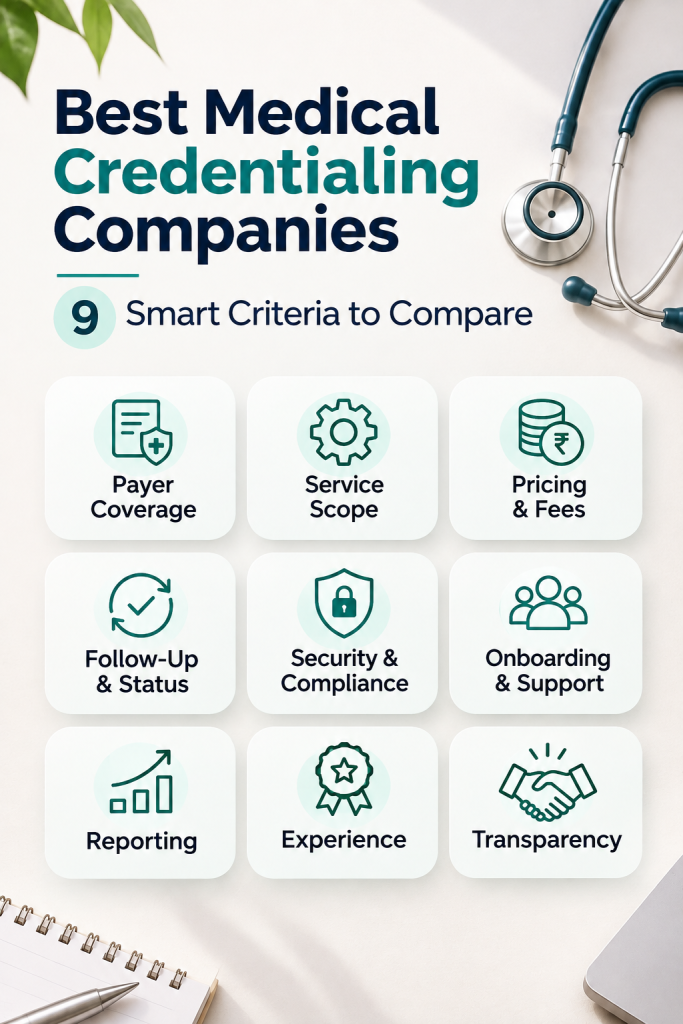
Start With Practice Fit—not a Universal “Best” Ranking
The best medical credentialing companies are not necessarily the largest, least expensive, or most visible providers. The right choice depends on your practice structure, specialty, payer mix, locations, provider count, and the amount of work you want to outsource.
Start by documenting what your practice needs. This step helps narrow the best medical credentialing companies to providers whose actual service scope matches your practice. List the clinicians and organization types involved, the states and practice locations, the commercial plans and government programs you intend to work with, and whether the project includes initial credentialing, payer enrollment, group affiliation, contracting, recredentialing, or demographic maintenance. Also identify any pending applications, expiring credentials, ownership changes, or billing deadlines.
This baseline prevents a common comparison mistake: asking every vendor for a general “credentialing quote” when each one may be pricing a different scope. One proposal might include CAQH profile maintenance and payer follow-up; another might cover application preparation only. Neither can be compared fairly until the deliverables are aligned.
Search results and review sites can help create a shortlist, but they do not prove that a company is right for your practice. Related searches such as best credentialing companies, top rated credentialing companies, and best credentialing services can help you discover vendors, but they are not evidence of quality or fit. Treat the phrase best medical credentialing companies as a buyer-research starting point. Your selection should be based on documented scope, payer experience relevant to your needs, written pricing, communication standards, security practices, and references you can validate.
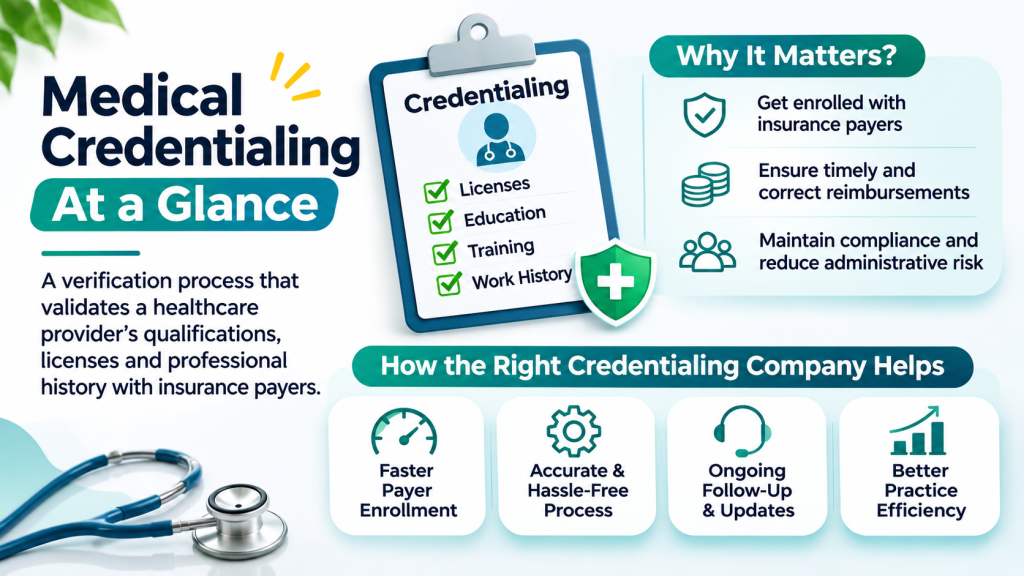
9 Criteria to Compare Medical Credentialing Vendors
Use the following nine criteria consistently in every discovery call and proposal review. These questions make claims from the best medical credentialing companies easier to test side by side. A structured evaluation makes it easier to compare the best medical credentialing companies without relying on marketing language.
1. Payer Coverage, State Reach, and Practice Fit
Ask which payer categories the vendor supports: Medicare, state Medicaid programs, and commercial health plans. When narrowing down the best medical credentialing companies, validate payer reach with recent, relevant examples rather than a nationwide claim alone. Then go beyond a broad claim such as “all major payers.” Request the actual payer names, states, provider types, and service locations relevant to your practice.
For Medicare, understand whether the vendor works with the applicable enrollment pathway and Medicare Administrative Contractor (MAC). CMS explains that providers use PECOS to submit and manage Medicare enrollment information, and that MACs process enrollment applications for many provider and supplier categories. That federal process should not be confused with commercial plan enrollment. Review the CMS Medicare enrollment application guidance when assessing a vendor’s Medicare workflow.
Medicaid requirements can vary by state and provider category. Ask whether the vendor has recent, relevant experience in the states where you practice, and whether it can explain when a state-specific portal, screening step, or separate managed-care plan process applies. A national footprint claim is not the same as demonstrated familiarity with your exact payer and jurisdiction.
2. Provider Type and Specialty Familiarity
A vendor should understand the documents, licensing structures, supervision rules, and payer requirements relevant to your clinician type. This is one of the most practical differentiators among the best medical credentialing companies for specialty practices. Ask about experience with your specialty—not just a broad list of specialties on a website.
For example, a behavioral health group, home health agency, DME supplier, physician practice, and therapy clinic may face different forms, supporting records, ownership disclosures, or enrollment pathways. Ask the company to describe a comparable project while protecting the client’s confidential information.
When evaluating the best medical credentialing companies, look for practical familiarity: Can the team identify the typical documents for your provider type? Can it explain what it needs from the clinician, group, and practice location? Does it know which items must be confirmed with the payer rather than assumed?
3. A Written Scope: Credentialing, Enrollment, Contracting, and Maintenance
Do not assume that “credentialing” includes every activity required before a practice can bill a particular plan. The best medical credentialing companies will explain where verification ends and enrollment, contracting, and billing setup begin. Ask the vendor to define each deliverable in writing.
Credential verification may include primary-source checks of items such as professional licensure, education and training, work history, and other relevant qualifications. Payer enrollment is a separate administrative process through which a provider or organization supplies information to a health plan or program. Contracting may involve network participation agreements and negotiated terms. Recredentialing, roster updates, demographic changes, and ongoing maintenance may be separate recurring tasks.
CAQH can help providers maintain and share professional and practice information with participating organizations, but a completed profile is not the same as a payer’s final credentialing decision or enrollment confirmation. CAQH’s Provider Data Portal guide explains profile completion, authorization, attestation, and document uploads.
The best medical credentialing companies will distinguish these tasks in their proposal. Ask whether the fee includes application preparation, submission, CAQH support, payer follow-up, responses to requests for additional information, contracting support, effective-date confirmation, recredentialing, and post-approval handoff. Record exclusions as clearly as inclusions.
4. Pricing Model and Extra Charges
Request a written fee schedule that shows the unit of billing. A fair comparison of the best medical credentialing companies starts with identical assumptions about providers, payers, locations, and deliverables. Is the fee charged per provider, per payer, per application, per location, or as a monthly retainer? Ask how the company handles group enrollment, additional locations, multiple tax IDs, application corrections, payer-specific forms, recredentialing, terminations, and urgent requests.
A low starting price may exclude the work that consumes the most time. A higher quote may include more follow-up and maintenance. Compare total expected cost for the same provider count, payer list, and scope rather than comparing two headline prices.
Ask for examples of situations that trigger extra charges and require written approval before out-of-scope work begins. Also clarify whether fees are refundable if a payer delays, requests more information, or does not approve an application. A vendor should explain its service fee separately from payer fees, where applicable.
When comparing the best medical credentialing companies, transparency matters more than a low number without context. Fortify RCM’s published pricing page currently lists credentialing and enrollment at $200 per insurance per provider and describes included activities on that page. This is a company-published offer, not a market benchmark; confirm the current scope and quote directly through the Fortify RCM pricing page.
5. Status Visibility, Documentation, and Reporting
Ask to see a sample status tracker or redacted report. The best medical credentialing companies should be able to demonstrate how a practice can see work completed, open dependencies, and the next action. A useful report should make it clear which provider and payer are involved, what stage the work has reached, when the last action occurred, what is outstanding, who owns the next step, and whether the payer has requested additional information.
Status labels should be defined. “Submitted,” “received,” “in review,” “approved,” “effective,” and “ready for billing” are not interchangeable. Ask what evidence supports each status and whether payer confirmations or reference numbers are recorded.
A vendor may not control a payer’s processing time, but it should be able to show the actions taken, outstanding dependencies, and next follow-up date. This is a meaningful way to assess the best medical credentialing companies: compare the quality of the work record, not merely how often a representative says an application is being handled.
6. Follow-Up, Escalation, and Response Ownership
Payer work often involves requests for clarification, missing documents, application corrections, or status checks. Ask who monitors payer communications, how frequently open cases are reviewed, and what happens when a payer does not respond.
Request written service expectations for acknowledging your practice’s questions, notifying you of payer requests, assigning an owner, and escalating unresolved issues. Avoid treating a promised payer turnaround as a vendor-controlled service level. The vendor can commit to its own communication and follow-up process; it generally cannot guarantee the payer’s decision date.
Clarify whether your practice must contact payers directly, whether the vendor can speak on your behalf under the required authorization, and who will handle an appeal or reconsideration when appropriate. Strong follow-up should be documented and traceable.
7. Information Security, Access, and Privacy Practices
Credentialing files can contain sensitive personal, professional, and practice information. Ask how the vendor receives documents, limits access, authenticates users, stores files, shares information with payers, manages subcontractors, and handles retention and deletion.
Ask whether a business associate agreement (BAA) is required for the relationship and, where applicable, whether the vendor will sign one. Review the vendor’s security policies, incident-response process, access controls, staff training, and document-transfer methods. Do not accept a website badge as a substitute for a clear explanation of safeguards.
HHS describes the HIPAA Security Rule as requiring appropriate administrative, physical, and technical safeguards for electronic protected health information held by covered entities and business associates. Use the HHS Security Rule overview as a reference point when asking security questions; determine the specific obligations that apply to your arrangement.
A careful review of privacy and access practices is essential when selecting the best medical credentialing companies, especially when a vendor will handle records for multiple clinicians or locations.
8. Onboarding, Handoffs, Capacity, and Account Ownership
Ask what happens after signing. A practical onboarding plan should identify the documents required, the person responsible for collecting them, the provider’s review and attestation responsibilities, the planned payer list, and the process for resolving missing or inconsistent information.
Find out who owns the account day to day. Will you have a named contact? What happens if that person is unavailable or leaves? How many accounts or applications does the team member typically manage? How are cases handed over between onboarding, application preparation, payer follow-up, and post-enrollment support?
Request a realistic implementation plan for your number of providers and payers. Be cautious about universal turnaround promises that ignore payer variation, incomplete documents, specialty differences, or additional review. The best medical credentialing companies should be able to explain dependencies and workload capacity without guaranteeing a result they do not control.
9. Experience, Quality Controls, and Ongoing Maintenance
Ask for relevant references, anonymized examples, process documentation, and the date of any performance data. Separate measured results from testimonials and marketing claims. If a vendor reports an approval rate or turnaround time, ask for the denominator, time period, payer mix, provider types, and how incomplete or withdrawn applications are treated.
Discuss how the company checks data before submission, catches expired documents, manages recredentialing dates, updates practice locations, and records payer correspondence. Ask whether quality checks are performed before an application is sent and how errors are corrected.
Some organizations use external accreditation or certification frameworks. For example, NCQA’s credentialing standards describe program requirements that include verification, confidentiality protections, peer review, and monitoring. Do not assume that every vendor needs the same accreditation; instead, ask what standards, audits, or documented quality controls apply to the particular service being offered.
A credible provider should be comfortable explaining what it measures and what it cannot promise. This is a stronger basis for choosing among the best medical credentialing companies than an unexplained “top-rated” label.
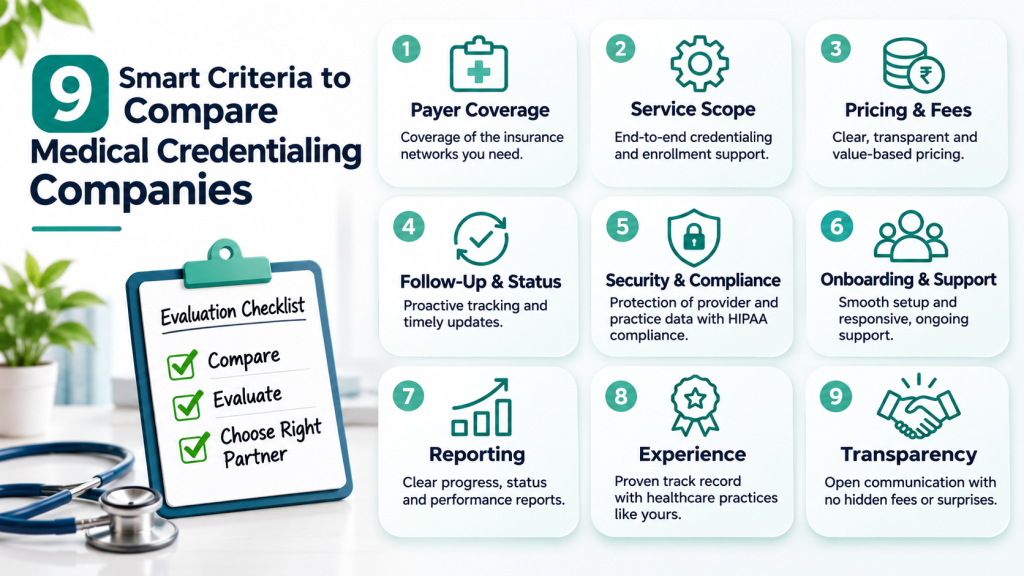
A Simple Scorecard to Use During Vendor Demos
Use one scorecard for every company. Rate each item from 1 to 5: 1 means the vendor cannot demonstrate the requirement; 3 means the response is partly documented or needs clarification; and 5 means the vendor provides clear, relevant evidence. Apply the same definitions to every proposal.
| Evaluation area | Suggested weight | Evidence to record |
|---|---|---|
| Payer and state fit | 15% | Named payers, states, provider types, and relevant examples |
| Specialty familiarity | 10% | Comparable provider or practice experience |
| Written scope | 15% | Included tasks, exclusions, deliverables, and handoff |
| Pricing transparency | 15% | Fee basis, additional charges, and approval rules |
| Follow-up and escalation | 10% | Contact cadence, ownership, and escalation path |
| Reporting and visibility | 10% | Sample tracker, status definitions, and documentation |
| Security and privacy | 10% | Access controls, document handling, BAA position, and policies |
| Onboarding and capacity | 10% | Named owner, staffing plan, timeline dependencies |
| Quality and maintenance | 5% | Quality checks, recredentialing, references, and dated metrics |
Multiply each vendor’s 1–5 rating by the weight to create a weighted comparison, or simply use the scorecard to identify gaps that need follow-up. Do not let a high total score hide a critical failure: weak data security, unclear scope, or no relevant payer experience may be a disqualifier regardless of the overall score.
This tool makes it easier to shortlist the best medical credentialing companies for your practice rather than accepting a ranking built for someone else’s needs. Keep the completed scorecards, proposals, and written answers together so the final decision can be explained to practice leadership.
Red Flags in a Proposal or Service-Level Agreement
Be cautious when a proposal uses broad claims but avoids specific deliverables. Warning signs include:
Guaranteed approval or fixed payer decision dates. A vendor can manage its own work and follow-up, but it cannot control every payer decision.
Unclear payer coverage. “All major payers” should be backed by a list relevant to your state, specialty, and provider type.
Vague pricing. The proposal does not explain whether fees are per provider, payer, location, or task, or how additional work is approved.
No status evidence. The vendor cannot show a sample tracker, dated updates, or a clear owner for open items.
No escalation path. It is unclear who handles payer requests, corrections, or unresolved applications.
Unclear data handling. The vendor cannot explain access controls, secure transfer, retention, or applicable contractual privacy obligations.
No defined handoff. The practice is left to determine what “complete” means or whether follow-up continues after a decision.
Also examine the service-level agreement (SLA) carefully. It should define the vendor’s response and reporting commitments, not promise outcomes that depend on third parties. Clarify termination rights, data return, access removal, open-case handoff, and fees for work already performed.
A proposal that looks attractive at first glance may not represent good value if these basics are missing. The best medical credentialing companies should welcome detailed questions and put the answers in writing.
Questions to Ask Before Requesting a Quote
Use these questions in a discovery call. Ask each shortlisted company the same questions so the answers are comparable.
Which specific payers, states, provider types, and practice locations do you currently support?
Does your service include credential verification, payer enrollment, contracting support, or only selected parts of the process?
What exactly is included in the quoted fee, and which events create an additional charge?
Who prepares, reviews, submits, and follows up on each application?
How will our practice see the status, supporting documents, payer requests, and next action?
What is your process when a payer requests corrections or additional information?
What information do you need from our clinicians and administrators, and how is it transferred securely?
Who is our day-to-day contact, and who covers the account when that person is unavailable?
How do you handle recredentialing, demographic updates, location changes, and post-enrollment handoff?
Can you provide relevant references or dated, clearly defined performance data without disclosing another client’s confidential information?
Ask for written answers and attach them to the proposal. If an answer depends on your payer mix, provider type, or state, ask the vendor to identify the dependency instead of accepting a generic response. A disciplined discovery process helps practices identify the best medical credentialing companies for their own operating requirements.
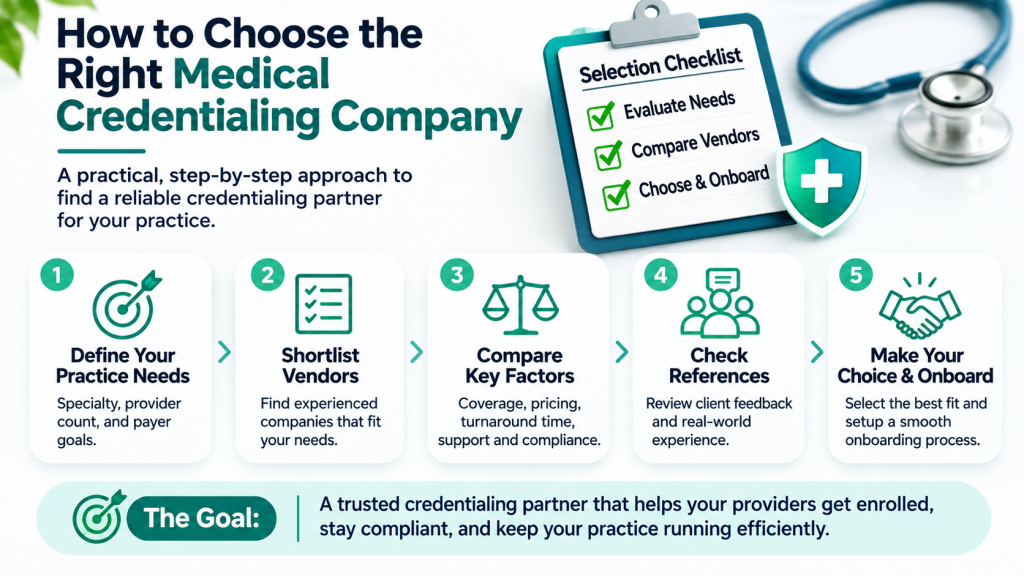
How to Verify Vendor Claims Before You Sign
Treat every vendor’s marketing statement as a claim to verify. If a company advertises a high approval rate, ask for its calculation method and reporting period. If it says it works with a payer, ask whether that means it has submitted applications for your provider type and state recently, or simply has a general relationship with that payer. If it advertises a short turnaround, ask what event starts the clock and whether the figure measures the vendor’s work or the payer’s full decision time.
Ask for references that resemble your practice in size, specialty, geography, and payer mix. A reference from a different setting may still be useful, but it does not prove the same performance will apply to your project. Confirm whether testimonials are authorized and whether case studies are representative or selected examples.
Where relevant to your provider screening process, ask who checks applicable exclusion information and how often. The HHS Office of Inspector General maintains the List of Excluded Individuals/Entities (LEIE), which can be searched online or downloaded. The OIG advises healthcare entities to routinely check the list; ask the vendor to explain whether this task is part of its scope or remains your organization’s responsibility.
Fortify RCM provides credentialing and enrollment services as well as broader revenue cycle support. Its published credentialing services page describes the company’s stated scope, including payer applications, CAQH support, follow-up, and related services. Because this article is published by Fortify RCM, that description should be treated as a self-reported company statement—not an independent endorsement or proof that Fortify is the best option for every practice. Compare it with competing proposals using the same scorecard.
Specialties We Serve
Credentialing and enrollment requirements can differ by provider category, specialty, practice structure, payer, and state. Fortify RCM’s website describes support for a range of healthcare organizations and clinicians, including:
Mental Health Providers
Credentialing and billing for psychologists, therapists, counselors, and social workers in private or group practice.
Nutritionists & Dietitians
Specialized RCM and credentialing support for MNT providers, licensed dietitians, and wellness nutritionists.
Occupational Therapists
End-to-end billing and enrollment services for pediatric and adult OT clinics and independent therapists.
Non-Emergency Medical Transportation (NEMT)
We handle Medicaid credentialing, EDI setup, and claims billing for NEMT providers.
Home Health Agencies
Complete RCM services tailored for HHAs including Medicare credentialing, OASIS billing, and claims management.
Skilled Nursing Facilities (SNFs)
Credentialing, billing, and AR support for SNFs—compliant with payer-specific guidelines and long-term care needs.
Applied Behavior Analysis (ABA)
We support ABA therapy providers with credentialing, insurance billing, authorization and appeals for denied behavioral health claims.
Chiropractors & Physical Therapists
Credentialing and billing help for musculoskeletal therapy, rehab clinics, and solo practitioners.
Durable Medical Equipment (DME) Providers
We handle Medicare/Medicaid credentialing, EDI setup, and claims submission for DME suppliers.
Nurse Practitioners & Physician Assistants
Complete credentialing and billing support for NPs & PAs operating independently or in group practices.
Dentists & Oral Health Providers
Support with dental insurance credentialing and claims processing for general dentists and specialists.
Vision & Eye Care Specialists
Credentialing and RCM services for optometrists, ophthalmologists, and vision therapy providers.
Frequently Asked Questions
1. How should a practice compare medical credentialing companies?
A practice should begin by identifying its provider types, specialties, practice locations, payer mix, and required services. Then evaluate the best medical credentialing companies using consistent criteria such as payer coverage, service scope, pricing, follow-up procedures, reporting, data security, and client support. Request written proposals, compare deliverables, and verify relevant experience before making a decision.
2. What services should a credentialing company include?
Services vary by vendor and agreement. The best medical credentialing companies may offer provider document collection, license and qualification verification coordination, CAQH profile support, payer application preparation and submission, application follow-up, responses to additional information requests, and enrollment status tracking. Some also provide recredentialing, demographic updates, or contracting support. Always confirm which services are included in the quoted fee and which require additional charges.
3. Is the cheapest credentialing vendor always the best option?
No. A low initial price may exclude important services such as payer follow-ups, application corrections, CAQH maintenance, or ongoing support. When comparing the best medical credentialing companies, evaluate the total cost against the actual services provided. Ask about per-provider and per-payer fees, additional charges, payment terms, and out-of-scope work before signing an agreement.
4. Should credentialing and medical billing be handled by one company?
It depends on your practice’s operational needs and internal resources. Working with one company may simplify communication between credentialing and billing teams, while separate vendors may offer more specialized support. The best medical credentialing companies should clearly explain their enrollment responsibilities and how they coordinate with billing teams. Make sure effective-date confirmation, payer status updates, and billing handoffs are properly documented.
5. Can a credentialing company guarantee payer approval?
No responsible vendor should guarantee payer approval or a specific effective date. Insurance companies and government programs review applications according to their own requirements and procedures. The best medical credentialing companies can support document preparation, application submission, follow-up, and responses to payer requests, but the final decision remains with the relevant payer or program.
6. What documents should a practice prepare before starting credentialing?
Practices may need current professional licenses, education and training records, work history, malpractice coverage details, NPI information, tax identification details, practice addresses, and relevant group or ownership information. Exact requirements depend on provider type, payer, and state. The best medical credentialing companies should provide a clear, payer-specific document checklist so your team can identify missing information before applications are submitted.
7. Do all insurance companies use CAQH ProView?
No. Many participating health plans use CAQH ProView to collect and access provider information, but not every payer uses it in the same way. Some insurance companies require separate applications, additional documents, or submissions through their own portals. The best medical credentialing companies should explain which payers accept CAQH information and identify any additional requirements. Completing a CAQH profile does not automatically guarantee payer approval or enrollment.
8. How often should provider credentialing information be updated?
Provider information should be reviewed regularly and updated whenever relevant details change, including professional licenses, practice locations, contact information, malpractice coverage, and group affiliations. Payers may also require periodic recredentialing or revalidation according to their own schedules. The best medical credentialing companies should help practices track applicable deadlines, maintain accurate records, and follow up on required updates.
Get a Credentialing Plan Built Around Your Practice — Schedule a Free Consultation
Choosing a credentialing company is an important business decision. The wrong service scope can leave your team managing payer follow-ups, missing documents, enrollment updates, and administrative tasks that you expected your vendor to handle.
Before committing to a credentialing partner, get clarity on what your practice actually needs.
Fortify RCM offers a free credentialing consultation to help you understand your next steps. During this discussion, you can review:
Your provider requirements: Number of providers, specialties, group structure, and practice locations.
Your payer requirements: Medicare, Medicaid, and the commercial insurance networks relevant to your practice.
Your current credentialing status: Pending applications, CAQH profile requirements, recredentialing dates, and outstanding payer requests.
Your required service scope: Initial credentialing, individual and group enrollment, payer follow-ups, contracting support, and ongoing updates.
Your pricing and deliverables: Understand the proposed service scope, applicable fees, and responsibilities before making a decision.
Whether you are launching a new practice, adding providers, expanding into new locations, or reviewing your existing credentialing arrangements, the conversation can help identify which administrative tasks need attention and what support may be appropriate.
Ready to discuss your credentialing requirements?
Schedule your free consultation with Fortify RCM and speak with the team about your provider enrollment needs.
Explore Fortify RCM Credentialing Services to review the available services before getting started.