
Choosing the right credentialing and contracting services can help healthcare practices bring structure to provider enrollment, payer communication, contract coordination, and ongoing credential maintenance. However, service providers differ in what they handle, what they exclude, and how they coordinate with insurance companies. Before selecting a partner, practice owners and administrators should understand the scope of support, responsibilities, and documentation they can expect. This guide outlines eight important questions to help you evaluate providers and make an informed decision.

Why Service Scope Matters Before You Choose a Partner
Preparing a provider for an insurance network can involve credential verification, payer enrollment, group and location records, follow-ups, and contract documents. A practice may need support with all these tasks or only a few.
The label credentialing and contracting services does not define what a vendor will actually do. Credentialing services for providers may cover application support without including contract work. One company may submit applications; another may also coordinate group enrollment, contract documents, fee-schedule discussions, and maintenance. Get the scope in writing.
Use these eight questions to assess the scope, payer dependencies, and proof of completion—not vendor rankings. Make the procurement review for credentialing and contracting services part of the written decision before agreeing to access, timelines, and fees. See Fortify RCM’s own credentialing services page.
When Do You Need Credentialing, Enrollment, or Contracting Support?
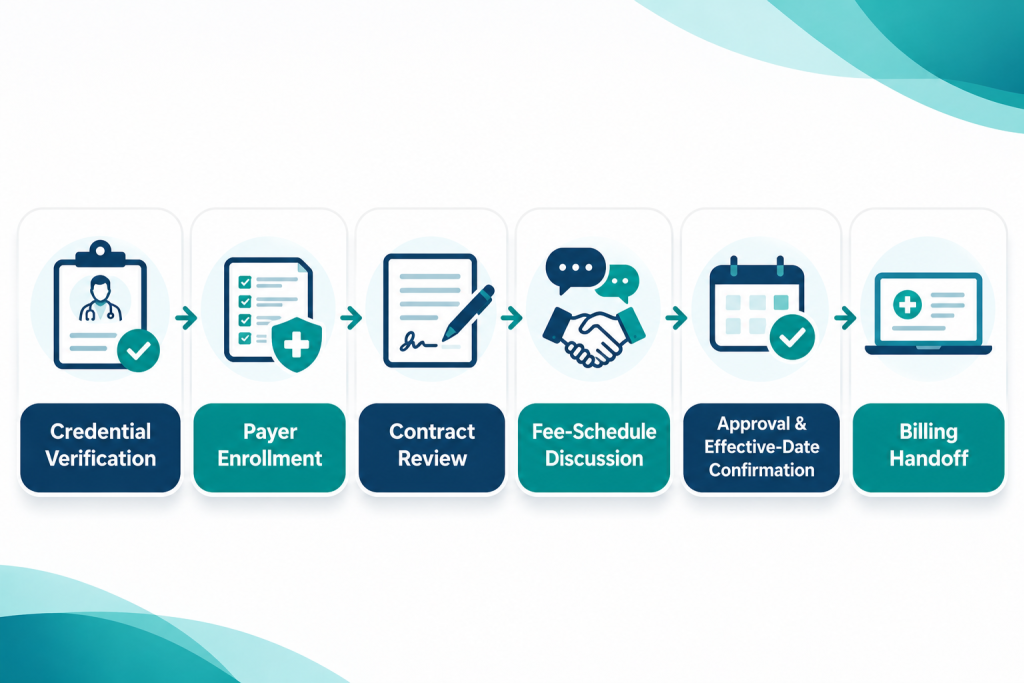
Credentialing verifies a provider’s qualifications, such as education, training, licenses, and work history. Payer enrollment completes a plan’s participation or billing-privilege requirements. Contracting concerns the participation agreement and its terms, which may include reimbursement arrangements.
These stages are related but not interchangeable. Some practices seek provider enrollment services alone; others need provider enrollment and credentialing services with contract coordination. Credentialing and contracting services should distinguish the stages: verification may be complete while enrollment is pending, or enrollment may be approved while an agreement still needs attention. Medicare, Medicaid, and commercial plans have different procedures.
A practice may need credential verification, individual or group enrollment, contract-document coordination, fee-schedule support where expressly included, or ongoing maintenance for recredentialing, revalidation, and record changes. The right credentialing and contracting services distinguish vendor deliverables from payer decisions. This prevents enrollment support from being mistaken for a completed contract. A provider file, enrollment application, contract, and billing-readiness check are separate checkpoints.
Eight Questions to Ask Before Signing
Use these questions to evaluate credentialing and contracting services against your payer mix, provider types, and desired contract support.
1. Which Payers, States, and Provider Types Are Included?
Ask for the actual payer list, states served, provider categories, and specialties supported. Share the plans your practice wants to join and confirm whether Medicare, relevant Medicaid programs, and commercial plans are included.
Clarify whether new applications and existing-record changes are both covered. Ask for: a written list of payers, provider types, states, exclusions, and payer-specific limitations. Do not assume all credentialing and contracting services cover every insurer or specialty.
2. Are Individual, Group, and Location Records Covered?
Individual provider, group, and location records may require separate actions, including affiliations, reassignment, tax, ownership, or address information. Ask which records the vendor prepares, submits, monitors, and updates.
For Medicare, confirm applicable PECOS actions; for commercial plans, ask for payer-specific explanations. Ask for: a responsibility matrix showing each record and its owner.
3. What Exactly Does “Contracting Support” Include?
“Contracting” may mean routing participation documents, tracking an agreement, coordinating questions, or helping discuss reimbursement terms. Those tasks are not automatically included in credentialing and contracting services.
Ask who contacts the payer, who reviews agreements, what fee-schedule support is offered, and which decisions require practice approval. A vendor cannot force a payer to offer a contract or accept requested rates. Ask for: written tasks, boundaries, and exclusions.
4. Who Owns Payer Follow-Ups and Escalations?
Payers may request missing documents, corrections, clarification, or another form after submission. If the practice and vendor each assume the other party is responding, the request can stall.
Ask who checks status, how often follow-ups occur, and how urgent requests are escalated. Ask for: a sample fictional status report showing payer, provider, submission date, current status, pending item, owner, and next action. Put follow-up ownership in the credentialing and contracting services agreement.
5. How Are Approval, Effective Dates, and Billing Handoffs Confirmed?
An application receipt is not proof that a provider is active with a payer. Ask how the vendor confirms the decision, effective date, provider/group relationship, location, and contract status.
Clarify what written evidence reaches the practice and billing team. Verify participation details before changing claim workflows. The payer controls approval and effective-date decisions. Ask for: payer confirmation, effective-date details, remaining contract requirements, and a documented billing handoff.
6. What Happens When an Application Is Pending, Returned, or Denied?
A pending application may mean the payer needs more information, not that it has issued a final denial. Ask how the vendor records the reason, assigns next steps, and tracks response deadlines.
Clarify who supplies documents, corrects details, and approves resubmission. Check whether appeal support is included or separately charged. Ask for: a written process for pending requests, corrections, resubmissions, escalations, and appeals.
7. Are Recredentialing, Revalidation, and Demographic Updates Included?
Practices may need to respond to recredentialing requests, update provider or location details, renew licenses, and report changes. Medicare revalidation is separate from commercial payer recredentialing.
Ask whether the vendor tracks dates, sends reminders, prepares updates, and follows up. Ask for: a maintenance calendar, covered-update list, reminder process, and clear practice/vendor responsibilities for ongoing credentialing and contracting services.
8. How Are Fees and Out-of-Scope Work Defined?
Ask whether fees are per provider, payer, location, application, or package. Confirm whether group enrollment, CAQH support, contract coordination, follow-ups, recredentialing, and demographic updates are included or charged separately.
Clarify approval and pricing for extra locations, new applications, ownership changes, and appeals. Ask for: an itemized fee schedule, exclusions, pass-through costs, change approvals, payment terms, and cancellation conditions. This should match the written credentialing and contracting services scope.
A Practical Scope Checklist to Send With Your Request
Prepare a scope document and send the same information to each provider:
-
Number of providers, groups, and locations.
-
Provider types, specialties, and states.
-
Target Medicare, Medicaid, and commercial payers.
-
New applications, existing records, and pending cases.
-
Individual, group, affiliation, and location requirements.
-
CAQH access, attestation, and update responsibilities.
-
Contract coordination and fee-schedule support needed.
-
Follow-up, escalation, reporting, and response expectations.
-
Recredentialing, Medicare revalidation, and updates.
-
Billing handoff and evidence of active status.
-
Pricing basis, exclusions, and agreement terms.
Use this as the baseline for vendor proposals. Keep it with the agreement so the scope of credentialing and contracting services remains clear. Ask each vendor to label tasks included, optional, excluded, or dependent on payer action. The resulting scope should identify practice approvals and become the work order. It should define credentialing and contracting services and the information the practice must supply.

Common Scope Gaps to Resolve Before Onboarding
Resolve these common gaps in writing:
-
Enrollment confused with credentialing: Qualification verification alone does not establish payer participation or billing privileges.
-
Group/location work omitted: Confirm whether group affiliations, reassignment, and locations require separate action.
-
Vague contracting scope: Define document routing, agreement tracking, fee-schedule support, and who can approve terms.
-
Unassigned payer requests: Name the owner for monitoring, documents, and escalation.
-
Approval confused with billing readiness: Verify payer, provider, group, location, contract status, and effective date.
-
Maintenance omitted: Define responsibility for recredentialing, Medicare revalidation, CAQH, and demographic changes.
A sound agreement for credentialing and contracting services defines tasks; it cannot guarantee payer acceptance, network participation, rates, or an effective date. Use these distinctions when comparing credentialing and contracting services from different vendors.
How to Start a Credentialing Scope Review
Start with the provider roster, target payers, pending applications, and need for contract or fee-schedule support. Map the provider enrollment process from submission to payer response, assign an owner to each task, and define completion evidence. Record the credentialing and contracting services expected before onboarding.
For Medicare, consult CMS’s provider enrollment guidance and enrollment application information. PECOS and paper forms depend on provider or supplier type; these are Medicare-specific instructions.
CMS’s revalidation guidance says most providers and suppliers generally revalidate every five years, while DMEPOS suppliers generally revalidate every three years. CMS may request off-cycle revalidation. These intervals do not apply to commercial payer recredentialing.
The CAQH ProView provider guide covers profile completion, authorization, attestation, and supporting documents. A profile does not replace payer applications or guarantee participation.
NCQA’s Credentialing Accreditation standards are for eligible organizations performing full-scope credentialing—not a universal requirement for every enrollment vendor.
Fortify RCM’s first-party pages describe individual/group enrollment, CAQH support, recredentialing, updates, payer follow-ups, and contract/fee-schedule negotiation. These are first-party descriptions, not an independent vendor assessment. Review its services overview and pricing details to confirm current inclusions. Confirm the credentialing and contracting services your practice selects are listed in the written agreement.
Specialties We Serve
Fortify RCM supports dental practices with dental billing and revenue cycle management services tailored to their operational needs. Whether you run an independent dental practice, manage a multi-provider clinic, or oversee a growing dental group, choosing the right billing partner starts with understanding your workflows, payer requirements, and reporting needs. Our goal is to help dental practices manage claims, payment posting, denial follow-up, and accounts receivable through a structured billing process.
Mental Health Providers
Credentialing and billing for psychologists, therapists, counselors, and social workers in private or group practice.
Nutritionists & Dietitians
Specialized RCM and credentialing support for MNT providers, licensed dietitians, and wellness nutritionists.
Occupational Therapists
End-to-end billing and enrollment services for pediatric and adult OT clinics and independent therapists.
Non-Emergency Medical Transportation (NEMT)
We handle Medicaid credentialing, EDI setup, and claims billing for NEMT providers.
Home Health Agencies
Complete RCM services tailored for HHAs including Medicare credentialing, OASIS billing, and claims management.
Skilled Nursing Facilities (SNFs)
Credentialing, billing, and AR support for SNFs—compliant with payer-specific guidelines and long-term care needs.
Applied Behavior Analysis (ABA)
We support ABA therapy providers with credentialing, insurance billing, authorization and appeals for denied behavioral health claims.
Chiropractors & Physical Therapists
Credentialing and billing help for musculoskeletal therapy, rehab clinics, and solo practitioners.
Durable Medical Equipment (DME) Providers
We handle Medicare/Medicaid credentialing, EDI setup, and claims submission for DME suppliers.
Nurse Practitioners & Physician Assistants
Complete credentialing and billing support for NPs & PAs operating independently or in group practices.
Dentists & Oral Health Providers
Support with dental insurance credentialing and claims processing for general dentists and specialists.
Vision & Eye Care Specialists
Credentialing and RCM services for optometrists, ophthalmologists, and vision therapy providers.
Frequently Asked Questions
1. What do credentialing and contracting services usually include?
The written scope may cover verification, applications, group enrollment, contract coordination, fee-schedule discussions, payer follow-ups, and maintenance. Confirm included and excluded tasks.
2. Is payer enrollment the same as contract negotiation?
No. Enrollment completes payer participation requirements; negotiation concerns agreement terms. One vendor may support both, but the tasks should be defined separately.
3. Does a CAQH profile complete payer credentialing automatically?
No. Providers must authorize access, attest to their information, and supply supporting documents. Payers may still require separate applications and approvals.
4. Are Medicare and commercial insurance enrollment the same?
No. Medicare follows CMS and PECOS processes. Commercial insurers set their own application, participation, and contracting requirements.
5. Can a credentialing company guarantee a payer contract or effective date?
No. The payer controls network decisions, contract terms, and effective dates. A vendor can coordinate applications and follow-ups, not guarantee outcomes.
6. What should a practice prepare before requesting a proposal?
Prepare the provider roster, locations, specialties, target payers, current enrollment status, pending applications, and requested contract support.
7. How should a practice track pending applications?
Track the provider, payer, group/location, submission date, status, outstanding request, owner, next follow-up date, and supporting evidence.
8. Is NCQA Credentialing Accreditation required for every enrollment vendor?
No. NCQA’s program applies to eligible full-scope credentialing organizations. It is not a universal requirement for every administrative enrollment vendor.
Discuss the Scope Your Practice Needs
The right credentialing and contracting services arrangement distinguishes credential verification, payer enrollment, contract coordination, fee-schedule discussions, and ongoing maintenance. Use this guide to define credentialing and contracting services that fit your payer and provider mix. Before choosing a provider, confirm which tasks are included, who owns follow-ups, and what documentation the practice will receive. No outside company can guarantee payer acceptance, network participation, reimbursement terms, or an effective date.
Fortify RCM publishes its own credentialing and enrollment service information. To discuss your provider count, payer list, group structure, and support needs, read about Fortify RCM or share your requirements through the contact page. Discuss the credentialing and contracting services your practice needs, then confirm the proposed scope in writing before proceeding.