
When patients have multiple health insurance plans, medical practices must determine which payer is responsible first. Incorrect payer order can lead to claim rejections, delayed payments, and unresolved balances. Coordination of benefits medical billing helps establish the correct payment sequence.
This guide explains how to verify insurance coverage, identify primary and secondary payers, submit secondary claims, resolve common billing issues, and manage follow-ups efficiently.

Understand What Coordination of Benefits Controls
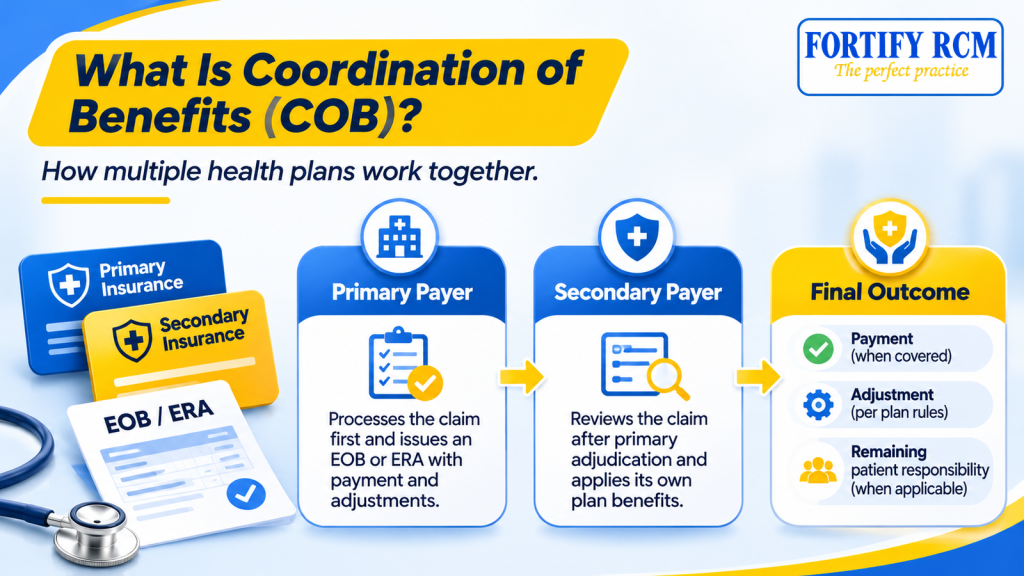
Coordination of benefits (COB) applies when a person has more than one health coverage arrangement and the plans must determine the order in which they consider a service. In coordination of benefits medical billing, the primary payer processes first under the applicable rules. A secondary payer considers the claim after primary adjudication, applying its own benefits, exclusions, and payment terms. A third payer may be involved in some circumstances, but it is not automatically responsible because another insurance card exists.
For a practice, coordination of benefits medical billing is both an insurance decision and an account-control task. The coordination of benefits medical billing record should show which policies applied on the date of service, how the team determined the order, what the first payer decided, and what information was sent next. A coordination of benefits medical billing workflow must keep three questions separate: Is the coverage active? Which plan is first for this service? What does the next plan owe under its own contract? In coordination of benefits medical billing, an eligibility response may answer the first question without settling the other two.
| Term | Meaning for the billing team |
|---|---|
| Primary payer | Plan or program with first payment responsibility |
| Secondary payer | Plan that considers the claim after primary adjudication |
| Tertiary payer | A possible third source when the coverage facts support it |
| EOB | Explanation of Benefits showing how a payer processed a claim |
| ERA | Electronic remittance carrying payment and adjustment details |
| Crossover | A process that may forward claim information to another payer |
CMS explains that a COB claim sent to a secondary payer contains adjudication information from the payer that processed the claim first. See CMS Coordination of Benefits transaction guidance. Use that as the transaction context in coordination of benefits medical billing, then confirm the exact instructions for the patient’s program and payer.
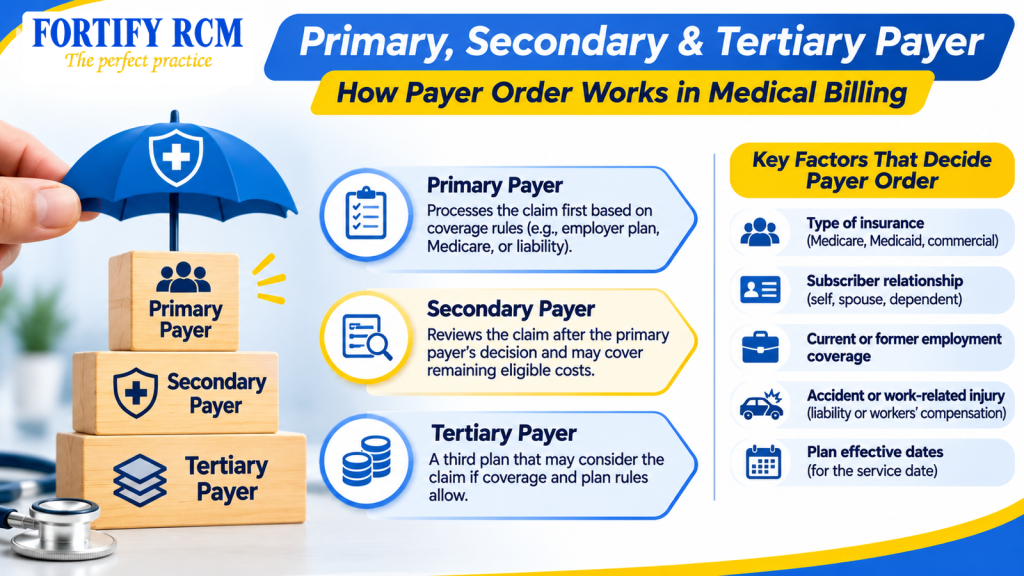
Establish the Correct Primary, Secondary, and Tertiary Payer
In coordination of benefits medical billing, payer order depends on the coverage circumstances and applicable rules, not a universal ranking of insurance companies. A reliable coordination of benefits medical billing decision starts with a complete list of plans and the facts behind each one. Identify whether coordination of benefits medical billing involves commercial insurance, employer coverage, Medicare, Medicaid, workers’ compensation, auto/no-fault, liability, military coverage, or another program. For coordination of benefits medical billing, record whether the patient is the subscriber, spouse, dependent child, or covered through another relationship.
Use this coordination of benefits medical billing review:
-
List each policy, payer name, plan type, member ID, group number, subscriber, relationship, and effective dates.
-
Ask why the person has the coverage: current or former employment, spouse or parent coverage, an individual plan, a government program, or an injury-related claim.
-
Check whether the visit is connected to an accident, workplace injury, or another event that may change responsibility.
-
Apply the relevant plan terms, payer manual, official program guidance, and state instructions.
-
Save the source, date checked, portal response or representative reference, and staff member responsible for the decision.
Medicare requires a distinct review. Medicare Secondary Payer (MSP) rules identify situations in which another insurer or entity has payment responsibility before Medicare. CMS states that entities billing Medicare must determine whether Medicare is primary for the items or services provided to a beneficiary. This does not mean Medicare is always secondary in coordination of benefits medical billing whenever another card is on file. Current employment, employer size, disability-related coverage, end-stage renal disease, workers’ compensation, and liability situations can affect the outcome. Review CMS Medicare Secondary Payer guidance and Medicare’s Who Pays First resource.
Medicaid follows a different framework. Federal guidance describes third-party liability (TPL) as the legal obligation of another party to pay some or all of the cost of medical assistance before Medicaid pays. States must take reasonable steps to identify liable third parties. Practices handling coordination of benefits medical billing should follow the applicable state Medicaid agency or managed-care plan instructions rather than treating Medicaid like an ordinary commercial secondary plan. See Medicaid Coordination of Benefits and Third Party Liability.
Collect and Verify Other Insurance Information
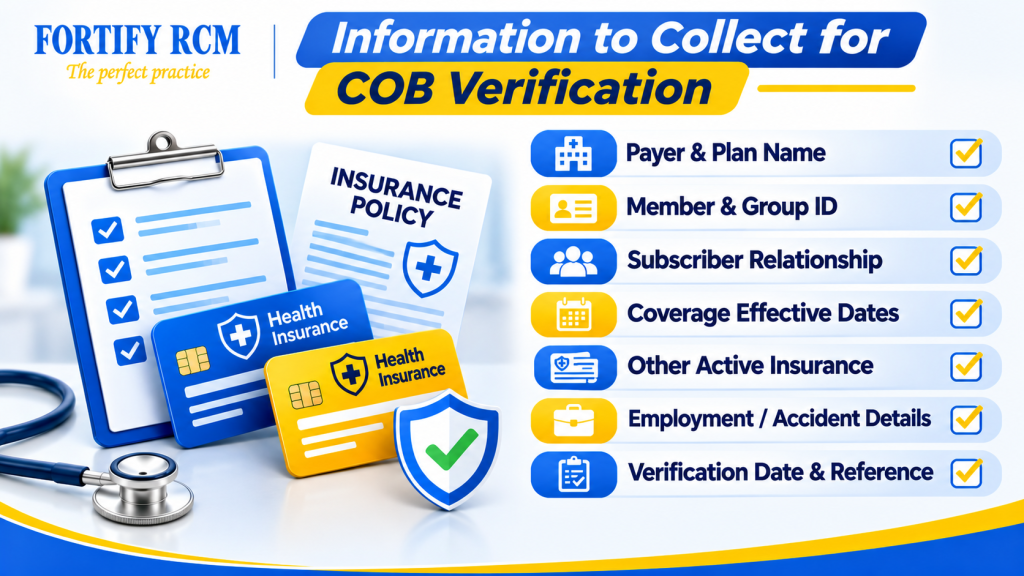
Coordination of benefits medical billing quality depends on what the practice collects before the claim is created. In coordination of benefits medical billing, ask about additional insurance at appropriate registration and update points, not only after a rejection. A patient may change jobs, join a spouse’s plan, become eligible for Medicare, or lose coverage between visits. Other insurance information for coordination of benefits medical billing must be linked to the date of service because a policy active today may not have covered an earlier encounter.
Capture the following details:
| Data element | Why it matters |
|---|---|
| Payer and plan name | Identifies the coverage source to verify |
| Member and group IDs | Helps locate the correct enrollment |
| Subscriber and relationship | Supports dependent-coverage review |
| Effective and termination dates | Confirms coverage for the service date |
| Other known coverage | Provides facts for payer-order review |
| Employment or accident details | Flags possible MSP, liability, or workers’ compensation rules |
| Verification method and date | Shows how information was checked |
| Call or portal reference | Lets another employee reproduce the inquiry |
A coordination of benefits medical billing verification should answer more than “active or inactive.” Ask whether the payer has another coverage record, whether it considers itself primary or secondary for the date of service, and whether it requires a particular claim route or attachment. An eligibility response may not resolve payer order. If the representative cannot confirm responsibility, document the unanswered question and escalate rather than turning an uncertain answer into a final decision.
Prepare and Submit the Secondary Claim
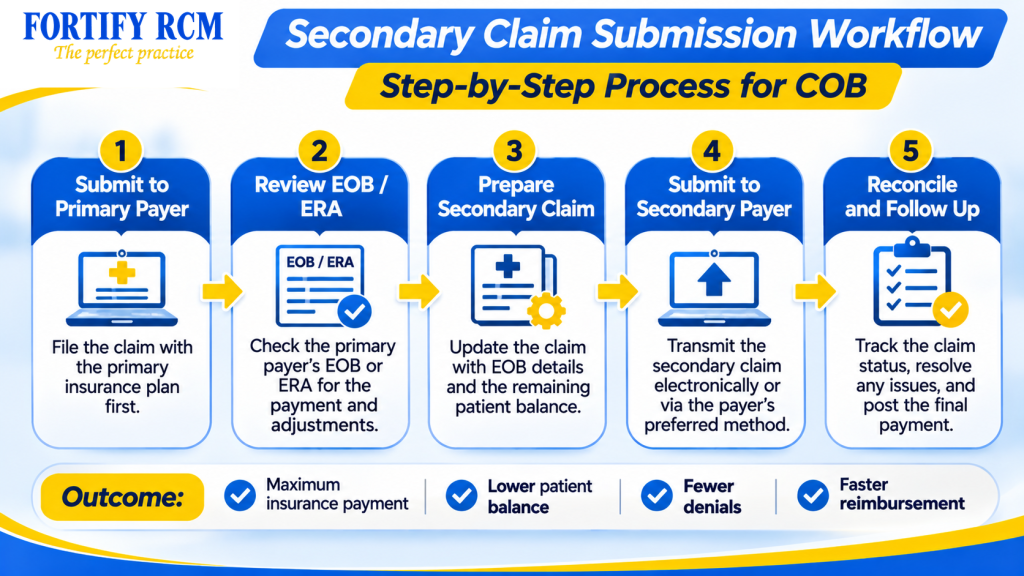
In coordination of benefits medical billing, a secondary claim is generally prepared after the primary payer adjudicates the claim, unless the payer or program directs the provider to use another route. The secondary payer needs the primary payer’s actual decision in coordination of benefits medical billing, not an estimate based on the charge or the patient’s understanding of the plan. Its own contract determines how the first payer’s payment and adjustments affect coordination of benefits medical billing for the secondary benefit.
For consistent coordination of benefits medical billing, follow these steps:
-
Confirm primary receipt. Retain the clearinghouse or payer acknowledgement. File acceptance does not mean adjudication is complete.
-
Obtain the EOB or ERA. Match it to the patient, claim, service date, and service lines.
-
Review the outcome. Capture allowed amounts, payments, patient responsibility, contractual adjustments, denial or remark information, and any data required by the secondary plan.
-
Resolve primary edits where needed. Distinguish an intake rejection from an adjudicated denial or a request for records. Correct, reconsider, or appeal according to the payer’s instructions.
-
Prepare the secondary submission. Confirm member identifiers, payer IDs, claim details, primary adjudication data, filing limit, companion guide, and attachment requirements.
-
Transmit and monitor. Save the submission record, check the acknowledgement, and assign any returned edit.
-
Post the response. Reconcile payments and adjustments, then route any remaining balance under the plan and practice policies.
CMS explains that HIPAA adopted standards used in coordination of benefits medical billing electronic transactions. CMS identifies the ASC X12 837 Health Care Claim transaction for electronic claim information and describes claims sent to secondary payers as including the earlier payer’s adjudication information. Before changing a claim configuration, practices and billing partners should confirm the relevant implementation guide, payer companion guide, clearinghouse edits, and current payer instructions. The official overview is the CMS Coordination of Benefits page.
Resolve Common COB Issues
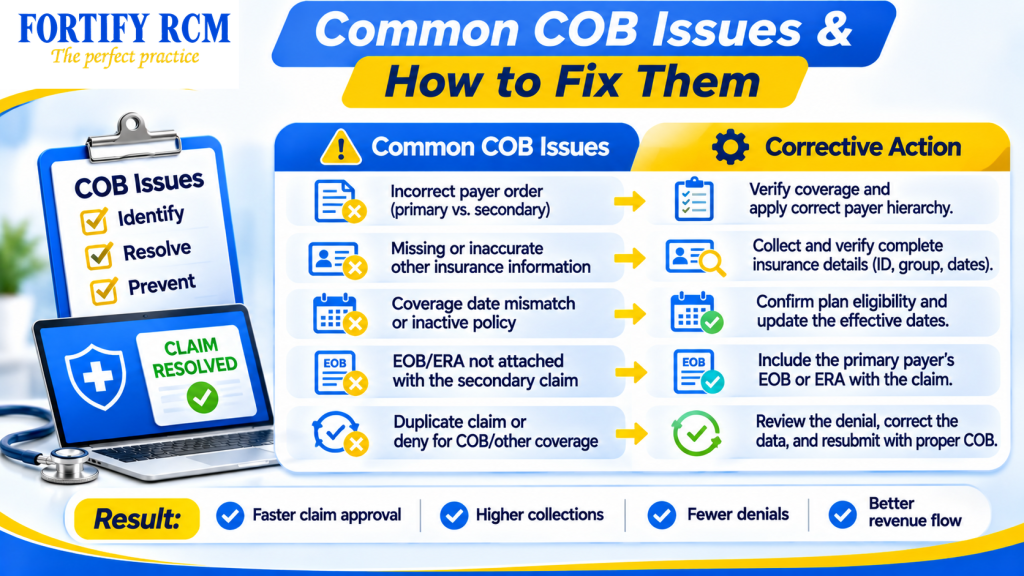
Secondary-claim delays in coordination of benefits medical billing often begin with missing coverage facts, inconsistent payer records, incomplete remittance details, or a handoff without an owner. Treat each coordination of benefits medical billing exception as a work item with evidence and a next action. In coordination of benefits medical billing, resending the same claim without understanding the payer’s message can create duplicates without changing the result.
| Problem | What to check | Corrective action |
|---|---|---|
| Old policy remains on file | Effective dates and patient update | Verify coverage for the service date; retain history |
| Payers disagree on order | Subscriber, employment facts, program and plan rules | Obtain payer clarification; escalate unresolved conflicts |
| Primary EOB/ERA missing | Primary claim status and remittance delivery | Retrieve remittance or confirm adjudication status |
| Secondary claim rejects | Member ID, payer ID, adjustment data, attachment | Correct the stated edit and retain the new acknowledgement |
| Crossover not visible | Eligibility, payer participation, destination record | Confirm forwarding; submit directly only when instructed |
| Balance remains after both payers | Secondary adjudication and contract terms | Reconcile the account and apply approved billing policy |
Track Secondary Claims and Audit Follow-Up
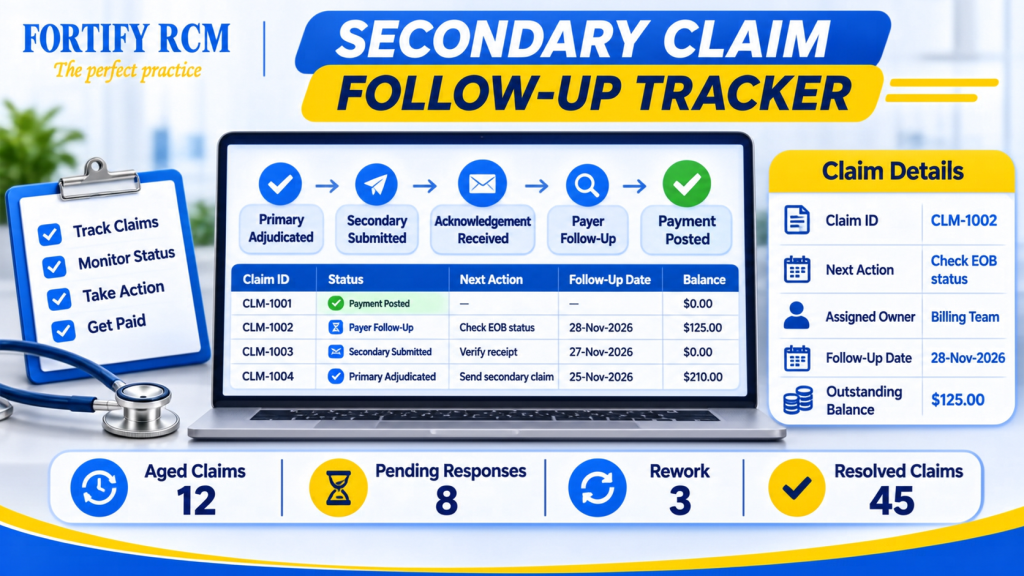
A coordination of benefits medical billing report may combine claims waiting for primary adjudication, claims ready for secondary submission, and claims already sent but not acknowledged. Separate statuses make a coordination of benefits medical billing queue actionable and prevent staff from treating every open balance as the same type of work.
| Status | Meaning | Next action |
|---|---|---|
| COB information needed | Coverage or payer order unclear | Contact patient or payer |
| Primary claim in process | First payer has not adjudicated | Check claim status |
| Primary adjudicated | EOB/ERA is available | Review lines and secondary requirements |
| Secondary ready | Required data assembled | Complete final claim check |
| Secondary submitted | Claim transmitted | Confirm acknowledgement and monitor |
| Returned for correction | Payer or clearinghouse identified an issue | Assign the edit to an owner |
| Secondary adjudicated | Secondary response received | Post and reconcile |
| Escalated | Conflict or delay needs higher-level action | Assign escalation owner and review date |
A coordination of benefits medical billing tracker should include patient-account identifier, service date, provider, primary and secondary payer, verified payer order, primary claim number, adjudication date, EOB/ERA location, secondary submission date, acknowledgement, current status, balance, next action, owner, and last follow-up date. Keep these details in an approved system with role-based access. Do not use an uncontrolled spreadsheet to store protected health information.
Set coordination of benefits medical billing follow-up timing using payer instructions, filing limits, and internal policy; there is no single interval for every plan. Prioritize missing acknowledgements, payer requests, approaching filing limits, unresolved order conflicts, older balances, and repeated corrections. Record the date, contact route, representative or portal reference, response, and promised next step. This makes coordination of benefits medical billing follow-up reproducible rather than dependent on memory.
Practices seeking broader operational support can review Fortify RCM’s revenue cycle management services, which describe eligibility, claims submission, payment posting, and follow-up activities.
Specialties We Serve
For coordination of benefits medical billing, behavioral health, physical and occupational therapy, home health, and physician practices may serve patients with overlapping commercial, Medicare, or Medicaid coverage. Fortify RCM supports workflows connecting eligibility review, claim submission, payment posting, and payer follow-up, with the process tailored to each practice’s services and payer mix.
Mental Health Providers
Credentialing and billing for psychologists, therapists, counselors, and social workers in private or group practice.
Nutritionists & Dietitians
Specialized RCM and credentialing support for MNT providers, licensed dietitians, and wellness nutritionists.
Occupational Therapists
End-to-end billing and enrollment services for pediatric and adult OT clinics and independent therapists.
Non-Emergency Medical Transportation (NEMT)
We handle Medicaid credentialing, EDI setup, and claims billing for NEMT providers.
Home Health Agencies
Complete RCM services tailored for HHAs including Medicare credentialing, OASIS billing, and claims management.
Skilled Nursing Facilities (SNFs)
Credentialing, billing, and AR support for SNFs—compliant with payer-specific guidelines and long-term care needs.
Applied Behavior Analysis (ABA)
We support ABA therapy providers with credentialing, insurance billing, authorization and appeals for denied behavioral health claims.
Chiropractors & Physical Therapists
Credentialing and billing help for musculoskeletal therapy, rehab clinics, and solo practitioners.
Durable Medical Equipment (DME) Providers
We handle Medicare/Medicaid credentialing, EDI setup, and claims submission for DME suppliers.
Nurse Practitioners & Physician Assistants
Complete credentialing and billing support for NPs & PAs operating independently or in group practices.
Dentists & Oral Health Providers
Support with dental insurance credentialing and claims processing for general dentists and specialists.
Vision & Eye Care Specialists
Credentialing and RCM services for optometrists, ophthalmologists, and vision therapy providers.
Frequently Asked Questions
1. What is coordination of benefits in medical billing?
Coordination of benefits medical billing determines the order in which multiple health plans consider a patient’s claim. The primary payer processes first, and another plan may review the claim afterward under its own terms. Coordination of benefits medical billing requires the practice to document coverage facts and the basis for the payer sequence.
2. How does a billing team determine which insurance is primary?
For coordination of benefits medical billing, list active plans, subscriber relationships, coverage dates, employment or retirement facts, and accident or program-specific circumstances. Apply the relevant plan terms and official rules. For Medicare, review CMS MSP guidance; for Medicaid, follow state third-party liability instructions. Card order is not a reliable decision rule.
3. When should a practice submit a secondary claim?
Coordination of benefits medical billing usually proceeds to secondary submission after the primary payer has adjudicated the claim and the practice has the required EOB or ERA data. A crossover may send information automatically in eligible cases, but the practice should confirm receipt. Follow payer instructions for direct submission or additional documentation.
4. What information may be required on a secondary claim?
The secondary payer may need service details, primary payer identification, adjudication results, payments and adjustments, and an EOB attachment. Requirements vary by payer and transaction route. Check the current companion guide rather than assuming every plan uses the same fields.
5. What should staff do if two payers disagree about responsibility?
Verify coverage facts for the service date, ask each payer a clear question, save responses and reference numbers, and escalate the conflict when needed. Do not submit a claim using an unsupported assumption. Correct the account when the payer sequence is clear.
6. How can a practice monitor outstanding secondary claims?
Use separate work-queue statuses for missing information, primary adjudication, secondary readiness, submission, rejection, payer follow-up, and final posting. Assign an owner and next-action date to each open item. Audit sampled accounts to confirm decisions, remittances, submissions, and balances are supported.
Review Your Secondary-Claim Workflow with Fortify RCM
When coordination of benefits medical billing records are incomplete or secondary claims lack clear ownership, a practice can lose visibility into the next required action. Fortify RCM’s coordination of benefits medical billing support may involve claim submission, EOB/ERA reconciliation, payment posting, and follow-up activities. Learn about Claims Submission & Payment Posting and how those functions may fit your billing process.
For a broader view, explore Fortify RCM Services, review published pricing, or browse the Fortify RCM blog library for related revenue-cycle topics. Confirm the service scope for your payer mix, claim volume, and internal responsibilities.
If your team is reviewing payer-order verification, secondary submission, or follow-up ownership, contact Fortify RCM to discuss the current process and whether a workflow review would be useful. Start by mapping how an account moves from registration to primary adjudication, secondary submission, and final reconciliation.