
Outsourcing revenue cycle management can give a healthcare practice access to specialized billing support, but it may also allow another organization to handle information connected to patients, claims, payments, and insurance coverage. Before a vendor receives system access, the practice should understand what information will move, who can view it, how it will be protected, and how responsibilities will be documented.
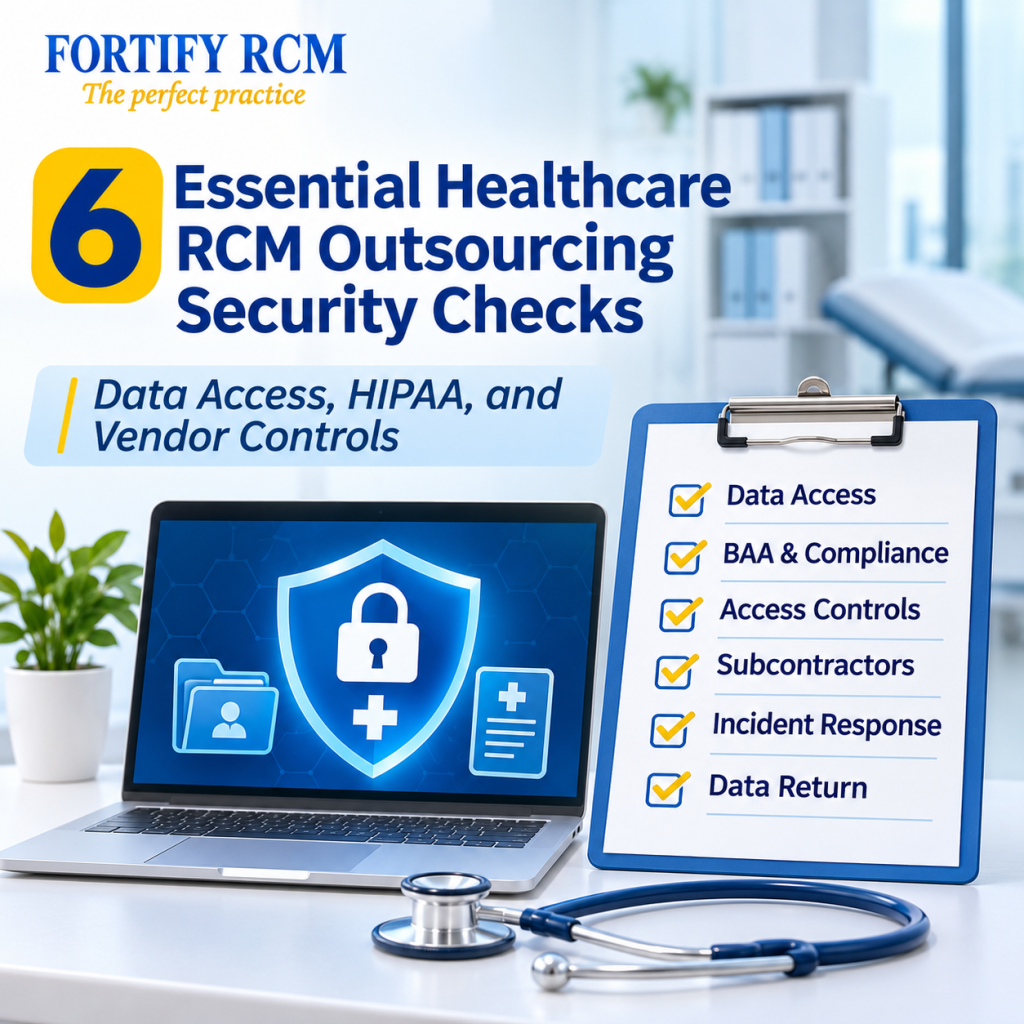
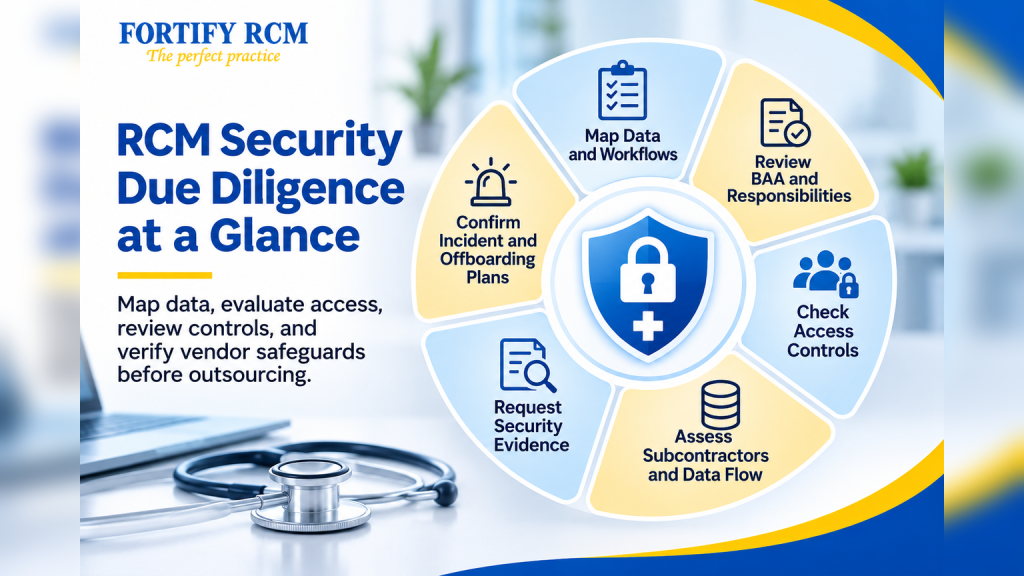
A structured healthcare RCM outsourcing security review should examine more than a vendor’s promise to follow HIPAA. It should test actual workflows, contractual safeguards, user access, subcontractors, evidence, incident procedures, and exit arrangements. The six checks below help practice owners, administrators, compliance leads, and IT teams evaluate a new engagement or renewal.
Why Security Due Diligence Matters in Healthcare RCM Outsourcing
RCM workflows may include registration, eligibility, claim submission, payment posting, denial follow-up, and accounts receivable. Depending on the scope, teams may handle patient identifiers, insurance details, diagnosis information, remittance data, and other protected health information (PHI).
A vendor’s access should therefore be evaluated as part of the practice’s broader privacy and security environment—not treated as a routine administrative arrangement. A healthcare RCM outsourcing security review helps the practice connect its billing workflows with the safeguards that apply to the information being handled.
Identify the information and systems involved
Ask what information the vendor will create, receive, maintain, or transmit. List the systems involved, including the EHR, practice management platform, clearinghouse, payer portals, file exchange, and reporting tools.
A healthcare RCM outsourcing security review should map the actual data flows. Include:
Information: PHI and other data needed for each task.
Users: Roles and reasons for access.
Subcontractors: Organizations that may handle or host data.
Copies and retention: Exports, temporary files, and storage periods.
Treat security as an operating requirement
Vendor controls affect confidentiality, billing accuracy, and availability. Consider the impact of unauthorized access, system outages, or unavailable records on daily operations—not only the possibility of a reportable breach.
The HIPAA Security Rule requires appropriate administrative, physical, and technical safeguards for electronic PHI. HHS risk analysis guidance addresses threats and vulnerabilities involving ePHI an organization creates, receives, maintains, or transmits. No checklist alone guarantees compliance.
Start with the HHS Risk Analysis Guidance and HIPAA Security Rule overview. Apply these resources to the practice’s own healthcare RCM outsourcing security risks.
Business Associate Agreement and Responsibility Boundaries
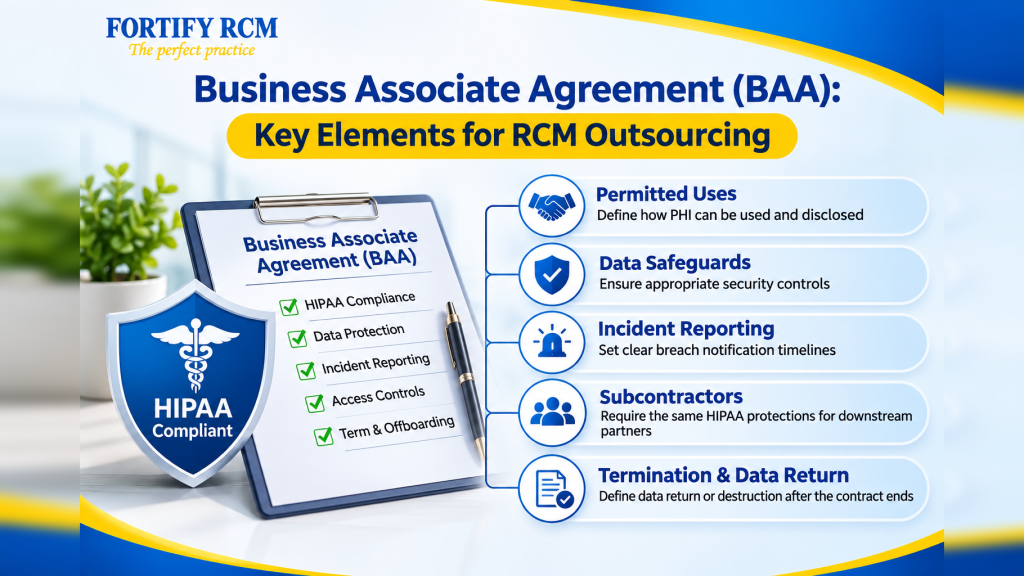
A Business Associate Agreement (BAA) is central to many RCM arrangements involving PHI. A general services contract or confidentiality statement is not a substitute for a required HIPAA agreement.
A medical billing or RCM company generally acts as a business associate when it performs billing functions involving PHI for a covered entity. HHS includes billing and claims processing among business associate functions. See HHS Business Associate guidance.
The BAA establishes contractual obligations, but does not by itself prove that a vendor’s systems are secure. It is one element of healthcare RCM outsourcing security.
What should the BAA cover?
Have qualified legal or compliance counsel review the agreement and scope of work.
| BAA provision | What the practice should check |
|---|---|
| Permitted uses | Purposes for which the vendor may use or disclose PHI |
| Safeguards | Appropriate protections for PHI |
| Incident reporting | How incidents and breaches are reported |
| Individual rights | Support for applicable access, amendment, and accounting duties |
| Subcontractors | Flow-down of applicable restrictions and conditions |
| Termination | Return or destruction of PHI where feasible |
| Retained data | Continued protections where return or destruction is infeasible |
Broad promises such as “the vendor will maintain data security” may be insufficient. Specify reporting, access, subcontractor, and termination responsibilities.
Review the HHS sample BAA provisions, then compare the agreement with actual workflows during your healthcare RCM outsourcing security review. The sample is not a substitute for legal advice.
Make operational ownership explicit
A BAA does not transfer every compliance duty to the vendor. Both parties must assign responsibility for access, accounts, training, monitoring, incident reporting, and corrective action.
The practice may control EHR and payer portal permissions while the vendor manages employee onboarding. Document access requests, approvals, changes, and removal when access is no longer needed.
Use a responsibility matrix listing each control, owner, evidence, and escalation contact. This makes healthcare RCM outsourcing security easier to review at onboarding and renewal.
Access and Security Controls Every Practice Should Review
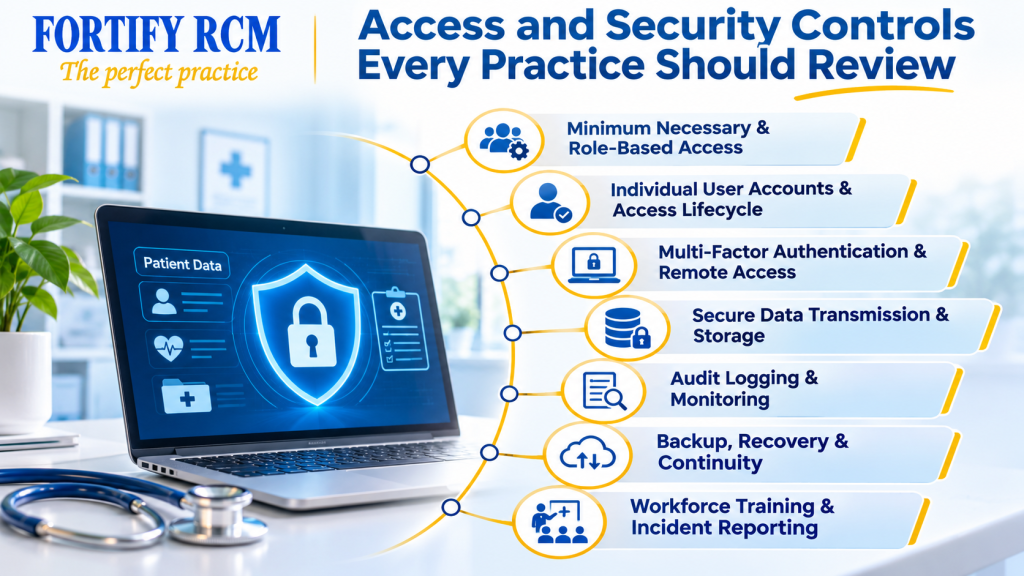
A healthcare RCM outsourcing security review should test everyday controls, not just written policies. Ask for evidence relevant to the services and systems involved.
1. Minimum necessary and role-based access
Give each employee access appropriate to assigned duties. Ask how roles, exceptions, and periodic permission reviews are approved and documented.
2. Individual accounts and access lifecycle
Use unique accounts, not shared credentials. Define who approves access, records role changes, and disables accounts when workers leave. The practice should retain control of its EHR and payer portal permissions.
Include periodic access reviews in the healthcare RCM outsourcing security checklist. A user list should show role, access level, business reason, and review date.
3. Authentication and remote access
Ask whether multifactor authentication (MFA) protects remote and privileged access. Review password recovery, failed-login monitoring, administrative accounts, and the systems covered.
4. Secure transmission and storage
Ask how information is protected in transit and at rest, which file-transfer tools are approved, and how shared folders are restricted. Prohibit personal email and uncontrolled downloads for PHI.
5. Audit logging and monitoring
Ask whether logins, record access, billing changes, exports, and administrative actions are logged. Confirm who reviews alerts, how long logs are kept, and whether records are available for investigations.
6. Backup, recovery, and continuity
Ask what is backed up, who restores it, how recovery is tested, and how billing continues during outages. Clarify how the practice can retrieve essential records.
7. Workforce training and incident reporting
Train PHI-handling employees on secure handling, phishing, approved channels, and incident reporting. Ask how initial and refresher training is documented.
Use NIST SP 800-66 Rev. 2 to frame vendor questions. It is implementation guidance, not a certification. Evaluate the answers against your healthcare RCM outsourcing security risk analysis.
Subcontractors, Data Lifecycle, and Vendor Due Diligence
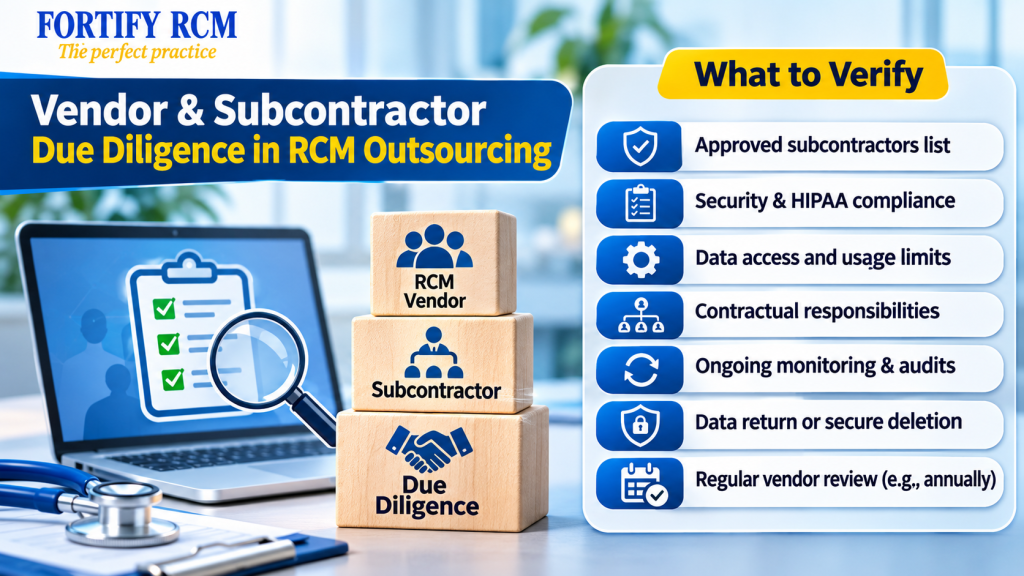
RCM vendor due diligence should identify technology providers, cloud service providers, document processors, and other subcontractors that may access PHI.
An effective healthcare RCM outsourcing security review traces PHI beyond the primary vendor and confirms how downstream safeguards apply.
Ask who else may handle the information
Ask which subcontractors handle PHI, what services they provide, what information they access, and which contractual safeguards apply.
HIPAA requires applicable contractual protections to flow down to subcontractors handling PHI. Confirm that agreements are in place and changes are reviewed as part of healthcare RCM outsourcing security due diligence.
Follow the full information lifecycle
| Stage | Due-diligence question |
|---|---|
| Collection | What information is received and from which source? |
| Access | Which employees and subcontractors can use it? |
| Storage | Where is it stored and what safeguards apply? |
| Transfer | Which approved channels are used? |
| Retention | What determines how long it is kept? |
| Return | How will the practice receive records at termination? |
| Destruction | How are eligible copies destroyed and documented? |
Include exports, temporary files, and support records. A healthcare RCM outsourcing security checklist should follow information through each system and approved subcontractor.
Agree on data return and retention before signing
The BAA should address return or destruction of PHI at termination where feasible. If neither is feasible, it should address continued protection and restricted use of retained information.
Agree on data formats, subcontractor copies, transition access, and written confirmation. These steps make healthcare RCM outsourcing security more reliable when a contract ends.
Vendor Evidence Review: What Should a Practice Request?
Vendor answers are only a starting point. Request evidence relevant to the services, systems, and PHI involved to test healthcare RCM outsourcing security claims.
Build a focused evidence request
| Evidence to request | What it helps evaluate |
|---|---|
| Security policies | Whether responsibilities and processes are documented |
| Risk analysis summary | Whether risks to ePHI have been assessed |
| Access procedure | How accounts and permissions are managed |
| Training summary | Whether relevant employees receive training |
| Incident response plan | How reports are escalated and investigated |
| Backup and recovery overview | How availability and restoration are addressed |
| Subcontractor information | Whether downstream access and agreements are managed |
| Independent assessment, if available | Scope and results of an external review |
| Retention and destruction procedure | How data is kept, returned, or destroyed |
A vendor may provide summaries or redacted reports. Agree on what evidence is needed and review only material relevant to the practice’s services. Make this part of healthcare RCM outsourcing security oversight. Retain the evidence with the practice’s vendor review records and record open items in its healthcare RCM outsourcing security register.
Ask scenario-based questions
Test scenarios such as an employee leaving, a misdirected file, a subcontractor change, or an access review. Ask who acts, when the practice is notified, and what evidence is retained.
Interpret reports and audit rights carefully
Review an assessment’s period, systems, locations, exceptions, and open remediation; it may not cover every purchased service.
HHS states that HIPAA does not expressly require a cloud service provider that is a business associate to provide security documentation or customer audits. Customers may negotiate additional assurances or audit rights in their contracts.
Review HHS guidance on cloud service providers. It applies to CSPs that are business associates. Document negotiated evidence and review rights as part of healthcare RCM outsourcing security oversight.
Incident and Offboarding Readiness: A Practical Risk Review Matrix
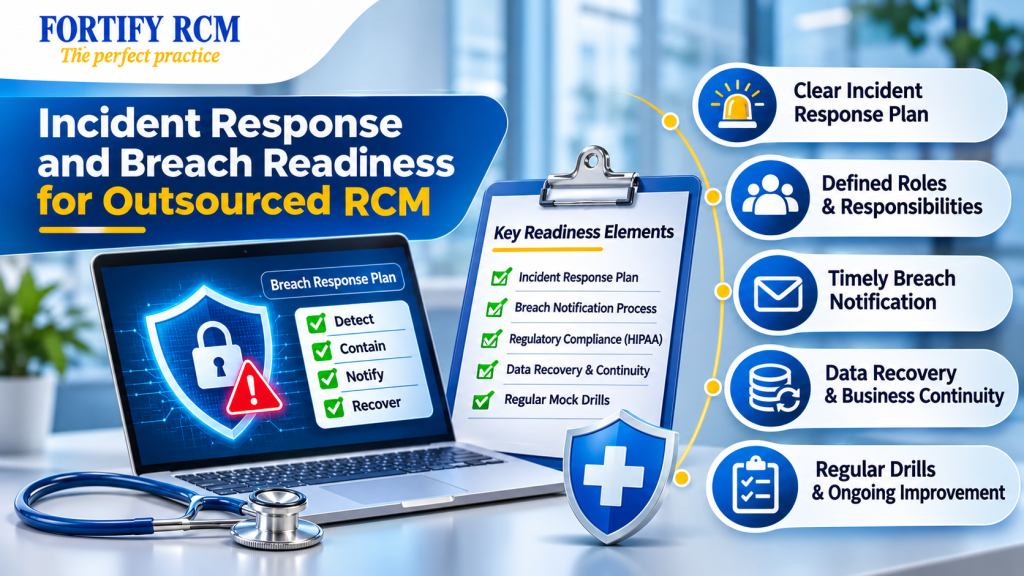
Vendors need clear incident and termination procedures. The practice should know how issues are reported, investigations supported, and billing records preserved.
Define incident notification and escalation
Define notification contacts, escalation methods, required information, and communication timelines in the BAA and operating procedures. Cover suspected incidents as well as confirmed breaches.
Under the HIPAA Breach Notification Rule, a business associate must notify the covered entity of a breach of unsecured PHI without unreasonable delay and no later than 60 calendar days after discovery. This is an outside limit, not a recommended target; practices may negotiate shorter notice periods. See the HHS Breach Notification Rule.
A healthcare RCM outsourcing security plan should define who receives notice, what facts are supplied, how evidence is preserved, and how both parties coordinate the investigation.
Use a practical risk review matrix
Set practice-specific risk ratings and escalation thresholds for each item.
| Review area | Warning sign | Follow-up action |
|---|---|---|
| User access | Shared accounts | Require individual accounts and role reviews |
| Employee exit | No removal process | Define notification and deactivation |
| Data transfer | Unapproved tools | Approve secure channels and train users |
| Audit monitoring | No clear log review | Request process and evidence |
| Subcontractors | Unknown downstream access | Identify subcontractors and confirm agreements |
| Incident response | Unclear timing | Agree contacts and contractual deadlines |
| Data retention | No return or destruction process | Document requirements |
| Offboarding | No transition plan | Create an exit checklist |
Record findings and prepare offboarding
Record each gap, evidence, impact, owner, due date, and corrective action. Resolve critical issues before granting access and escalate significant concerns.
Before services begin, agree how the practice will:
Confirm the termination date and transition owner.
Identify vendor users with access to practice systems.
Revoke EHR, payer portal, and application accounts.
Retrieve required reports, claim histories, and records.
Address retained copies and subcontractor access.
Preserve information needed for appeals, audits, or continuity.
Obtain written confirmation of agreed completed actions.
A documented exit plan makes healthcare RCM outsourcing security a continuing responsibility.
Specialties We Serve
Security needs vary by specialty. Fortify RCM lists mental health, ABA, home health, NEMT, DME, and dental among its provider markets. Each practice should confirm that access controls fit its workflows. A specialty-aware healthcare RCM outsourcing security review should consider the systems and records involved.
Mental Health Providers
Credentialing and billing for psychologists, therapists, counselors, and social workers in private or group practice.
Nutritionists & Dietitians
Specialized RCM and credentialing support for MNT providers, licensed dietitians, and wellness nutritionists.
Occupational Therapists
End-to-end billing and enrollment services for pediatric and adult OT clinics and independent therapists.
Non-Emergency Medical Transportation (NEMT)
We handle Medicaid credentialing, EDI setup, and claims billing for NEMT providers.
Home Health Agencies
Complete RCM services tailored for HHAs including Medicare credentialing, OASIS billing, and claims management.
Skilled Nursing Facilities (SNFs)
Credentialing, billing, and AR support for SNFs—compliant with payer-specific guidelines and long-term care needs.
Applied Behavior Analysis (ABA)
We support ABA therapy providers with credentialing, insurance billing, authorization and appeals for denied behavioral health claims.
Chiropractors & Physical Therapists
Credentialing and billing help for musculoskeletal therapy, rehab clinics, and solo practitioners.
Durable Medical Equipment (DME) Providers
We handle Medicare/Medicaid credentialing, EDI setup, and claims submission for DME suppliers.
Nurse Practitioners & Physician Assistants
Complete credentialing and billing support for NPs & PAs operating independently or in group practices.
Dentists & Oral Health Providers
Support with dental insurance credentialing and claims processing for general dentists and specialists.
Vision & Eye Care Specialists
Credentialing and RCM services for optometrists, ophthalmologists, and vision therapy providers.
Frequently Asked Questions About Healthcare RCM Outsourcing Security
1. What should a practice ask an RCM vendor about HIPAA?
Ask whether the vendor is a business associate, whether a BAA will be signed, what PHI it accesses, which subcontractors may handle it, and how incidents are reported. Request evidence of access controls, training, safeguards, and retention. Start your healthcare RCM outsourcing security review with these questions.
2. Is a BAA required for an outsourced medical billing company?
A medical billing company handling PHI for a HIPAA covered entity generally qualifies as a business associate. The covered entity should have an appropriate written BAA before disclosing PHI. Have counsel review the arrangement.
3. How should a practice control outsourced billing staff access?
Use unique accounts, role-based permissions, approved requests, periodic reviews, and timely account removal. Check authentication, remote access, logs, and secure transfer. These are core healthcare RCM outsourcing security controls. Review them whenever the vendor adds a system, user group, or billing task.
4. What security evidence should an RCM vendor provide?
Request security policies, risk analysis information, access procedures, training, incident response, backup information, subcontractor details, and retention procedures. Check the scope and date of independent assessments.
5. What happens to PHI when an RCM outsourcing agreement ends?
The BAA should address PHI return or destruction where feasible, and continued protection where it is not. Agree on formats, transition access, subcontractor copies, retention, and completion records in the healthcare RCM outsourcing security review.
Review Your RCM Vendor’s Security Before Granting Access
Choose an outsourced RCM partner based on more than service scope and billing capabilities. A documented healthcare RCM outsourcing security review helps practices track what information moves, who can access it, incident handling, and termination arrangements.
Reviewing the BAA, access controls, subcontractors, evidence, incident response, and offboarding can expose gaps early. A documented healthcare RCM outsourcing security process helps the practice compare vendors consistently. For contract considerations, read Fortify RCM’s guide to pricing and contract checks for an RCM outsourcing company.
Explore Fortify RCM’s revenue cycle management services, service offerings, and pricing information. To discuss your workflows, contact the Fortify RCM team.