
Choosing a revenue cycle management outsourcing company requires more than comparing service fees. Practices must understand what services are included, how additional charges work, and whether the contract clearly defines performance, data security, and responsibilities. This guide covers seven essential pricing and contract checks to help healthcare practices make informed RCM outsourcing decisions.
Start by Defining the Exact RCM Scope
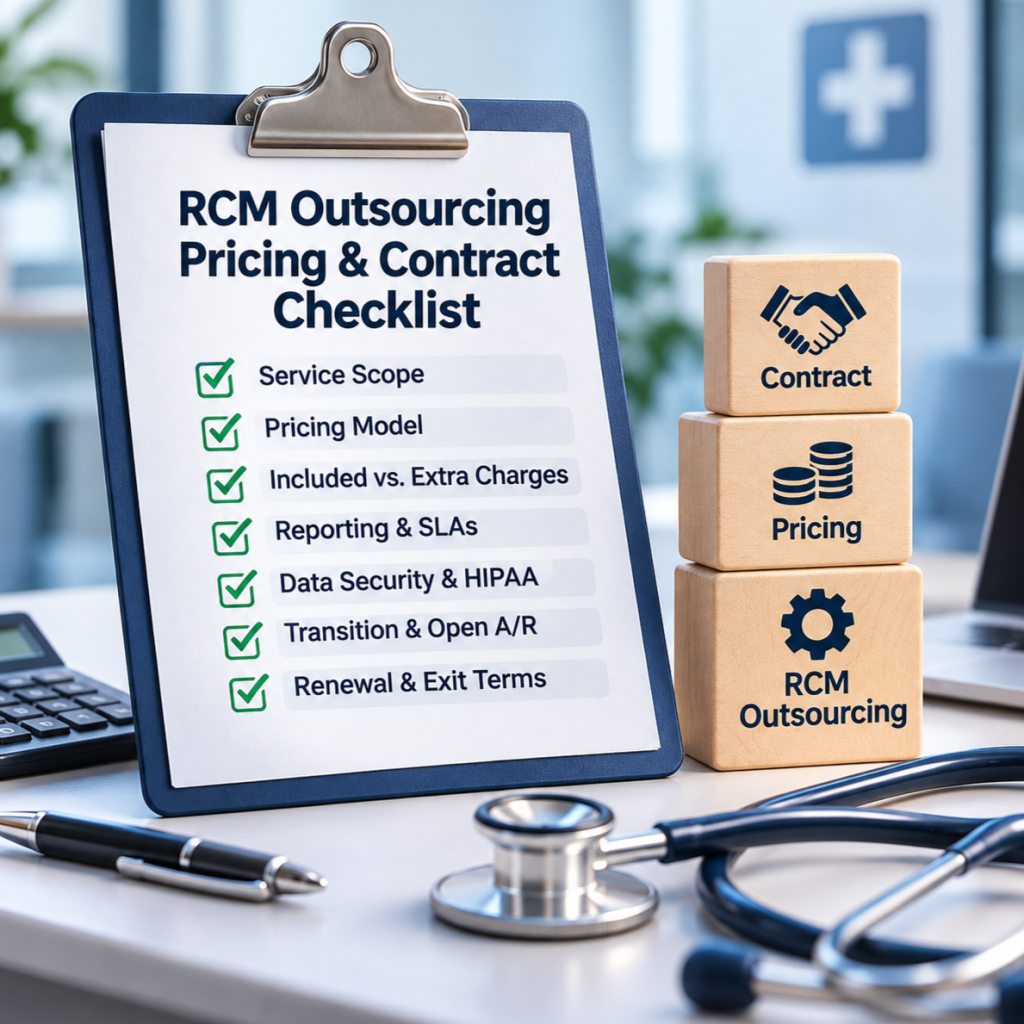
Before comparing the pricing of a revenue cycle management outsourcing company, establish which activities your practice actually needs. A proposal cannot be evaluated accurately unless every provider is quoting against a comparable scope of work.
Revenue cycle management includes multiple administrative activities, beginning with patient registration and insurance verification and continuing through claims submission, payment posting, denial resolution, and accounts receivable follow-up.
Some practices require comprehensive revenue cycle management outsourcing services, while others only need support with specific billing functions.
For example, an independent medical practice may need assistance with claim submission and payment posting but prefer to retain patient communication and front-office responsibilities internally. A growing multi-provider organization may require broader support, including eligibility verification, denial management, and aged A/R follow-up.
Before requesting proposals, document the following:
-
Services required: Identify whether you need eligibility verification, claims submission, payment posting, denial management, or complete RCM support.
-
Services excluded: List activities that will remain with your internal employees.
-
Claim volume: Estimate monthly claim submissions and the number of providers covered.
-
Payer mix: Identify the major commercial, Medicare, and Medicaid payer relationships relevant to your practice.
-
Existing A/R: Establish whether outstanding claims from previous months will be included.
-
Technology: Document your existing EHR, practice management system, and clearinghouse arrangements.
A revenue cycle management outsourcing company should provide a written description of its responsibilities rather than relying on general statements such as complete billing support.
Ask for a service scope document that identifies each task, its assigned owner, expected frequency, and escalation process.
This also makes it easier to compare revenue cycle management outsourcing services from different providers without confusing a limited billing package with a comprehensive RCM arrangement.
Check 1: Compare Pricing Models on the Same Basis
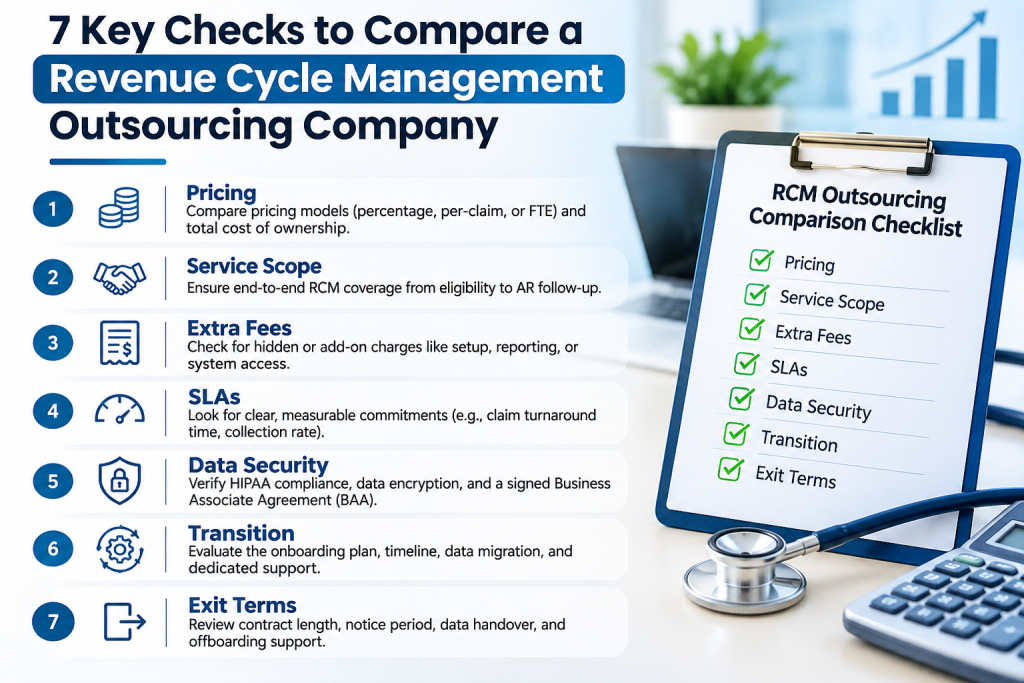
The first financial check is understanding how the revenue cycle management outsourcing company calculates its fees.
RCM providers may offer different commercial arrangements depending on service scope, claim volume, provider count, and operational requirements.
Common pricing structures include:
1. Percentage of collections
The provider charges an agreed percentage of defined collections. This model can align the service fee with collected revenue, but the contract must explain exactly which collections are included.
For example, clarify whether the calculation includes insurance payments only or also patient payments, copayments, deductibles, and other balances.
2. Fixed monthly fee
A practice pays an agreed recurring amount for a defined package of services. This can make monthly budgeting easier, provided the contract clearly identifies volume limits and additional charges.
3. Per-claim pricing
The provider charges according to the number of claims processed. This structure may be useful when claim volumes are predictable, but practices should confirm whether rejected claims, corrected claims, and resubmissions are charged separately.
4. Dedicated staffing or FTE-based pricing
Some arrangements charge for assigned billing personnel or dedicated operational resources. The agreement should explain staffing levels, working hours, supervision, and replacement arrangements.
How to compare two proposals
Consider the following hypothetical illustration:
| Pricing component | Provider A | Provider B |
|---|---|---|
| Monthly base fee | $1,500 | $1,200 |
| Additional reporting | Included | $150 |
| Onboarding | $500 | $300 |
| Denial follow-up | Included | Additional |
| Monthly fee before other extras | $1,500 | $1,350 |
Provider B appears less expensive initially. However, additional denial-management charges could change the total cost.
This is why practices should compare the total expected cost rather than choosing the revenue cycle management outsourcing company with the lowest advertised fee.
Ask every shortlisted provider to calculate its proposal using the same service requirements and an agreed billing period.
Check 2: Identify Included Services and Additional Charges
A competitive-looking RCM proposal does not necessarily include every activity your practice expects.
Before signing, request a detailed breakdown of included services, optional services, and excluded responsibilities.
Potential additional charges may relate to:
-
Initial account setup and onboarding.
-
Historical claims and aged A/R cleanup.
-
Denial appeals and complex claim investigations.
-
Additional provider or location onboarding.
-
Custom reporting and analytics.
-
Software integrations or third-party technology.
-
Special projects and out-of-scope administrative work.
-
Transition assistance when changing providers.
These charges are not automatically inappropriate. The important issue is whether they are disclosed, agreed upon, and connected to clearly defined deliverables.
Ask these questions before accepting the proposal
-
Are all claims included within the quoted fee?
-
Are rejected claims and corrected claims charged separately?
-
Is historical A/R management included?
-
Are denial appeals part of the standard service?
-
Are there additional charges for new providers?
-
Can the provider introduce new charges without written approval?
A revenue cycle management outsourcing company should explain what happens when the practice’s workload increases beyond the original agreement.
For example, if a practice adds two providers or opens another location, the agreement should explain how pricing will be adjusted.
Avoid accepting vague clauses that permit additional charges without an agreed pricing method or approval process.
A written fee schedule provides a more reliable foundation for comparing revenue cycle management outsourcing services and controlling unexpected expenditure.
Check 3: Define Service Levels, Deliverables, and Reporting
Pricing alone cannot establish whether an outsourcing relationship will perform as expected. Practices also need measurable service expectations.
A professional revenue cycle management outsourcing company should explain how it measures operational activity, communicates issues, and reports progress.
The contract should distinguish between activity-based deliverables and outcome-based performance indicators.
For example, submitting claims within an agreed processing window is an operational commitment. Improving collections or reducing denials is an outcome that can depend on multiple factors, including payer behaviour, documentation quality, coding accuracy, and the practice’s existing workflows.
Important RCM KPIs to discuss
Clean claim rate: Measures the percentage of claims accepted for processing without initial rejection or correction, according to an agreed definition.
Days in accounts receivable: Indicates the average time outstanding insurance and patient balances remain in A/R. Define which balances and calculation method are included.
Denial rate: Measures the proportion of claims denied during the selected reporting period. Specify whether the denominator is claims submitted, claims adjudicated, or another agreed population.
First-pass resolution rate: Tracks claims processed successfully without requiring rework, using a clearly documented definition.
Net collection rate: Measures collections against an agreed collectible amount, with appropriate adjustments for contractual obligations.
A/R aging: Shows outstanding balances grouped into aging periods, such as 0–30, 31–60, 61–90, and over 90 days.
Put reporting expectations in writing
The agreement should specify:
-
Which reports will be provided.
-
How frequently reports will be delivered.
-
Who reviews and approves performance reports.
-
How unresolved issues are escalated.
-
How performance targets are calculated.
-
What happens when agreed service levels are repeatedly missed.
Ask the revenue cycle management outsourcing company to provide sample reports using fictional or properly de-identified information.
Also establish baseline performance before outsourcing begins. Without a baseline, it becomes difficult to distinguish actual operational improvement from changes in claim volume, payer mix, or outstanding balances.
For further context, practices can review the CMS Medicare Claims Processing Manual when assessing relevant Medicare billing and claims-processing requirements.
Check 4: Review Privacy, Data Security, and Business Associate Responsibilities
Healthcare billing involves sensitive patient and financial information. Therefore, data protection should be a central part of every RCM outsourcing agreement.
If an outsourcing provider qualifies as a HIPAA business associate because it performs functions involving protected health information on behalf of a covered entity, the parties generally need an appropriate Business Associate Agreement (BAA).
The agreement should not simply state that the provider follows HIPAA requirements. It should describe the actual responsibilities, safeguards, and permitted uses of protected health information.
Important security and contractual checks
Business Associate Agreement: Confirm that an appropriate written BAA is executed before the provider handles PHI.
Access controls: Establish which personnel can access practice systems and patient information.
User authentication: Understand how individual users are identified and authenticated.
Audit logs: Confirm whether access and system activity can be recorded and reviewed.
Data transmission: Understand how information is transferred and protected.
Incident reporting: Define how suspected security incidents and reportable breaches will be communicated and escalated.
Subcontractors: Establish whether subcontractors can access PHI and how applicable contractual safeguards are passed down.
Data retention: Determine how information is retained, returned, or securely destroyed when the relationship ends.
The US Department of Health and Human Services provides official guidance on Business Associate Contract Requirements.
Its HIPAA Security Rule guidance also explains the importance of administrative, physical, and technical safeguards.
Practices should ask the revenue cycle management outsourcing company to explain its security processes and provide appropriate supporting documentation.
A signed BAA alone should not be treated as proof that every security risk has been addressed. Practices should review their own compliance responsibilities and obtain appropriate legal or security advice.
Check 5: Clarify Transition, Open A/R, Renewal, and Exit Terms
The final financial and contractual checks concern what happens throughout the outsourcing relationship, particularly when services begin, change, or end.
An agreement may have attractive pricing but still create operational difficulties if ownership of outstanding claims and patient balances is unclear.
A. Transition and onboarding responsibilities
Before the revenue cycle management outsourcing company starts working on live accounts, agree on:
-
Implementation responsibilities and milestones.
-
Required system access and user permissions.
-
Existing claim and A/R data transfer.
-
Payer portal access and clearinghouse coordination.
-
Workflow testing and validation.
-
Staff communication and training.
-
Go-live approval and escalation arrangements.
Do not assume that every transition can be completed within the same number of days. Timelines depend on system access, payer requirements, data quality, practice size, and the agreed scope.
B. Ownership of open A/R
This is particularly important when changing billing providers.
The agreement should establish:
-
Who works claims submitted before the transition date.
-
Who follows up on previously denied claims.
-
Who manages appeals already in progress.
-
How pending payer responses are monitored.
-
How outstanding balances are reconciled.
-
Who receives and reviews payment information.
Create a documented opening A/R inventory so both parties can identify which accounts are assigned to each team.
C. Renewal and termination clauses
Review the agreement’s initial term, renewal conditions, notice period, and termination provisions.
Check whether the contract includes minimum commitments, automatic renewal, early termination charges, and requirements for ending the relationship.
D. Data return and operational handover
The agreement should explain how the practice receives its records and operational information when services end.
This may include:
-
Claim and payment records.
-
A/R aging reports.
-
Denial and appeal histories.
-
Supporting billing documentation.
-
Relevant account status information.
-
Access transfer and system deactivation.
-
PHI return or destruction in accordance with applicable contractual and legal requirements.
A revenue cycle management outsourcing company should provide a practical handover process that helps prevent disruption to billing operations.
Have qualified legal counsel review important contract provisions before signing. This article provides general business guidance, not legal advice.
Specialties We Serve
Fortify RCM supports healthcare organizations with revenue cycle management and billing services across multiple specialties, including mental health providers, nutritionists and dietitians, occupational therapists, NEMT providers, home health agencies, skilled nursing facilities, ABA providers, chiropractors and physical therapists, DME providers, nurse practitioners, physician assistants, dentists, and vision care specialists. Our approach focuses on understanding each practice’s operational requirements and providing relevant billing and RCM support.
Mental Health Providers
Credentialing and billing for psychologists, therapists, counselors, and social workers in private or group practice.
Nutritionists & Dietitians
Specialized RCM and credentialing support for MNT providers, licensed dietitians, and wellness nutritionists.
Occupational Therapists
End-to-end billing and enrollment services for pediatric and adult OT clinics and independent therapists.
Non-Emergency Medical Transportation (NEMT)
We handle Medicaid credentialing, EDI setup, and claims billing for NEMT providers.
Home Health Agencies
Complete RCM services tailored for HHAs including Medicare credentialing, OASIS billing, and claims management.
Skilled Nursing Facilities (SNFs)
Credentialing, billing, and AR support for SNFs—compliant with payer-specific guidelines and long-term care needs.
Applied Behavior Analysis (ABA)
We support ABA therapy providers with credentialing, insurance billing, authorization and appeals for denied behavioral health claims.
Chiropractors & Physical Therapists
Credentialing and billing help for musculoskeletal therapy, rehab clinics, and solo practitioners.
Durable Medical Equipment (DME) Providers
We handle Medicare/Medicaid credentialing, EDI setup, and claims submission for DME suppliers.
Nurse Practitioners & Physician Assistants
Complete credentialing and billing support for NPs & PAs operating independently or in group practices.
Dentists & Oral Health Providers
Support with dental insurance credentialing and claims processing for general dentists and specialists.
Vision & Eye Care Specialists
Credentialing and RCM services for optometrists, ophthalmologists, and vision therapy providers.
Frequently Asked Questions
1. What should I check before choosing a revenue cycle management outsourcing company?
Before selecting a revenue cycle management outsourcing company, review its service scope, pricing structure, reporting process, security practices, specialty experience, and contract terms. Request a written proposal that clearly explains responsibilities and additional charges.
2. How does a revenue cycle management outsourcing company determine its pricing?
A revenue cycle management outsourcing company may calculate fees using a percentage of collections, a fixed monthly fee, per-claim pricing, or dedicated staffing arrangements. Pricing generally depends on claim volume, provider count, services required, and operational complexity.
3. Which services should a revenue cycle management outsourcing company include?
The services depend on your practice requirements. Common offerings include insurance eligibility verification, claims submission, payment posting, denial management, accounts receivable follow-up, and reporting. Always confirm which activities are included in the quoted fee.
4. How can I compare proposals from different RCM providers?
Compare proposals using the same service requirements, claim volume, and pricing assumptions. Ask each revenue cycle management outsourcing company to provide a breakdown of included services, additional fees, reporting standards, implementation costs, and contract conditions.
5. What security questions should I ask a revenue cycle management outsourcing company?
Ask about HIPAA compliance responsibilities, Business Associate Agreements, employee access controls, data encryption, audit logs, incident reporting, subcontractor access, and data retention. The provider should explain how protected health information is handled and safeguarded.
6. Who manages outstanding accounts receivable when changing RCM providers?
The practice should establish written responsibility for outstanding claims, unpaid balances, denials, and appeals before transitioning. Confirm that the new revenue cycle management outsourcing company has a documented handover process and access to the necessary billing records.
7. Which KPIs should an outsourced RCM provider report?
Important KPIs include clean claim rate, denial rate, days in accounts receivable, net collection rate, first-pass resolution rate, and A/R aging. Agree on calculation methods, reporting frequency, performance baselines, and escalation procedures with your provider.
8. Does a revenue cycle management outsourcing company need a Business Associate Agreement?
When a revenue cycle management outsourcing company performs functions involving protected health information on behalf of a HIPAA covered entity, it generally qualifies as a business associate. An appropriate Business Associate Agreement should establish permitted data uses, disclosures, and safeguarding responsibilities.
9. Can a revenue cycle management outsourcing company support multiple healthcare specialties?
Yes. A revenue cycle management outsourcing company may support multiple specialties depending on its operational experience, payer knowledge, billing workflows, and available resources. Practices should verify relevant specialty experience before finalizing an agreement.
10. What should I review before signing an RCM outsourcing contract?
Review the complete service scope, pricing, additional charges, service-level expectations, reporting obligations, data protection provisions, transition responsibilities, renewal conditions, and termination clauses. Ensure that your revenue cycle management outsourcing company clearly documents responsibilities, open A/R ownership, and data-return arrangements.
Make a More Informed RCM Outsourcing Decision with Fortify RCM
Choosing a revenue cycle management outsourcing company should involve more than comparing service fees. Your practice needs clear pricing, defined responsibilities, reliable reporting, appropriate data protection, and an agreement that supports long-term operational continuity.
At Fortify RCM, we understand that every healthcare practice has different billing requirements and operational priorities. Our services include eligibility and benefits verification, claims submission, payment posting, denial management, EDI/ERA/EFT setup, and revenue cycle management support.
Our pricing information outlines the current RCM fee structure and the services included in the offering.
If you are reviewing outsourced RCM options, we can help you understand the available services and discuss which support model may align with your practice’s requirements.
Explore Fortify RCM Pricing or Contact Our Team to discuss your current billing workflows, service requirements, and operational goals.
Fortify RCM — Helping healthcare practices manage their revenue cycle with greater clarity and accountability.