
Prior authorization delays can disrupt patient care, increase administrative workload, and create revenue-cycle problems for healthcare practices. Missing documentation, incorrect service details, and delayed follow-ups can turn routine requests into costly problems.
Effective prior authorization denial management connects verification, documentation, tracking, and billing review to reduce errors and protect practice revenue. A repeatable prior authorization denial management workflow gives each request a clear owner.
Understanding Prior Authorization and Its Impact on Revenue
Prior authorization is a payer review that may be required before a specific medical service, procedure, medication, or treatment is provided. It helps determine whether the requested service meets the payer’s applicable coverage criteria. Requirements vary by insurer, plan, service, and patient coverage, so practices must verify the rules that apply to each request. This is why prior authorization denial management begins with plan-specific verification.
Authorization, referral, precertification, and medical necessity are related but different concepts. A referral may direct a patient to another provider, while prior authorization is a payer review of a planned service. Medical necessity refers to the clinical justification for that service. Confusing these requirements can create gaps in the workflow. Keeping them distinct is a basic control in prior authorization denial management.
Authorization problems may lead to delayed services, rescheduled appointments, administrative rework, or claim denials. Even an approval does not guarantee payment. Eligibility, coding, coverage, documentation, timely filing, and other payer requirements may still apply. A reliable prior authorization denial management process connects pre-service checks with scheduling, clinical teams, and billing operations.
For Medicare-related programs, providers should understand how CMS prior authorization and pre-claim review initiatives distinguish a prior authorization decision made before services from a pre-claim review decision made before claim submission. Commercial payer rules and individual plan requirements may differ. For that reason, prior authorization denial management should begin before the appointment is confirmed.
7 Strategies to Prevent Prior Authorization Denials

Preventing authorization issues requires a repeatable workflow rather than waiting for a denial to identify a problem. These strategies help practices improve prior authorization denial management across the request lifecycle. Together, they make prior authorization denial management part of daily operations.
1. Verify Insurance and Authorization Requirements
Confirm the patient’s active coverage, payer, plan details, and authorization requirements before scheduling or providing the service. Eligibility verification does not necessarily mean authorization is unnecessary. Check the payer’s current policy for the specific service and member plan. This initial verification helps prevent avoidable submission errors. It is the first control in prior authorization denial management.
2. Submit Complete Clinical Documentation
Include relevant clinical notes, diagnosis details, procedure information, test results, treatment history, and supporting records requested by the payer. Documentation should address the applicable clinical criteria rather than simply providing unrelated records. Focused records make requests easier to review and help prevent delays. Complete records are central to prior authorization denial management.
3. Check Procedure and Provider Details
Verify the requested service, procedure code, provider, facility, units, and dates wherever applicable. Incorrect or inconsistent details can create a mismatch between the authorization and the service eventually performed. Confirm that approved information is available to the teams that need it. This handoff is an important control in prior authorization denial management.
4. Track Every Authorization Request
Maintain a centralized tracker for submitted, pending, approved, denied, and additional-information requests. Assign an owner and next action to every unresolved case. This is a practical foundation for prior authorization denial management because it prevents requests from disappearing into individual inboxes or disconnected spreadsheets.
5. Follow Up on Pending Requests
Do not allow requests to remain pending without review. Monitor them according to payer response expectations and upcoming service dates. Escalate urgent cases through the appropriate payer process and document each communication. Timely outreach is a core part of prior authorization denial management.
6. Communicate Approval Details Across Teams
Share approval status and relevant conditions with scheduling, clinical, and billing teams. The authorization number alone may not provide the full picture; dates, service scope, provider, location, and approved units may also matter. Sharing those details reduces handoff errors. Clear handoffs keep prior authorization denial management from ending at approval.
7. Review Denial Trends Regularly
Analyze authorization-related denials to identify recurring issues such as incomplete records, incorrect codes, missed submission steps, or poor follow-up. Use findings to update checklists, staff training, and payer-specific workflows. Regular review makes prior authorization denial management a prevention activity rather than only a response to rejected claims.
CMS explains changes under its Interoperability and Prior Authorization Final Rule (CMS-0057-F), including requirements for impacted payers to provide specific denial reasons and use prior authorization APIs on implementation timelines. Practices should check the rule’s scope rather than assume it applies to every payer or service.
Documentation Checklist for Authorization Requests
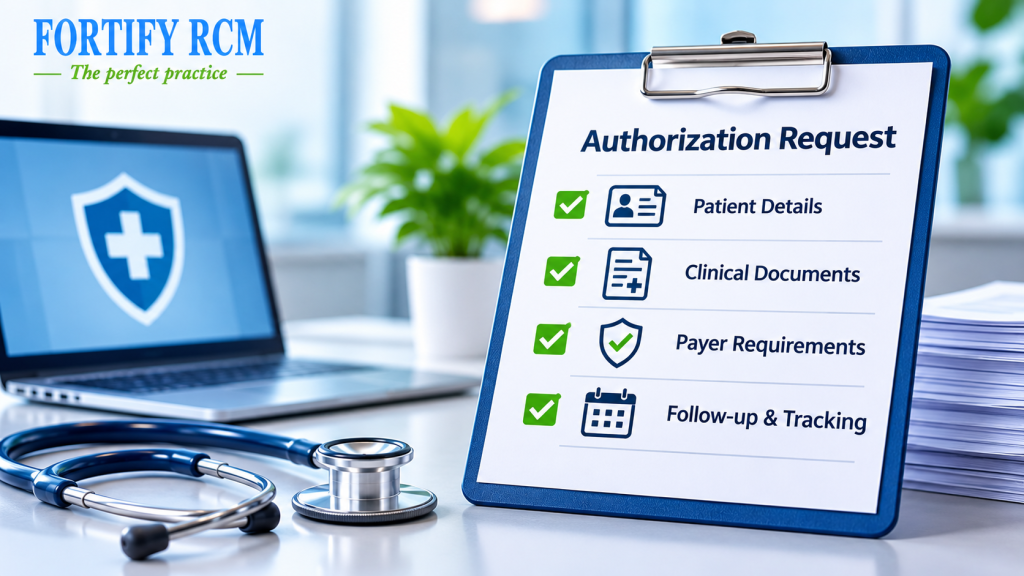
Incomplete or inconsistent documentation can delay payer review or contribute to an unfavorable decision. Before submitting a request, staff should confirm that required information is available, accurate, and relevant to the service. This review is a practical checkpoint in prior authorization denial management.
Pre-submission checklist
-
Patient demographics and insurance member ID
-
Payer and plan information
-
Ordering and rendering provider details, when required
-
Diagnosis and clinical indication
-
Procedure or service details
-
CPT or HCPCS codes, where applicable
-
Requested date of service
-
Units, visits, or treatment frequency, when required
-
Relevant clinical notes and progress records
-
Test results or imaging reports, when applicable
-
Previous treatments and outcomes, where clinically relevant
-
Medical-necessity supporting documentation
-
Required payer forms or clinical questionnaires
-
Submission confirmation and tracking number
Practices should not rely on generic notes when a payer requests specific clinical evidence. Records should clearly support the requested service and answer the payer’s stated questions. A standardized checklist supports prior authorization denial management by helping staff identify missing details before submission and reducing avoidable back-and-forth. Teams should use the same review steps for every relevant case to make prior authorization denial management consistent.
For example, a procedure request may need a recent progress note, relevant imaging, a documented treatment history, and a clear explanation of why the proposed service is appropriate. Exact requirements depend on the payer and service. Staff should use the payer’s current instructions rather than assume one checklist satisfies every plan. Consistent checklist use makes prior authorization denial management repeatable across staff and locations.
Common Denial Reasons and Corrective Actions

Authorization denials should be reviewed individually. Resubmitting the same information without understanding the reason may delay resolution. Review the denial notice, payer portal, and related communication before deciding on the next step. Careful investigation is essential to prior authorization denial management. Teams should use prior authorization denial management to address the documented cause rather than resubmit blindly.
| Denial or issue | Possible reason | Corrective action |
|---|---|---|
| Authorization not found | Request was not submitted or confirmation was not retained | Verify the original submission and obtain proof |
| Insufficient clinical information | Supporting records do not address payer criteria | Review the requirements and submit relevant documentation |
| Incorrect procedure details | Code, provider, units, or service information mismatch | Correct the request and verify all details |
| Authorization expired | Service falls outside the approved dates | Review payer requirements and request updated authorization if necessary |
| Wrong payer or plan | Coverage information was inaccurate | Reverify eligibility and submit to the correct payer |
| Additional information required | Payer needs clarification or supporting records | Assign an owner and respond within the applicable timeframe |
| Medical necessity denial | Clinical criteria may not be satisfied or adequately supported | Review the payer’s rationale and applicable reconsideration or appeal options |
An effective prior authorization denial management workflow records the denial reason, action taken, responsible staff member, submission dates, payer communication, and final resolution. This record helps practices identify whether a problem arose from intake, documentation, submission, or follow-up. Root-cause review turns the process into continuous improvement. A denial log gives prior authorization denial management a clear record of recurring issues and corrective actions.
For Medicare review cases, CMS review reason codes and statements can help providers understand standardized reasons associated with certain review decisions. Practices should still use the specific payer notice and applicable program rules when choosing a response.
Authorization Tracking and Follow-Up Workflow
Pending requests can create operational problems when the service date approaches without a clear decision. A centralized tracking system helps staff prioritize cases, maintain accountability, and make prior authorization denial management easier to monitor. An up-to-date tracker is central to prior authorization denial management. It also gives managers a practical view of workload and aging requests.
Essential tracking fields
| Tracking field | Purpose |
|---|---|
| Patient reference | Identify the case securely |
| Payer and plan | Confirm the insurance destination |
| Service or procedure | Identify the requested treatment |
| Request submission date | Track request age |
| Confirmation number | Verify submission |
| Status | Submitted, pending, approved, denied, or additional information requested |
| Last follow-up | Maintain communication history |
| Next action date | Prevent missed follow-up |
| Service date | Prioritize time-sensitive requests |
| Authorization details | Record approval number, dates, scope, and units, when applicable |
| Assigned owner | Establish accountability |
| Escalation notes | Record unresolved problems |
Follow-up process
-
Verify that the request was received by the payer.
-
Review pending requests against the payer’s stated or applicable response timeframe.
-
Prioritize cases with upcoming service dates.
-
Contact the payer when follow-up is due.
-
Record the response, reference number, and next action.
-
Escalate unresolved or urgent cases through the appropriate channel.
-
Inform the relevant team if the service may be affected.
For certain impacted payers and non-drug medical items and services, CMS describes decision timeframes of up to seven calendar days for standard requests and 72 hours for expedited requests, subject to applicable requirements. These are not universal deadlines for every insurer or request. Review CMS guidance on improving prior authorization processes and confirm which rules apply to the payer and plan involved.
A useful tracker should show both the current status and the next owner action. Managers can review cases approaching the scheduled service date, requests awaiting clinical records, and cases that have exceeded the payer’s stated response window. This visibility helps teams keep prior authorization denial management consistent without treating every request as equally urgent. A documented owner makes prior authorization denial management easier to audit.
Team Responsibilities and Process Improvement

Authorization management involves several teams. Without defined ownership, requests may remain unresolved because each department assumes another team is responsible. Clear roles strengthen prior authorization denial management and make it easier to identify where a process breaks down. Managers should assign accountability for prior authorization denial management at each handoff.
Scheduling team: Identify services that may require authorization and flag appointments with unresolved requests.
Clinical team: Provide relevant documentation, answer clinical questions, and support the medical rationale when additional information is requested.
Authorization team: Verify payer requirements, submit requests, monitor status, follow up, document communication, and coordinate corrections.
Billing team: Check authorization details where applicable and flag discrepancies between the approved service and the billed service.
RCM supervisor: Review unresolved cases, recurring denial reasons, staff workload, and corrective actions.
Practices can strengthen the process through standardized checklists, centralized work queues, exception alerts, staff training, and regular denial reviews. Useful performance measures include authorization-related denial rate, percentage of requests submitted with complete documentation, pending requests by age, follow-up compliance, and recurring denial reasons. Reviewing these indicators helps teams assess prior authorization denial management objectively. Strong prior authorization denial management also depends on reviewing whether corrective actions have actually reduced repeat issues.
The goal is not simply to process requests faster. A strong program reduces avoidable errors, improves communication, and gives the practice a repeatable method for addressing payer requirements. The AMA’s prior authorization practice resources provide additional tools and guidance for reviewing authorization burden and workflows.
Specialties We Serve
Prior authorization requirements can vary across orthopedics, cardiology, radiology, pain management, behavioral health, and other specialty practices. Each specialty may require different clinical records, procedure details, payer criteria, and follow-up processes. Specialty-sensitive prior authorization denial management should reflect those differences. Fortify RCM supports healthcare practices in improving revenue-cycle coordination, billing accuracy, and operational consistency. Learn more about the healthcare specialties and services supported by Fortify RCM.
Mental Health Providers
Credentialing and billing for psychologists, therapists, counselors, and social workers in private or group practice.
Nutritionists & Dietitians
Specialized RCM and credentialing support for MNT providers, licensed dietitians, and wellness nutritionists.
Occupational Therapists
End-to-end billing and enrollment services for pediatric and adult OT clinics and independent therapists.
Non-Emergency Medical Transportation (NEMT)
We handle Medicaid credentialing, EDI setup, and claims billing for NEMT providers.
Home Health Agencies
Complete RCM services tailored for HHAs including Medicare credentialing, OASIS billing, and claims management.
Skilled Nursing Facilities (SNFs)
Credentialing, billing, and AR support for SNFs—compliant with payer-specific guidelines and long-term care needs.
Applied Behavior Analysis (ABA)
We support ABA therapy providers with credentialing, insurance billing, authorization and appeals for denied behavioral health claims.
Chiropractors & Physical Therapists
Credentialing and billing help for musculoskeletal therapy, rehab clinics, and solo practitioners.
Durable Medical Equipment (DME) Providers
We handle Medicare/Medicaid credentialing, EDI setup, and claims submission for DME suppliers.
Nurse Practitioners & Physician Assistants
Complete credentialing and billing support for NPs & PAs operating independently or in group practices.
Dentists & Oral Health Providers
Support with dental insurance credentialing and claims processing for general dentists and specialists.
Vision & Eye Care Specialists
Credentialing and RCM services for optometrists, ophthalmologists, and vision therapy providers.
FAQs
1. What is prior authorization denial management?
It is the process of identifying, tracking, investigating, and resolving authorization-related denials while improving workflows to prevent recurring errors. It includes verification, documentation, follow-up, communication, and review of denial trends.
2. What are common reasons for prior authorization denials?
Common issues include missing clinical documentation, incorrect service information, payer requirements not being followed, expired approvals, authorization not being obtained, or insufficient supporting information. The exact reason should be confirmed from the payer’s notice. Documenting that reason is an important part of prior authorization denial management.
3. Does an approved prior authorization guarantee claim payment?
No. Authorization does not necessarily guarantee payment. Claims may still be subject to eligibility, coverage, coding, documentation, medical necessity, timely filing, and other payer requirements.
4. How can healthcare practices reduce authorization denials?
Practices can verify payer requirements, submit complete records, check procedure details, monitor pending requests, communicate approval information, and review denial patterns regularly. A documented workflow helps teams apply these steps consistently. Practices can use these recurring checks to strengthen prior authorization denial management.
5. How should pending authorization requests be monitored?
A centralized tracker should include the request date, payer, service date, status, assigned owner, last follow-up, next action, and escalation details. Cases should be prioritized according to urgency and payer response expectations. This structure supports consistent prior authorization denial management.
6. Why is authorization follow-up important?
Follow-up helps identify delays, missing information, and unresolved requests before they affect scheduled services or downstream billing. It also creates a record of payer communication and the actions taken by the practice.
Reduce Authorization Errors and Protect Your Revenue Cycle
Repeated authorization problems can consume staff time, disrupt scheduling, and contribute to avoidable billing issues. A standardized process helps healthcare practices improve documentation coordination, request tracking, payer follow-up, and denial analysis.
Fortify RCM works with healthcare practices to strengthen revenue-cycle workflows, improve billing operations, and identify opportunities to reduce administrative inefficiencies. A structured approach to prior authorization denial management can sit alongside these broader revenue-cycle controls. Explore Fortify RCM’s revenue cycle management services to understand how billing support, eligibility verification, claims submission, payment posting, and denial follow-up fit into a coordinated workflow. Practices needing support with claim processing can also review claims submission and payment posting services.
If your team is struggling with pending requests, recurring authorization-related denials, or inconsistent follow-up, reviewing the current workflow can be a valuable first step. You can review Fortify RCM’s service options and pricing or discuss your practice’s needs directly through the Fortify RCM contact page. A focused discussion can help identify where additional operational support may fit your practice’s requirements.