Unprocessed credentialing paperwork and prolonged payer enrollment backlogs can stall your medical practice’s monthly revenue flow. At Fortify RCM, we deliver comprehensive credentialing services for providers, driving swift network participation across Medicare, Medicaid, and leading private insurance carriers. Whether you are expanding an established medical group or onboarding fresh practitioners, our team navigates the tedious administrative hurdles so your clinical team can concentrate on delivering quality care.
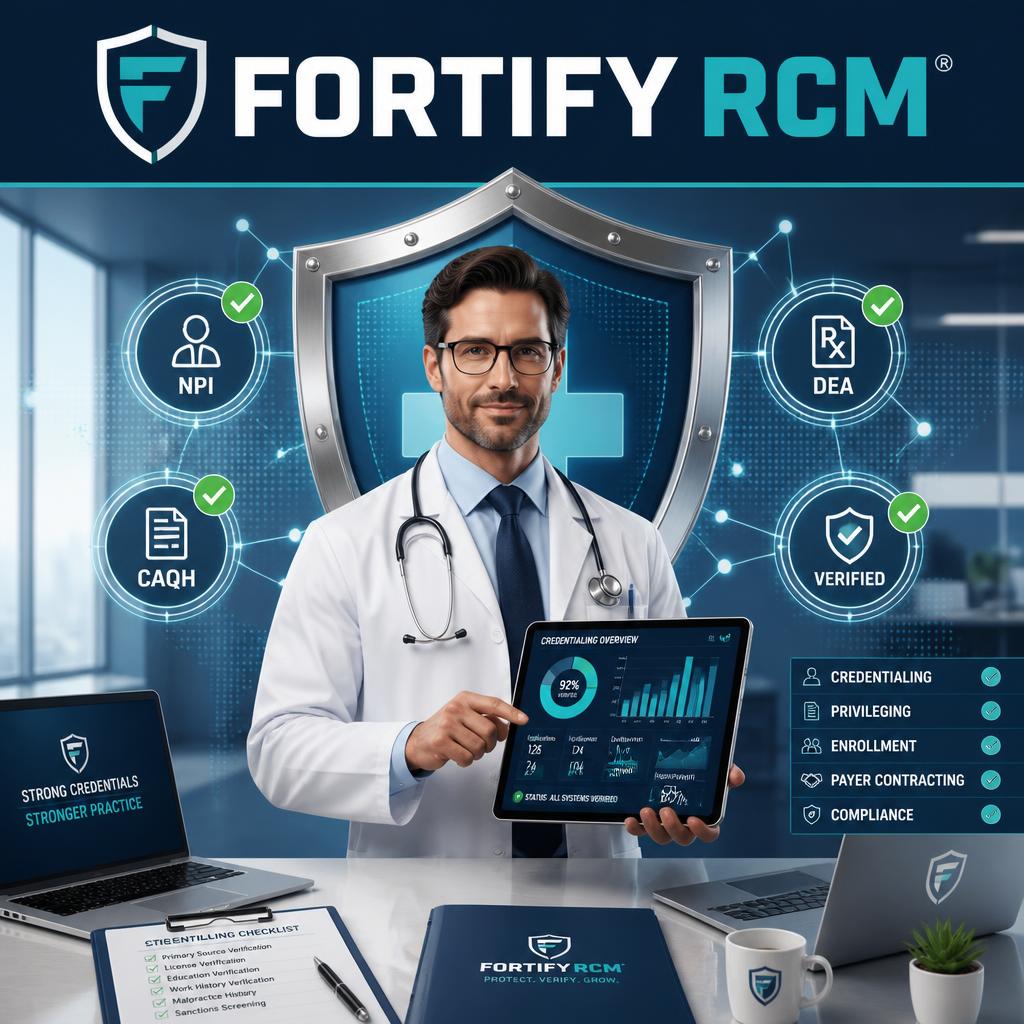
Why Modern Medical Practices Rely on Credentialing Services for Providers
A smooth medical credentialing workflow serves as the engine of an effective healthcare revenue cycle. However, complex payer requirements, tedious verification checks, and changing state regulations often lead to administrative bottlenecks.
-
Protect Practice Cash Flow: Unapproved practitioners are legally unable to submit insurance claims, causing stuck billing and permanent financial leakages.
-
Remove Staff Workload: In-house billing teams waste valuable hours holding on calls with payer representatives. Strategic outsourcing frees up internal staff for clinical operations.
-
Ensure Regulatory Compliance: By utilizing structured credentialing services for providers, you maintain rigorous compliance standards across primary source verification (PSV), board certifications, and active state medical licenses.
Our Step-by-Step Provider Onboarding Framework
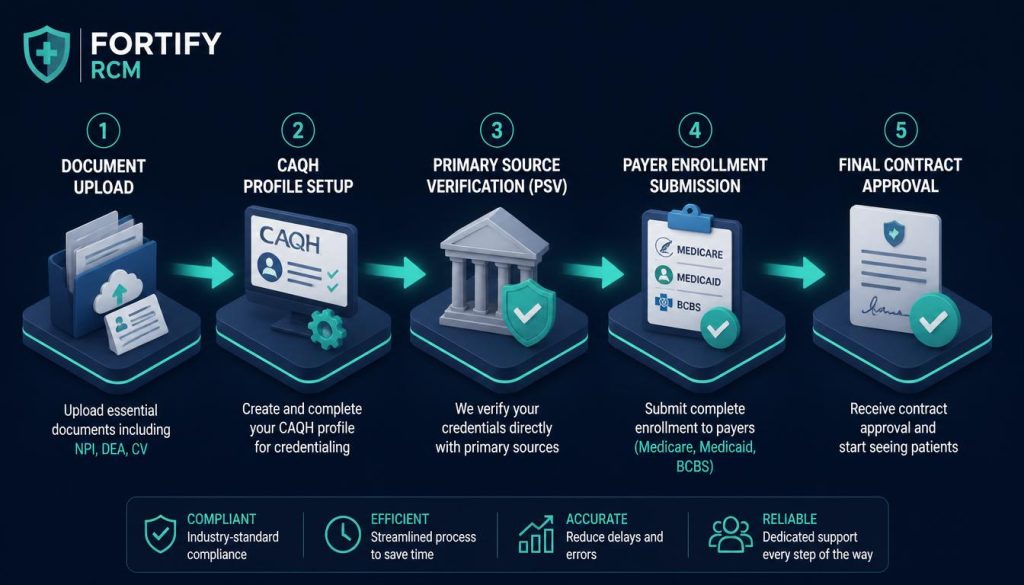
Through our expert credentialing services for providers, we deploy a streamlined, step-by-step strategy designed to accelerate turnaround times while minimizing application errors:
-
Document Intake & Pre-Audit: We gather and meticulously verify every necessary provider credential (NPI numbers, state licenses, board credentials, malpractice COI, DEA certificates, and CVs).
-
CAQH Profile Management & Attestation: Our team creates or updates your CAQH ProView repository, maintaining timely attestations to prevent profile expirations.
-
Multi-Payer Application Filing: Through our credentialing services for providers, we submit error-free credentialing packets across selected commercial, Medicare, and Medicaid payer panels.
-
Primary Source Verification (PSV): We independently cross-check credentials and background qualifications directly with issuing regulatory boards.
-
Proactive Payer Follow-Up: Specialists conduct weekly check-ins with payer credentialing committees to push applications through approval queues faster.
-
Contract & Fee Schedule Optimization: Upon network approval, we help review contract terms and fee schedules to secure optimal reimbursement rates.
Payer Networks Covered Under Our Enrollment Services
Our credentialing services for providers span an extensive matrix of national, regional, and government insurance programs:
-
Commercial Payer Networks: Blue Cross Blue Shield (BCBS), Aetna, Cigna, UnitedHealthcare (UHC), Humana, and Kaiser Permanente.
-
Specialized Panels: Behavioral health networks, Managed Care Organizations (MCOs), and Workers’ Compensation insurance boards.
Everyday Credentialing Bottlenecks We Eliminate
-
Protracted Approval Delays: Traditional enrollment timelines drag on for 3 to 4 months. By utilizing professional credentialing services for providers, our proactive tracking methods significantly cut down unnecessary waiting periods.
-
Application Rejections & Resubmissions: Simple clerical mistakes or unaccounted gaps in a provider’s CV often trigger instant rejections. We audit every detail prior to submission.
-
Lapsed Attestations & Outdated Records: We systematically monitor expiration dates for licenses, DEA renewals, and re-credentialing windows to safeguard against unexpected panel drops.
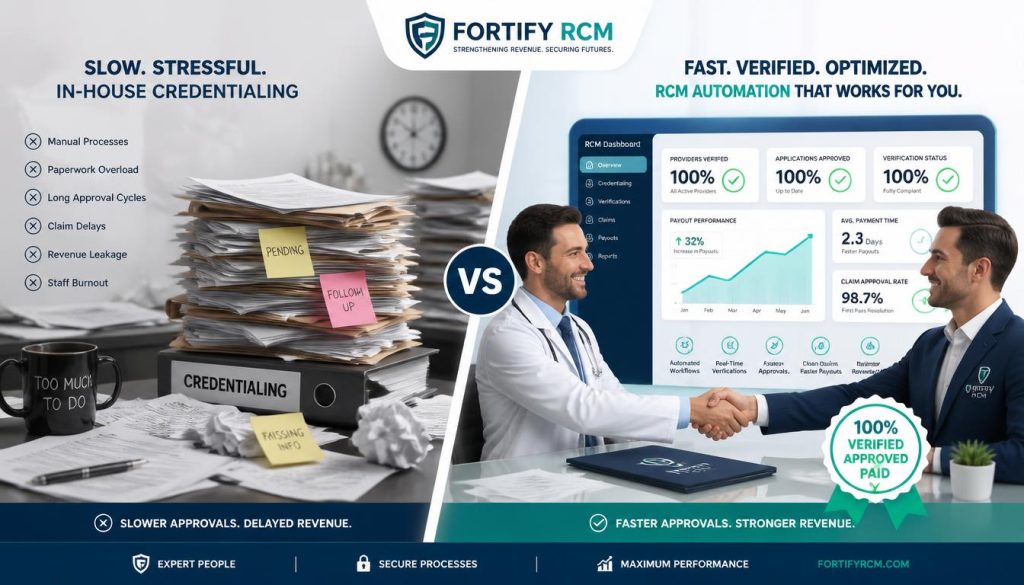
In-House Operations vs. Outsourced Provider Credentialing Services
Assigning credentialing duties to internal billing staff frequently creates operational strain. Here is why choosing specialized credentialing services for providers yields better operational output:
-
Dedicated Credentialing Experts: While internal administrative staff handle multiple clinic duties, our credentialing services for providers connect you with dedicated specialists who focus solely on payer communications and audit requirements.
-
Reduced Overhead Costs: Maintaining dedicated in-house credentialing personnel inflates payroll and software licensing expenses. Outsourcing provides a flexible, performance-aligned service model.
-
Accelerated Enrollment Speeds: Direct lines of communication with payer network managers enable us to resolve application holds much faster than traditional in-house channels.
Essential Documentation for Provider Enrollment
To guarantee a smooth onboarding process when opting for credentialing services for providers, practices should compile a clean digital repository of practitioner credentials. We assist in auditing:
-
Individual & Business Identifiers: Type 1 & Type 2 NPI credentials, state medical licenses, and board certification records.
-
Clinic & Financial Credentials: Form W-9, official physical location details, EFT banking info, and billing taxonomy codes.
-
Certificates & Experience Logs: Active DEA/CDS certificates, malpractice insurance face sheets (COI), and a fully structured CV formatted in Month/Year sequence without unaccounted time gaps.
Healthcare Specialties We Serve
Fortify RCM proudly offers credentialing services in West Virginia for a wide range of healthcare professionals and organizations. Whether you’re an independent provider or a growing group practice, our team ensures your credentials are properly managed with each payer you choose to work with.
Mental Health Providers
Credentialing and billing for psychologists, therapists, counselors, and social workers in private or group practice.
Nutritionists & Dietitians
Specialized RCM and credentialing support for MNT providers, licensed dietitians, and wellness nutritionists.
Occupational Therapists
End-to-end billing and enrollment services for pediatric and adult OT clinics and independent therapists.
Non-Emergency Medical Transportation (NEMT)
We handle Medicaid credentialing, EDI setup, and claims billing for NEMT providers.
Home Health Agencies
Complete RCM services tailored for HHAs including Medicare credentialing, OASIS billing, and claims management.
Skilled Nursing Facilities (SNFs)
Credentialing, billing, and AR support for SNFs—compliant with payer-specific guidelines and long-term care needs.
Applied Behavior Analysis (ABA)
We support ABA therapy providers with credentialing, insurance billing, authorization and appeals for denied behavioral health claims.
Chiropractors & Physical Therapists
Credentialing and billing help for musculoskeletal therapy, rehab clinics, and solo practitioners.
Durable Medical Equipment (DME) Providers
We handle Medicare/Medicaid credentialing, EDI setup, and claims submission for DME suppliers.
Nurse Practitioners & Physician Assistants
Complete credentialing and billing support for NPs & PAs operating independently or in group practices.
Dentists & Oral Health Providers
Support with dental insurance credentialing and claims processing for general dentists and specialists.
Vision & Eye Care Specialists
Credentialing and RCM services for optometrists, ophthalmologists, and vision therapy providers.
Frequently Asked Questions (FAQs)
1: How long does it usually take to finish provider credentialing?
On average, insurance payers take between 60 and 90 days to complete enrollment. However, when delivering credentialing services for providers, our specialists execute constant follow-ups with network representatives to expedite application reviews wherever possible.
2: Which primary documents are required to begin the provider credentialing process?
To start, you need an active state medical license, NPI registration, DEA certificate, board credentials, a detailed CV (with month/year dates and explained gaps), malpractice coverage policy face sheets, and a signed W-9 form.
3: Is a healthcare provider allowed to render services while credentialing is pending?
Certain commercial payers allow retroactive reimbursement billing once the final contract is executed. However, when utilizing credentialing services for providers, our team ensures clear guidance so you know when claims can be safely submitted following official approval.
4: How does provider enrollment differ from medical credentialing?
Credentialing is the background assessment phase where an insurer validates a provider’s qualifications, training, and license status. Enrollment is the subsequent administrative action that connects the verified provider to a practice’s billing contract so claims can be processed.
5: What is the standard frequency for provider re-credentialing?
Most commercial insurance panels and government health programs require re-credentialing every 2 to 3 years. Tracking re-credentialing schedules is essential to prevent unexpected claim holds or temporary network termination.
6: What makes CAQH attestation critical for insurance enrollment?
CAQH (Council for Affordable Quality Healthcare) operates as a centralized provider database for health plans. Profiles require re-attestation every 120 days; failing to keep this repository updated can stall pending enrollment applications or hold up claim payouts.
7: What steps does Fortify RCM take to avoid application holds and rejections?
As part of our credentialing services for providers, we perform rigorous pre-submission checks across every document, form, and CV entry to identify and correct discrepancies beforehand. Additionally, our team initiates direct weekly check-ins with payer credentialing committees.
On average, insurance payers take between 60 and 90 days to complete enrollment. However, when delivering credentialing services for providers, our specialists execute constant follow-ups with network representatives to expedite application reviews wherever possible.
To start, you need an active state medical license, NPI registration, DEA certificate, board credentials, a detailed CV (with month/year dates and explained gaps), malpractice coverage policy face sheets, and a signed W-9 form.
Certain commercial payers allow retroactive reimbursement billing once the final contract is executed. However, when utilizing credentialing services for providers, our team ensures clear guidance so you know when claims can be safely submitted following official approval.
Credentialing is the background assessment phase where an insurer validates a provider’s qualifications, training, and license status. Enrollment is the subsequent administrative action that connects the verified provider to a practice’s billing contract so claims can be processed.
Most commercial insurance panels and government health programs require re-credentialing every 2 to 3 years. Tracking re-credentialing schedules is essential to prevent unexpected claim holds or temporary network termination.
CAQH (Council for Affordable Quality Healthcare) operates as a centralized provider database for health plans. Profiles require re-attestation every 120 days; failing to keep this repository updated can stall pending enrollment applications or hold up claim payouts.
As part of our credentialing services for providers, we perform rigorous pre-submission checks across every document, form, and CV entry to identify and correct discrepancies beforehand. Additionally, our team initiates direct weekly check-ins with payer credentialing committees.
Transform Your Practice Cash Flow with Fortify RCM
Stop letting slow payer enrollment hold back your monthly billing. Team up with Fortify RCM for dependable, transparent, and accurate credentialing services for providers.