
Healthcare providers must complete several administrative requirements before participating in insurance networks and billing for covered services. Incomplete records, inconsistent information, and missed follow-ups can complicate enrollment and create extra work for practice administrators.
The medical credentialing process helps verify a provider’s professional qualifications and prepare the information required by healthcare organizations and insurance payers. Depending on the provider and payer, this may involve reviewing licenses, education, training, professional history, and malpractice coverage.
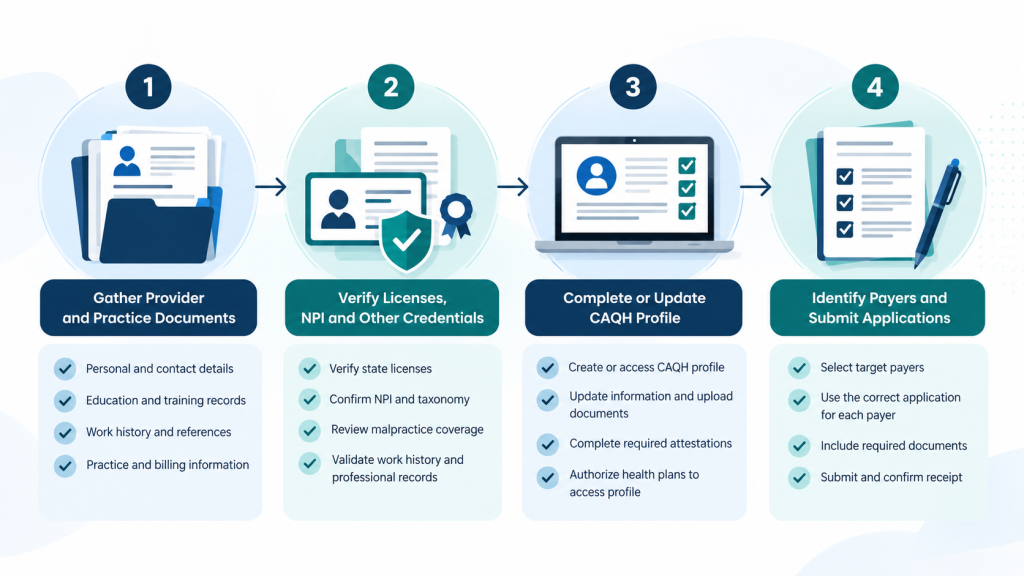
A clear workflow helps practices organize documents, monitor applications, and communicate decisions to the appropriate teams. This guide explains eight practical steps, from preparing provider records and reviewing CAQH information to confirming payer participation and coordinating billing readiness.

Understanding Medical Credentialing and Payer Enrollment
Credentialing allows a healthcare organization or insurance payer to evaluate whether a provider meets its professional qualification requirements. The review may include education, training, licenses, certifications, employment history, and other supporting records. The exact requirements depend on the provider’s role and the organization conducting the review.
The medical credentialing process and payer enrollment are related, but they are not interchangeable. Credentialing focuses on verifying qualifications, while enrollment establishes a provider’s participation with a particular insurance plan. A completed credentialing review does not automatically confirm that every payer has approved the provider for billing.
Requirements can also differ between commercial insurance plans and government programs. For example, Medicare enrollment follows specific procedures, and providers should consult the official CMS provider enrollment guidance when determining which requirements apply.
Before starting, identify the provider type, intended insurance networks, practice locations, and responsible staff members. These details help determine which applications are necessary and who will manage each stage.
Steps 1–3 — Organize Documents, Verify Qualifications, and Review CAQH
Step 1: Prepare a Complete Provider Document File
Start by creating a checklist of the records required for the provider and the relevant payer. Depending on the application, documents may include an active professional license, education and training records, work history, malpractice insurance information, identification details, and National Provider Identifier (NPI) information.
Check names, dates, addresses, and other identifying details across all documents. Differences between application forms and supporting records can lead to clarification requests or additional administrative work.
Keep digital copies in a secure location with controlled access. Track expiration dates for licenses and insurance documents, and assign responsibility for updating records when information changes. A complete document file makes the medical credentialing process easier to coordinate across multiple applications.
For NPI-related information, practices can consult the official NPPES NPI Registry. An NPI lookup can help verify identifier details, but it does not establish that a provider’s professional qualifications or insurance enrollment have been approved.
Step 2: Check Licenses and Professional Qualifications
Review the provider’s qualifications using appropriate verification sources. Depending on the requirements, this may include confirming license status, education, training, certifications, malpractice coverage, and relevant professional history.
Do not rely solely on information supplied in an application when independent verification is required. Record the date and outcome of each check, and investigate discrepancies before submitting the application whenever possible.
The medical credentialing process depends on accurate provider information, but verification does not guarantee payer approval. If a qualification cannot be confirmed, contact the relevant issuing organization or follow the payer’s instructions for resolving the issue.
Step 3: Review and Update the CAQH Profile
CAQH ProView allows providers to maintain professional information that participating health plans may use during credentialing. Review the profile for missing sections, outdated practice details, inconsistent employment history, and expired documents.
Providers can access CAQH ProView to maintain their information. Follow the applicable instructions for completing attestations and authorizations, and confirm whether the relevant payer requires additional documents or a separate application.
A CAQH profile does not guarantee acceptance by every insurance plan. Each payer may have its own review and enrollment requirements. Keeping profile information accurate can nevertheless reduce inconsistencies and make it easier to respond when a payer requests updated details.
Steps 4–6 — Choose Insurance Networks, Manage Applications, and Verify Decisions
Step 4: Identify the Right Insurance Networks
Before submitting applications, determine which insurance networks are relevant to the practice’s patients, specialties, locations, and service plans. Review each payer’s participation criteria and identify whether additional information is required for individual providers or practice locations.
The medical credentialing process should be planned for each payer separately because forms, documentation, and review procedures can vary. Confirm whether enrollment forms, location details, or other supporting information must be submitted in addition to credentialing documents.
Prioritize applications according to the practice’s operational needs, but avoid promising a specific approval date unless the payer has provided a reliable timeline.
Step 5: Submit Applications and Monitor Progress
Once the application and supporting records have been checked, submit them through the payer’s designated channel. Save a copy of the submission, confirmation number, and any correspondence that identifies the application.
Use a tracking sheet or practice management system to record:
Provider and insurance payer
Application submission date
Reference or confirmation number
Current application status
Missing information or pending requests
Last contact date and next follow-up
Approval status and effective date, when confirmed
This tracking method gives the team a clear view of outstanding work and helps prevent applications from being overlooked. During the medical credentialing process, respond to payer requests promptly and record the outcome of each follow-up.
Step 6: Confirm the Payer’s Decision
Submitting an application is not the same as receiving approval. Review written notifications and check whether additional requirements remain outstanding before treating the provider as enrolled.
Confirm the provider’s status, effective date, applicable practice locations, and relevant participation or billing instructions. Share the confirmed information with scheduling, administrative, and billing teams so they can update internal records.
If the application remains pending, contact the payer through its designated channel and document the response. Processing times vary according to payer procedures, application completeness, and the verification required. The medical credentialing process should therefore be tracked until the practice has a clear, documented outcome.
Preventing Application Errors and Delays
Administrative problems often arise from incomplete forms, expired documents, inconsistent provider details, outdated CAQH information, and missed requests for clarification. These issues may require additional communication and can make it harder for teams to understand the status of an application.
Before submission, use a checklist to verify that required fields are complete, supporting documents are attached, and identifying details match across records. Assign a specific team member to monitor the application and escalate unresolved issues.
Regular follow-ups should be documented rather than handled through memory alone. Record the date of contact, the payer’s response, any outstanding requirement, and the next planned action. This creates a useful history if another employee needs to take over the application.
A well-organized medical credentialing process cannot guarantee a faster decision because the payer controls its review and approval procedures. However, accurate records and timely responses can help practices avoid preventable administrative errors and identify missing information earlier.
Steps 7–8 — Prepare for Billing and Maintain Provider Records
Step 7: Coordinate Enrollment Information With the Billing Team
Credentialing and enrollment updates should reach the staff responsible for claims submission and revenue cycle management. Before billing a payer, confirm the provider’s participation status, effective date, applicable location, and relevant billing instructions.
Approval alone does not mean that every claim will be reimbursed. Claim outcomes can depend on payer rules, covered services, provider arrangements, patient eligibility, and claim documentation. The billing team should check the requirements relevant to the service before submitting claims.
A shared workflow can help administrators communicate enrollment updates and identify unresolved items. Practices can also review Fortify RCM’s revenue cycle management services to understand the operational support available for billing and related workflows.
Step 8: Keep Provider Records Current
Credentialing responsibilities continue after an application has been submitted or approved. Practices should monitor license and certification expiration dates, update provider details when changes occur, and respond to payer requests for revalidation or other required updates.
Assign a clear owner to each provider’s records and establish a regular review schedule. Track changes to practice addresses, contact information, professional qualifications, and other details that may affect payer records. Store supporting documents securely and update internal systems when necessary.
Reviewing records routinely helps staff identify upcoming renewals and outstanding tasks before they become urgent. It also provides a clearer view of each provider’s current documentation and enrollment status.

Connecting Credentialing With Revenue Cycle Management
Provider credentialing and revenue cycle management support different but connected parts of practice administration. Credentialing verifies professional qualifications, enrollment establishes the relevant payer relationship, and revenue cycle management covers activities associated with claims, payments, denials, and accounts receivable.
These functions need accurate communication. Billing teams require reliable provider information, confirmed participation dates, and the correct payer details to manage claims appropriately. If enrollment updates are not communicated, staff may have difficulty determining whether a provider is ready to bill a particular payer.
Practices can improve coordination by using shared records, assigning responsibility for updates, and documenting approval decisions. For broader operational support, explore Fortify RCM’s services and review the options that match your practice’s needs.
Healthcare Specialties We Serve
Fortify RCM supports dental practices with dental billing and revenue cycle management services tailored to their operational needs. Whether you run an independent dental practice, manage a multi-provider clinic, or oversee a growing dental group, choosing the right billing partner starts with understanding your workflows, payer requirements, and reporting needs. Our goal is to help dental practices manage claims, payment posting, denial follow-up, and accounts receivable through a structured billing process.
Mental Health Providers
Credentialing and billing for psychologists, therapists, counselors, and social workers in private or group practice.
Nutritionists & Dietitians
Specialized RCM and credentialing support for MNT providers, licensed dietitians, and wellness nutritionists.
Occupational Therapists
End-to-end billing and enrollment services for pediatric and adult OT clinics and independent therapists.
Non-Emergency Medical Transportation (NEMT)
We handle Medicaid credentialing, EDI setup, and claims billing for NEMT providers.
Home Health Agencies
Complete RCM services tailored for HHAs including Medicare credentialing, OASIS billing, and claims management.
Skilled Nursing Facilities (SNFs)
Credentialing, billing, and AR support for SNFs—compliant with payer-specific guidelines and long-term care needs.
Applied Behavior Analysis (ABA)
We support ABA therapy providers with credentialing, insurance billing, authorization and appeals for denied behavioral health claims.
Chiropractors & Physical Therapists
Credentialing and billing help for musculoskeletal therapy, rehab clinics, and solo practitioners.
Durable Medical Equipment (DME) Providers
We handle Medicare/Medicaid credentialing, EDI setup, and claims submission for DME suppliers.
Nurse Practitioners & Physician Assistants
Complete credentialing and billing support for NPs & PAs operating independently or in group practices.
Dentists & Oral Health Providers
Support with dental insurance credentialing and claims processing for general dentists and specialists.
Vision & Eye Care Specialists
Credentialing and RCM services for optometrists, ophthalmologists, and vision therapy providers.
FAQs – Credentialing Services in Kentucky
1. What is the medical credentialing process?
The medical credentialing process involves reviewing a healthcare provider’s professional qualifications, such as licenses, education, training, and work history. When insurance participation is required, payer enrollment may also be necessary to establish the provider’s relationship with the health plan.
2. How does provider credentialing differ from payer enrollment?
Credentialing verifies a provider’s qualifications. Payer enrollment establishes participation with a particular insurance company and may involve additional application requirements. Completing one does not automatically confirm that the other is complete.
3. What documents are usually needed for a new provider?
Requirements vary, but may include professional licenses, education and training records, work history, malpractice insurance information, NPI details, and other supporting documents. Always check the relevant payer’s current application instructions.
4. Does a completed CAQH profile guarantee approval?
No. CAQH ProView helps providers maintain information that participating health plans may use during credentialing. Each payer may still require its own application, verification, and enrollment steps.
5. How long does the medical credentialing process take?
The timeline varies by payer, provider type, application completeness, and verification requirements. Practices should check directly with each payer and track pending applications rather than rely on one timeline for every situation.
6. Does an NPI confirm that a provider is credentialed?
No. An NPI identifies a provider within the applicable system. It does not by itself confirm professional qualification verification, insurance network participation, or payer approval.
7. Can a provider see patients before payer approval?
Not automatically. The practice should confirm the payer’s participation status, effective date, applicable location, and billing requirements before submitting claims.
8. What should happen after a payer approves a provider?
Save the approval notice, record the effective date, update internal provider records, and notify the appropriate billing and administrative teams. Continue monitoring renewal dates and any additional payer requirements.
Conclusion — Build an Efficient Medical Credentialing Workflow
A reliable credentialing workflow helps practices organize provider documents, verify qualifications, track payer applications, and communicate decisions to the right teams. Clear responsibilities and consistent recordkeeping can reduce administrative errors and make outstanding requirements easier to identify.
Providers and administrators should confirm payer-specific requirements, retain written decisions, and check effective dates before assuming that billing can begin. Ongoing record reviews also help practices manage renewals and changes to provider information.
For assistance with credentialing administration and related revenue cycle workflows, explore Fortify RCM’s credentialing services or contact our team to discuss your practice’s operational needs.